Facts
Respondent No. 1 was initially appointed as a Karyakar in 1988 and worked in that capacity until 2007. She was subsequently appointed as Mukhya Sevika on a sanctioned post with effect from 17 July 2022. She claimed gratuity for her service from 28 January 1988 to 30 April 2022.
Source reference: paras. 5–8; pp. 2–6The Controlling Authority, by order dated 10 October 2023 in Gratuity Case No. 43 of 2023, directed the petitioner to pay ₹6,06,093 with interest at 10% per annum.
Source reference: paras. 5–8; pp. 2–6The petitioner challenged the Controlling Authority’s order before the Appellate Authority after a delay of 501 days. The Deputy Labour Commissioner rejected the appeal by order dated 1 July 2025 in Gratuity Appeal No. 120 of 2025, holding it barred by limitation.
Source reference: paras. 5–8; pp. 2–6The petitioner thereafter invoked the High Court’s jurisdiction under Article 226 of the Constitution seeking quashing of both orders.
Source reference: para. 1; p. 1Issues
Whether the Appellate Authority was empowered under Section 7(7) of the Payment of Gratuity Act, 1972 to condone a delay of 501 days in filing the appeal?
Source reference: paras. 8–10; pp. 5–8Whether the orders of the Controlling Authority and the Appellate Authority warranted interference by the High Court?
Source reference: paras. 1, 8–11; pp. 1, 5–9Law Applied
The Court applied Section 7(7) of the Payment of Gratuity Act, 1972, which requires an appeal against an order under Section 7(4) to be filed within 60 days from receipt of the order and permits the Appellate Authority, upon satisfaction of sufficient cause, to extend the period by a further 60 days.
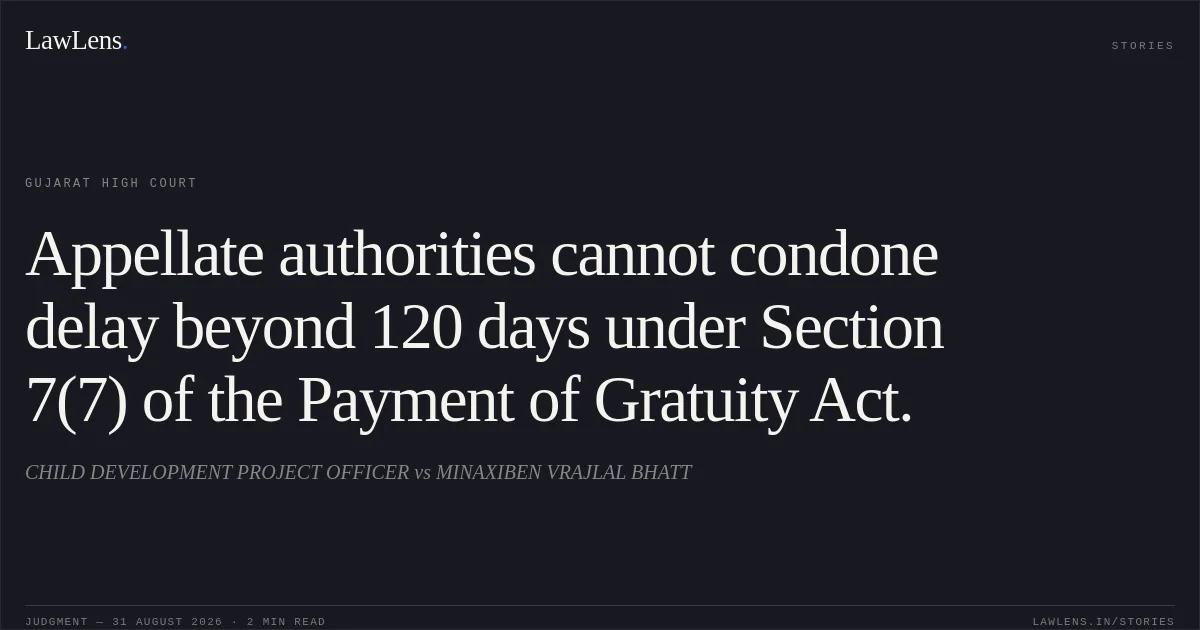
Source reference: para. 9; pp. 6–7The Court held that the statutory scheme creates an outer limitation period of 120 days and does not confer jurisdiction on the Appellate Authority to condone delay beyond that period.
Source reference: para. 10; pp. 7–8The Court also referred to the decisions in Special Civil Application No. 10769 of 2026 and the Larger Bench decision in Special Civil Application No. 12147 of 2013, relied upon by the respondent in support of the restrictive interpretation of Section 7(7).
Source reference: para. 7; p. 4Reasoning
The Court found that the petitioner’s appeal was filed 501 days after the Controlling Authority’s order, substantially beyond the initial 60-day period and the additional 60-day condonable period prescribed by Section 7(7).
Source reference: paras. 8–10; pp. 5–8Although the petitioner asserted that sufficient cause had been shown and also raised arguments concerning the computation of gratuity, the statutory limitation provision did not permit the Appellate Authority to entertain an appeal filed beyond 120 days.
Source reference: paras. 6, 10; pp. 3–4, 7–8Consequently, the Appellate Authority correctly rejected the appeal as time-barred, and the High Court found no jurisdictional or legal error warranting interference. The Court therefore did not examine the petitioner’s substantive challenge to the gratuity calculation on merits.
Source reference: paras. 10–11; pp. 7–9Holding
The Court answered the limitation issue against the petitioner, holding that Section 7(7) of the Payment of Gratuity Act permits condonation only up to a total period of 120 days and that an appeal filed after 501 days is not maintainable.
The writ petition was dismissed, the order dated 1 July 2025 rejecting the appeal was upheld, and the challenge to the Controlling Authority’s order dated 10 October 2023 consequently failed.
Source reference: para. 11; p. 8Any interim relief was vacated and the rule/notice was discharged.
Source reference: para. 11; p. 8Acts & Sections Cited
1 provisions across 1 statute referred to in this judgment. Linked provisions open on LawLens.
PAYMENT OF GRATUITY ACT, 19721
Original Court PDF
CHILD DEVELOPMENT PROJECT OFFICERvsMINAXIBEN VRAJLAL BHATT
Click to open original judgment
Original judgment, available to read, download and summarize on LawLens.in