Facts
The three connected writ petitions concerned the proposed acquisition of agricultural lands at Village Jhirniya, Tehsil Ghattiya, District Ujjain, for construction of a Greenfield four-lane road connecting Indore–Ujjain–Jaora.
Source reference: para. 1In W.P. No. 21594 of 2026, approximately 3.665 hectares of private agricultural land were proposed to be acquired under the Right to Fair Compensation and Transparency in Land Acquisition, Rehabilitation and Resettlement Act, 2013 (“2013 Act”).
Source reference: para. 3The petitioners challenged the acquisition proceedings, the Social Impact Assessment and Expert Group reports, the order dated 25 March 2026, notices issued under the 2013 Act, and the determination of compensation.
Source reference: para. 2The respondents contended that a final award had already been passed before institution of the petitions, that the petitioners had an efficacious remedy under Section 64 of the 2013 Act, and that most of the approximately 1,568 beneficiaries had accepted the award and compensation.
Source reference: paras. 7–8, 14Issues
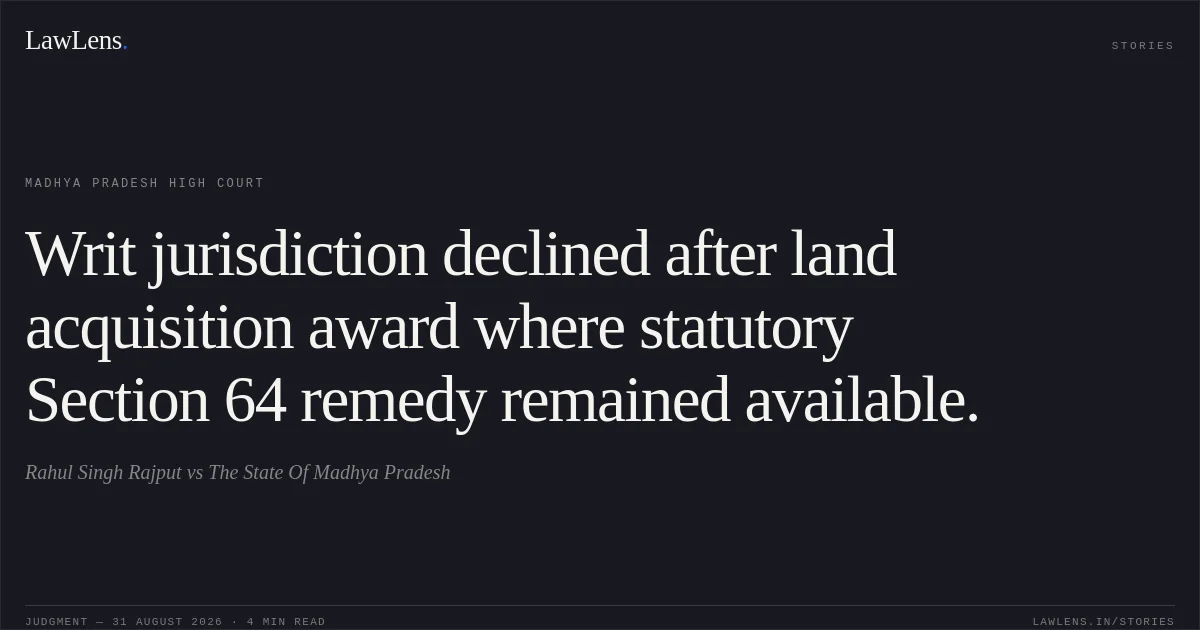
Whether the writ petitions challenging the acquisition proceedings were maintainable under Article 226 after the passing of the final land-acquisition award, particularly when the petitioners had a statutory remedy under Section 64 of the 2013 Act.
Source reference: paras. 14–17Whether the hearing and consideration of objections under Sections 15 and 21 of the 2013 Act by the Sub-Divisional Officer, rather than the Collector or the competent authority, vitiated the acquisition proceedings.
Source reference: paras. 4, 10–12Whether alleged non-compliance with the provisions concerning Social Impact Assessment, publication, consent, consideration of alternatives and related procedural requirements rendered the acquisition proceedings illegal.
Source reference: paras. 3–5, 8, 13–17Whether the Court should interfere under Article 226 in view of the substantial compliance asserted by the respondents and the overriding public interest in timely completion of the road project.
Source reference: paras. 14–17Law Applied
The Court applied Article 226 of the Constitution and the statutory scheme of the 2013 Act, particularly Sections 4–11 concerning Social Impact Assessment and preliminary acquisition proceedings, Sections 15 and 21 concerning objections and notices, Sections 26 and 28 concerning compensation, and Section 64 providing a reference remedy against the award concerning measurement, compensation, apportionment and rehabilitation and resettlement entitlements.
Source reference: paras. 2–5, 16The Court considered Dinesh v. State of M.P., 2024 SCC OnLine SC 937, and Shiv Singh v. State of H.P., (2018) 16 SCC 270, which treat compliance with the Collector’s statutory role in hearing objections and making recommendations as mandatory.
Source reference: paras. 10, 12It also considered Kesar Singh v. State of M.P., 2025 SCC OnLine MP 3827, which states that a statutory power requiring the Collector to hear objections cannot ordinarily be delegated and that the person hearing objections should be the competent authority deciding them.
Source reference: para. 11The Court further relied on the alternative-remedy and public-interest principles reflected in Saira Bee v. Urban Administration & Development Department, W.A. No. 117 of 2025, Anil Verma v. State of M.P., W.P. No. 13246 of 2026, and J.K. Lakshmi Cement Ltd. v. M.P. Metro Rail Corporation Ltd., W.P. No. 13286 of 2021.
Source reference: paras. 7, 14It accepted the principle of substantial compliance, as discussed in Yudhvir Singh v. Govt. of NCT of Delhi, 2024 SCC OnLine Del 471, and gave weight to public infrastructure considerations recognised in A.J. George v. State of Kerala and Bhimavarapu Giridhar Kumar Reddy v. Union of India.
Source reference: paras. 7–8, 14Reasoning
The Court acknowledged that the petitioners’ objections concerning the role of the Sub-Divisional Officer and the alleged procedural defects raised serious legal questions, and it noted the authorities holding that the Collector’s statutory functions in relation to objections cannot be delegated.
Source reference: paras. 10–12Nevertheless, on the material before it, the Court found that the 2013 Act and the Madhya Pradesh Rules, 2015 had been broadly followed and that there had been substantial compliance with the acquisition procedure.
Source reference: para. 17The Court placed particular emphasis on the fact that the petitions were filed after the final award, that Section 64 provided a statutory mechanism for challenging surviving grievances relating to the award, and that more than 1,300 of approximately 1,568 beneficiaries had accepted compensation.
Source reference: paras. 14, 16–17Balancing the alleged procedural lapses against the public importance and time-bound nature of the road project, including its asserted relevance to Simhasth Mahakumbh, 2028, the Court held that the acquisition could not be interdicted under Article 226 merely because of alleged minor procedural deviations, especially when an alternative statutory remedy was available.
Source reference: paras. 8, 14, 17Holding
The Court dismissed W.P. Nos. 21594, 21222 and 21223 of 2026, holding that the acquisition proceedings did not warrant interference under Article 226 and that the petitioners could pursue the statutory remedy under Section 64 of the 2013 Act in accordance with law.
The Court did not quash the acquisition notifications, Social Impact Assessment or Expert Group reports, the impugned order, notices, or the final award. Any interim relief or stay was vacated.
Source reference: para. 20Acts & Sections Cited
18 provisions across 1 statute referred to in this judgment. Each provision opens on LawLens.
Right to Fair Compensation and Transparency in Land Acquisition, Rehabilitation and Resettlement Act, 2013
Original Court PDF
Rahul Singh RajputvsThe State Of Madhya Pradesh
Click to open original judgment
Original judgment, available to read, download and summarize on LawLens.in