Facts
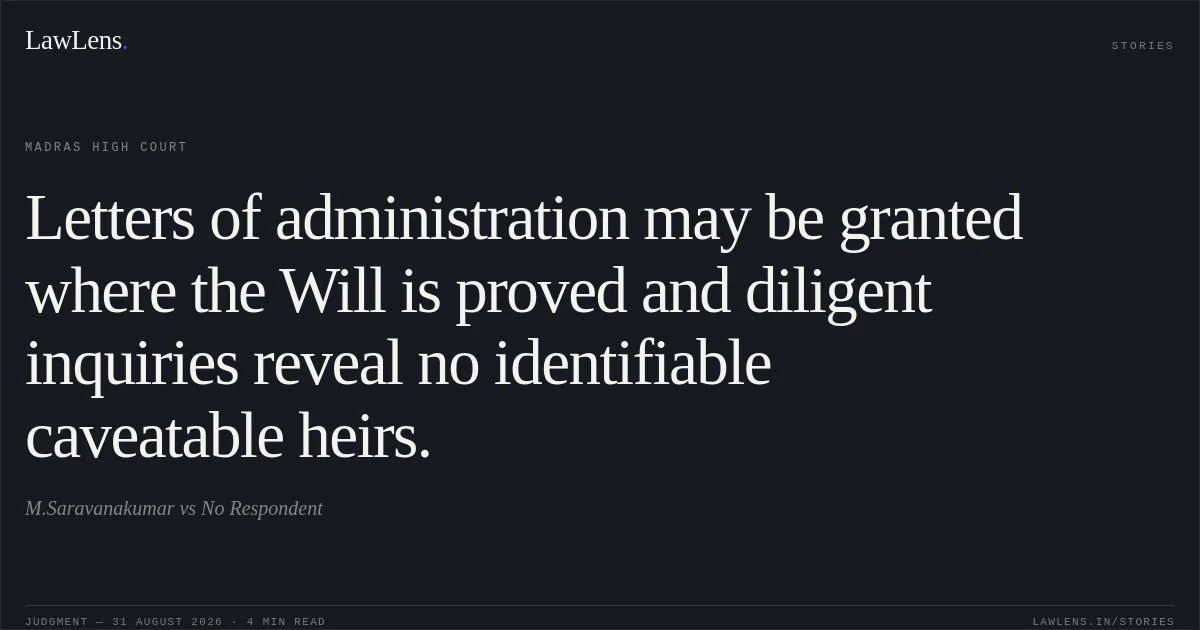
The petitioner sought Letters of Administration with the Will annexed under Sections 232 and 276 of the Indian Succession Act, 1925, read with Order XXV Rule 5 of the Original Side Rules, in respect of the unregistered Will dated 29 January 2009 executed by A. Vasantha Devi, who died on 22 February 2025 within the jurisdiction of the Court.
Source reference: p.2, paras.1–2The deceased was unmarried, had no apparent surviving legal heirs, and had not appointed an executor. Under the Will, she bequeathed her property at C.K.P. Koil Street, Choolai, Chennai, together with the rental rights, and the balance in her State Bank of India account to the petitioner.
Source reference: p.2, para.2The petitioner, who was unrelated to the deceased, stated that he and his mother had cared for her, that he resided with her, and that he performed her last rites.
Source reference: p.3, para.4The Will was signed by the testatrix in the presence of three attesting witnesses. The first attesting witness had died; the other two witnesses were examined and supported due execution, attestation, and the testatrix’s soundness of mind.
Source reference: pp.3–5, paras.5, 9–10The Court initially noted that the Will referred to relatives on the paternal and maternal sides who might possess a caveatable interest under Sections 15 and 8 of the Hindu Succession Act, 1956, and directed the petitioner to ascertain and implead such persons under Order XXV Rule 31 of the Original Side Rules.
Source reference: pp.5–6, paras.11–12The petitioner subsequently produced genealogical materials, including a legal heirship certificate and a family-genealogy document, and stated that no surviving or traceable heirs could be identified.
Source reference: pp.6–7, paras.13–15Public notices were published in the Tamil and English newspapers. No objection or caveat was filed.
Source reference: p.4, para.8The petitioner examined himself and the two surviving attesting witnesses, and produced the Will and supporting title, death, identity, publication, and estate documents.
Source reference: pp.4–5, paras.9–10; pp.10–11Issues
1. Whether the petitioner had satisfactorily established the due execution and attestation of the Will dated 29 January 2009 so as to justify the grant of Letters of Administration with the Will annexed?
Source reference: p.8, paras.17–182. Whether the petitioner was entitled to the grant despite the absence of an executor named in the Will?
Source reference: p.2, para.2; p.8, para.183. Whether reasonable and diligent steps had been taken to identify and notify persons having a caveatable interest, particularly the deceased’s relatives under the applicable rules of succession?
Source reference: pp.5–8, paras.11–16Law Applied
The Court applied Sections 232 and 276 of the Indian Succession Act, 1925, governing the grant of Letters of Administration with the Will annexed where no executor has been appointed and prescribing the relevant petitionary requirements.
Source reference: p.2, para.1It applied Section 63 of the Indian Succession Act concerning execution and attestation of an unprivileged Will, requiring the testator’s signature or acknowledgment and attestation by witnesses.
Source reference: p.3, para.5The Court also considered Sections 15 and 8, read with the Schedule, of the Hindu Succession Act, 1956, under which the deceased’s relatives could potentially succeed to her estate if the Will were not established and therefore might possess a caveatable interest.
Source reference: p.5, para.11Order XXV Rules 5 and 31 of the Original Side Rules governed the petition and the requirement to bring persons with a possible caveatable interest on record or serve notice upon them.
Source reference: pp.1–2; p.6, para.12The governing principles were therefore proof of testamentary execution and attestation, satisfaction regarding the absence or notice of persons with caveatable interest, and administration of the estate subject to the Court’s directions.
Source reference: no citationReasoning
The Court found that the evidence of the second and third attesting witnesses established that the testatrix signed the Will in their presence, acknowledged her signature, executed it while in a sound state of mind and good health, and that they attested it at her request.
Source reference: pp.3–5, paras.5, 10Their evidence accordingly satisfied the requirements of Section 63 of the Indian Succession Act, and the Will was held to have been duly proved.
Source reference: p.8, para.17Although the Court initially identified a potential caveatable interest among relatives on both sides of the testatrix’s family, it considered the additional genealogical materials and the petitioner’s explanation regarding the family history and searches undertaken.
Source reference: pp.6–8, paras.13–16It concluded that reasonable and diligent efforts had been made and that no presently identifiable or traceable person with a caveatable interest required impleadment.
Source reference: pp.6–8, paras.13–16The absence of objections following newspaper publication further supported proceeding with the petition.
Source reference: p.4, para.8Since the Will appointed no executor, and the petitioner was its beneficiary, the Court held that he was entitled to Letters of Administration with the Will annexed.
Source reference: p.8, para.18Holding
The Original Petition was allowed.
The Court directed that Letters of Administration with the Will dated 29 January 2009 annexed be granted to M. Saravanakumar, limited to the State of Tamil Nadu and the schedule property.
Source reference: p.8, para.19The petitioner was required to execute a security bond of ₹25,000 in favour of the Assistant Registrar (Original Side), file a full and true inventory of the estate within six months of the grant, and render true accounts within one year.
Source reference: pp.8–9, paras.19–20No order as to costs was made.
Source reference: p.9, para.20Acts & Sections Cited
6 provisions across 3 statutes referred to in this judgment. Each provision opens on LawLens.
Indian Succession Act, 19253
Hindu Succession Act, 19562
Bharatiya Sakshya Adhiniyam, 20231
Original Court PDF
M.SaravanakumarvsNo Respondent
Click to open original judgment
Original judgment, available to read, download and summarize on LawLens.in