Facts
The petitioners sought bail under Section 483 of the Bharatiya Nagarik Suraksha Sanhita, 2023 (BNSS), in connection with Excise Satellite Unit, Jeypore P.R. No. 142 of 2025–26, corresponding to T.R. Case No. 106 of 2025, involving an alleged offence under Section 20(b)(ii)(C) of the Narcotic Drugs and Psychotropic Substances Act, 1985.
Source reference: para. 1Shyam Sundar specifically pleaded violation of Section 58 of the BNSS read with Article 22(2) of the Constitution; the Court permitted the same legal issue to be considered in Romeo Adakatia’s case as well.
Source reference: para. 3The prosecution records stated that information was received at 9.00 a.m. on 23 August 2025, although the Arresting Officer later claimed that “9.00 a.m.” had been mistakenly recorded instead of “9.00 p.m.”
Source reference: paras. 3–5The arrest memos contained overwritten dates, changing 23 August 2025 to 24 August 2025, while the Officer-in-Charge’s signatures continued to bear the date 23 August 2025.
Source reference: para. 4Although the petitioners were shown as arrested at 1.50 a.m. and 2.00 a.m. on 24 August 2025, the Court inferred from the contemporaneous records that they had been detained much earlier, probably shortly after 9.00 a.m. on 23 August 2025.
Source reference: paras. 4–5They were produced before the Special Judge at 7.30 p.m. on 24 August 2025, from a place approximately 80 kilometres away.
Source reference: paras. 5–6Issues
Whether the petitioners were produced before a Magistrate within the period of twenty-four hours prescribed by Article 22(2) of the Constitution and Section 58 of the BNSS, excluding only the time necessary for journey.
Source reference: paras. 3, 5–6Whether the apparent delay and discrepancies in the arrest records rendered the petitioners’ arrest and subsequent remand illegal or vitiated.
Source reference: paras. 4–6Whether the petitioners were entitled to bail on the ground that their arrest and remand were constitutionally and statutorily invalid.
Source reference: para. 6Law Applied
The Court applied Article 22(2) of the Constitution, which requires every arrested and detained person to be produced before the nearest Magistrate within twenty-four hours of arrest, excluding the time necessary for journey, and prohibits detention beyond that period without Magistrate’s authority.
Source reference: para. 3Section 58 of the BNSS embodies the corresponding statutory safeguard against detention beyond twenty-four hours without production before a Magistrate.
Source reference: para. 3Section 43(1) of the BNSS provides that arrest occurs when the arresting officer or other person actually touches or confines the person to be arrested, unless the person submits to custody by words or conduct.
Source reference: para. 5The Court distinguished “custody” from “arrest,” observing that every arrest involves custody, though custody may exist without formal arrest; a person detained or confined by a law-enforcement agency is nevertheless under duress and cannot be kept beyond the constitutional period without judicial authorization.
Source reference: paras. 5–6Where the constitutional time limit is breached, the arrest is illegal or vitiated, and the subsequent remand also stands vitiated.
Source reference: para. 5Reasoning
The Court rejected the explanation that the reference to 9.00 a.m. in Form C2 was merely a clerical error for 9.00 p.m., because the form expressly stated that the information was received at “9 o’clock in the morning” during patrolling duty, followed immediately by detection of the alleged offence.
Source reference: paras. 3–4The overwritten arrest dates and the Officer-in-Charge’s signature dated 23 August 2025 further undermined the prosecution’s claim that the petitioners were arrested only at 1.50 a.m. and 2.00 a.m. on 24 August 2025.
Source reference: para. 4Treating the petitioners’ custody as commencing at approximately 10.00 a.m. on 23 August 2025, the twenty-four-hour period expired at about 10.00 a.m. on 24 August 2025.
Source reference: para. 5Even after allowing approximately three hours for the journey from the place of occurrence, production at 7.30 p.m. on 24 August 2025 was beyond the permissible period.
Source reference: para. 5Consequently, the Court held that the arrest violated Article 22(2) and Section 58 of the BNSS, and that the subsequent judicial remand was also vitiated.
Source reference: para. 6Holding
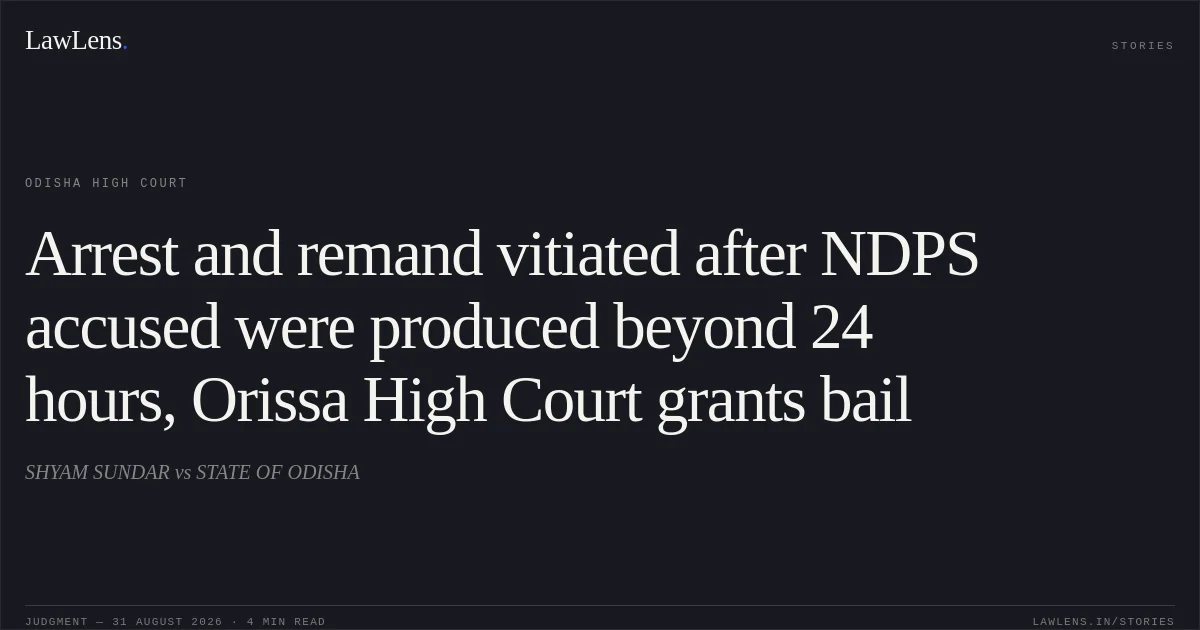
The Court answered the issues in favour of the petitioners, holding that they had not been produced before the Magistrate within the constitutionally and statutorily prescribed period.
Their arrest and subsequent remand were therefore vitiated.
Source reference: para. 6Both bail applications were allowed, and Shyam Sundar and Romeo Adakatia were directed to be released on bail upon furnishing bonds of ₹1,00,000 each with two solvent sureties for the like amount, subject to the satisfaction of the court in seisin of the case and such further conditions as that court might impose.
Source reference: para. 7The Court directed communication of the order to the concerned court and jail authorities.
Source reference: para. 8Acts & Sections Cited
4 provisions across 2 statutes referred to in this judgment. Each provision opens on LawLens.
Bharatiya Nagarik Suraksha Sanhita, 20233
Narcotic Drugs and Psychotropic Substances Act, 19851
Original Court PDF
SHYAM SUNDARvsSTATE OF ODISHA
Click to open original judgment
Original judgment, available to read, download and summarize on LawLens.in