Facts
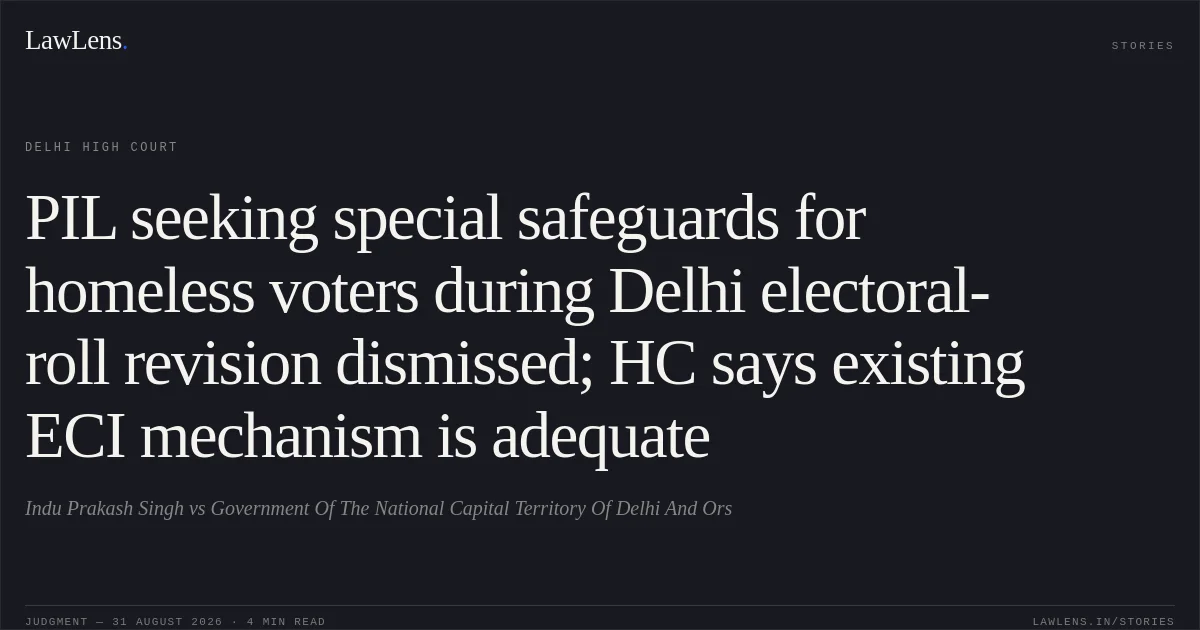
The petitioner filed a Public Interest Litigation challenging the alleged exclusion of homeless persons and persons displaced by demolition drives from Delhi’s electoral rolls during the ongoing Special Intensive Revision (“SIR”) exercise. The petitioner contended that the house-to-house enumeration process, based on addresses recorded in the previous electoral roll, would cause displaced electors to be marked as absent or shifted and would prevent persons not included in the previous roll from receiving Enumeration Forms.
Source reference: pp. 2–7, paras. 1–12It was further alleged that homeless persons faced difficulties in satisfying the ordinary-residence requirement, accessing Forms 6 and 8A, and obtaining enrolment at temporary shelters, pavements or rehabilitation colonies. The petitioner sought directions for a special facilitative mechanism, identification of affected persons, field verification, special enrolment camps, grievance redressal measures, and invalidation of the timeline for preparation of the draft electoral roll.
Source reference: pp. 2–5, paras. 3–6; pp. 2–3, para. 1The Election Commission of India (“ECI”) opposed the petition, relying on Clause 8.5 of its Manual on Electoral Rolls, March 2023, which permits enrolment of homeless and pavement-dwelling persons without documentary proof of ordinary residence, subject to verification by the Booth Level Officer (“BLO”) through visits to the place where the person sleeps.
Source reference: pp. 8–9, paras. 16–17The ECI also submitted that affected persons could seek enrolment by filing Form 6 and that homeless persons were already appearing in the draft electoral roll with “0” recorded as the house number.
Source reference: pp. 9–10, paras. 18–20Issues
Whether the existing SIR procedure unlawfully or structurally excluded homeless persons and persons displaced by demolition drives from the electoral rolls.
Source reference: pp. 2–7, paras. 1–12Whether the ECI was required to formulate and implement a special facilitative mechanism, including special camps, relaxed documentation requirements, field verification and grievance redressal, for such persons.
Source reference: pp. 2–5, paras. 1–6, 15Whether the ECI’s existing mechanism under Clause 8.5 of the Manual on Electoral Rolls, read with Form 6, was adequate to facilitate enrolment of homeless or displaced persons.
Source reference: pp. 8–11, paras. 16–25Whether the ECI directives requiring preparation of the draft electoral roll by 17 August 2026 were liable to be invalidated for allegedly failing to protect the electoral rights of homeless and demolition-affected persons.
Source reference: p. 2, para. 1(e)Law Applied
The Court considered Article 326 of the Constitution, which embodies universal adult suffrage, and Section 20 of the Representation of the People Act, 1950 (“RP Act”), concerning determination of a person’s ordinary residence in a constituency.
Source reference: pp. 3–4, para. 4; p. 7, para. 12It relied principally on Clause 8.5 of the ECI’s Manual on Electoral Rolls, March 2023, under which homeless persons, including pavement dwellers and persons without documentary proof of ordinary residence, are eligible for enrolment if they ordinarily reside at the stated place; the BLO must verify the person’s presence by visiting that place for more than one night, and record information regarding the person’s place of birth and previous residence.
Source reference: pp. 8–9, para. 16The Court also applied Rules 13(1) and 26 of the Registration of Electors Rules, 1960, under which an excluded or newly situated elector may apply for enrolment through Form 6.
Source reference: p. 11, para. 24The Court noted the Supreme Court’s decision in Sana Parveen & Ors. v. Election Commission of India & Ors., W.P.(C) No. 191/2026, where affected persons were directed to approach the District BLO for factual verification and remedial action in accordance with law.
Source reference: p. 9, para. 18Reasoning
The Court held that the petitioner’s apprehension of an automatic exclusion of homeless persons was unfounded because the ECI Manual already provided a specific procedure for their enrolment without documentary proof of residence.
Source reference: p. 11, para. 22Under Clause 8.5, a homeless or displaced person could provide the place where he or she ordinarily slept, file Form 6, and have the address verified by the BLO through visits conducted over more than one night.
Source reference: p. 11, para. 24The Court further found that the ECI had placed on record an extract of the draft electoral roll showing homeless persons by name, photograph, age and gender, with “0” as the house number, demonstrating that the prescribed mechanism was being implemented in practice.
Source reference: p. 12, para. 25The petitioner’s assertions regarding large-scale exclusion were treated as bald and unsupported because no specific names, particulars or numbers of affected persons were furnished.
Source reference: p. 11, para. 23In the absence of concrete instances establishing systemic exclusion or inadequacy of the existing procedure, the Court declined to issue policy directions or interfere with the SIR timeline.
Source reference: pp. 11–12, paras. 22–26Holding
The Court held that an adequate mechanism already existed for enrolment of homeless and demolition-displaced persons through Clause 8.5 of the Manual on Electoral Rolls and Form 6, coupled with BLO verification of the person’s place of ordinary residence.
It found no legal or factual basis to direct the ECI to create an additional special mechanism, issue targeted guidelines, establish special camps or invalidate the SIR directives.
Source reference: p. 12, para. 26The PIL was accordingly dismissed, and the pending application was also disposed of.
Source reference: p. 12, para. 26Acts & Sections Cited
1 provisions across 1 statute referred to in this judgment. Each provision opens on LawLens.
Representation of the People Act, 19501
Original Court PDF
Indu Prakash SinghvsGovernment Of The National Capital Territory Of Delhi And Ors
Click to open original judgment
Original judgment, available to read, download and summarize on LawLens.in