Facts
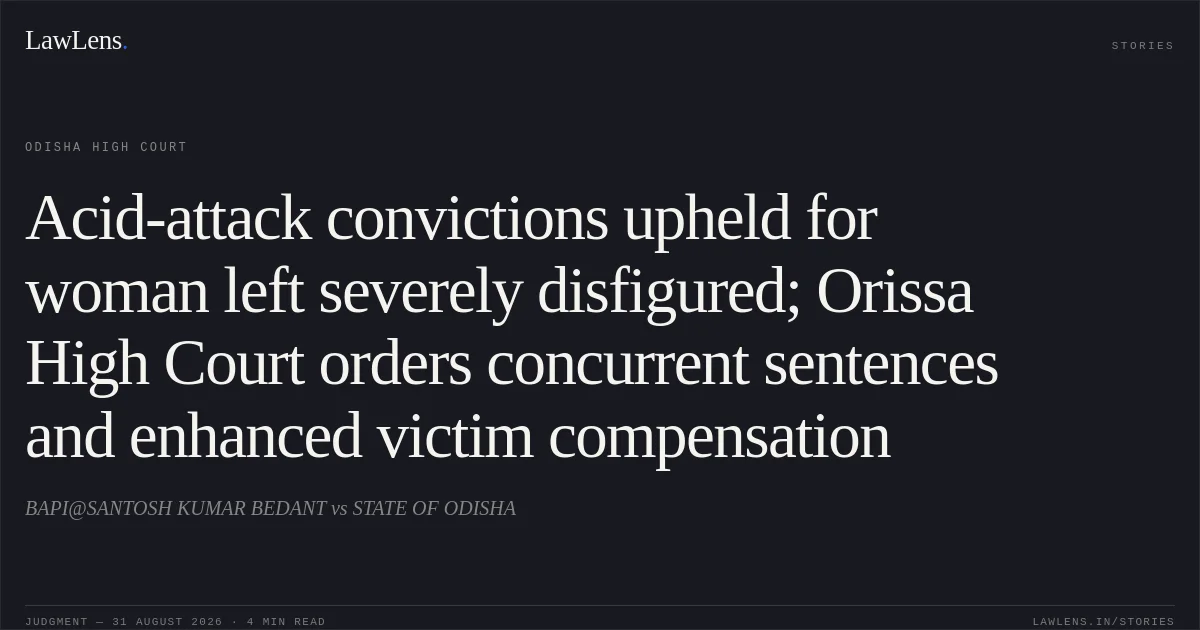
On 18 April 2009, at approximately 7:15 p.m., the victim was returning from her aunt’s house with her cousin, P.W.7 Bhaskar Das, when the appellants allegedly approached them on a motorcycle.
Source reference: pp. 3–8, paras. 3–6Appellant Santosh allegedly demanded that the victim marry him and, upon her refusal, poured acid on her head and face before fleeing with appellant Anil.
Source reference: pp. 3–8, paras. 3–6The victim sustained extensive burns and permanent injuries to her face, scalp, ear, eyes, neck, chest and other parts of her body and underwent prolonged medical treatment.
Source reference: pp. 3–8, paras. 3–6An FIR was lodged on 4 May 2009, and the case was initially closed by a final report. It was reopened in 2017 after information supplied by the victim, following which the appellants were arrested and charge-sheeted.
Source reference: p. 4, para. 4The trial Court acquitted them of offences under Sections 328/506/34 IPC but convicted them under Sections 307/326/34 IPC.
Source reference: pp. 11–14, paras. 7–9Each appellant was sentenced to nine years’ rigorous imprisonment under Section 307/34 IPC and five years’ rigorous imprisonment under Section 326/34 IPC, with the sentences directed to run consecutively.
Source reference: pp. 11–14, paras. 7–9The appeals challenged the conviction and sentence; during hearing, the appellants principally sought modification of the consecutive sentences to concurrent sentences.
Source reference: pp. 20–22, paras. 18–19Issues
Whether the testimony of the injured victim, P.W.3, corroborated by the eyewitness P.W.7, the informant and the medical evidence, was sufficient to sustain the appellants’ convictions under Sections 307/326/34 IPC.
Source reference: p. 14, para. 9Whether the nature of the acid attack and the injuries established the requisite intention or knowledge for an offence under Section 307 IPC, and whether appellant Anil shared the common intention under Section 34 IPC.
Source reference: pp. 18–20, para. 16Whether the substantive sentences under Sections 307/34 and 326/34 IPC, arising from the same occurrence, should run concurrently rather than consecutively under Section 31 Cr.P.C.
Source reference: pp. 20–25, paras. 18–21Law Applied
The Court applied Sections 307, 326 and 34 IPC: Section 307 requires proof of the requisite intention or knowledge to cause death; Section 326 concerns voluntarily causing grievous hurt by dangerous means; and Section 34 attributes liability where a criminal act is done in furtherance of common intention.
Source reference: no citationThe Court relied on the principle that the testimony of an injured witness ordinarily carries enhanced evidentiary value and should not be discarded absent compelling reasons, as recognised in State of Madhya Pradesh v. Man Singh, 2003 (3) Crimes 380 (SC), and Bijay Sankar Sindhe v. State of Maharashtra, 2008 (1) Crimes 216 (SC).
Source reference: pp. 9–12, para. 7For sentencing, Section 31 Cr.P.C. confers discretion to direct sentences for multiple offences at one trial to run concurrently or consecutively, having regard to the nature of the offences and aggravating or mitigating circumstances; the Court relied on O.M. Cherian v. State of Kerala, (2015) 2 SCC 501, V.K. Bansal v. State of Haryana, (2013) 7 SCC 211, Mohd. Akhtar Hussain v. Collector of Customs, (1988) 4 SCC 183, Manoj v. State of Haryana, (2014) 2 SCC 153, and Sunil Kumar v. State of U.P., (2021) 5 SCC 560.
Source reference: pp. 22–26, paras. 20–21The Court also considered the reformative and rehabilitative principles of sentencing recognised in Mohd. Giasuddin v. State of A.P., (1977) 3 SCC 287, alongside the gravity of the offence and its impact on the victim.
Source reference: pp. 26–28, paras. 22–23Section 357 Cr.P.C. was applied for disbursement of the fine as compensation to the victim.
Source reference: p. 30, para. 25Reasoning
The Court found P.W.3’s evidence clear, consistent and materially intact despite extensive cross-examination.
Source reference: pp. 14–18, paras. 10–14Her status as the injured victim, the immediate disclosure to her mother, and the extensive injuries caused by the acid attack substantially corroborated her account.
Source reference: pp. 14–18, paras. 10–14P.W.7 provided a natural eyewitness account, identifying both appellants, describing their approach on the motorcycle, Santosh’s demand and act of pouring acid, and their subsequent flight.
Source reference: pp. 15–16, para. 11His relationship with the victim was not, by itself, a ground for rejection where his evidence was cogent and corroborated.
Source reference: pp. 15–16, para. 11The Court held that pouring acid on the victim’s head and face, coupled with the seriousness and extent of the injuries, permitted an inference of the intention or knowledge required under Section 307 IPC.
Source reference: pp. 18–19, para. 16Although Santosh allegedly poured the acid, Anil’s presence as the motorcycle rider and his concerted conduct before and after the occurrence established participation in furtherance of common intention under Section 34 IPC.
Source reference: p. 19, para. 16However, for sentencing, the Court held that both offences arose from the same act and transaction and were based substantially on the same evidence.
Source reference: pp. 28–29, para. 24Balancing the gravity of the acid attack and its devastating consequences against the appellants’ incarceration of more than eight years, it exercised its discretion under Section 31 Cr.P.C. to direct concurrent sentences.
Source reference: pp. 28–29, para. 24Holding
The High Court upheld the appellants’ convictions under Sections 307/326/34 IPC and found no perversity or material infirmity in the trial Court’s appreciation of the evidence.
The appeals were dismissed.
Source reference: p. 30, paras. 25–26The substantive sentences of nine years under Section 307/34 IPC and five years under Section 326/34 IPC were directed to run concurrently instead of consecutively.
Source reference: p. 30, paras. 25–26The fines were enhanced to ₹40,000 each under Section 307/34 IPC, with one year’s rigorous imprisonment in default, and ₹10,000 each under Section 326/34 IPC, with three months’ rigorous imprisonment in default.
Source reference: p. 30, paras. 25–26The realised fine was directed to be disbursed to the victim as compensation under Section 357 Cr.P.C.
Source reference: p. 30, paras. 25–26Acts & Sections Cited
10 provisions across 2 statutes referred to in this judgment. Each provision opens on LawLens.
Code of Criminal Procedure, 19735
Indian Penal Code, 18605
Original Court PDF
BAPI@SANTOSH KUMAR BEDANTvsSTATE OF ODISHA
Click to open original judgment
Original judgment, available to read, download and summarize on LawLens.in