Facts
The Appellant, a person with 100% hearing impairment, applied for the post of Executive Trainee (Mechanical) under a recruitment advertisement issued through GATE 2026 and was shortlisted for interview
Source reference: paras. 4.1–4.4In the employment Application Form dated 15.06.2026, he answered “No” to Question No. 20, which required disclosure of any pending or previously instituted criminal, disciplinary or vigilance case
Source reference: para. 4.5The Respondents subsequently issued him an offer of appointment dated 08.07.2026, subject to document and antecedent verification
Source reference: para. 4.6; para. 11At the time of joining on 15.07.2026, the Appellant answered “Yes” to questions in the Attestation Form concerning prosecution and pending court cases, and disclosed an affidavit referring to FIR No. 171/2020 under Sections 324, 323, 504, 506 and 34 IPC
Source reference: para. 4.7–4.8A second FIR, No. 21/2022, involving similar allegations arising from an ancestral property dispute, was disclosed later in the writ proceedings
Source reference: para. 8; para. 12The Respondents prevented him from continuing the training pending verification and subsequently issued a communication dated 04.08.2026 disengaging him from the recruitment process
Source reference: paras. 4.9–4.12; paras. 10, 16The learned Single Judge dismissed his writ petition, holding that the subsequent disclosures could not cure the incorrect declaration in the Application Form
Source reference: para. 4.12Issues
Whether the Appellant’s negative response to Question No. 20 constituted suppression or furnishing of incorrect information regarding pending criminal proceedings
Source reference: paras. 18–20Whether Question No. 20 was vague or ambiguous so as to excuse the Appellant’s failure to disclose the FIRs
Source reference: paras. 5, 18–21Whether the subsequent disclosures in the Attestation Form and affidavit negated or cured the earlier incorrect declaration
Source reference: paras. 18, 22–24Whether the Respondents’ decision to prevent the Appellant from continuing training and disengage him from the recruitment process was arbitrary or otherwise liable to interference under Article 226 of the Constitution
Source reference: paras. 4.12, 18, 24What directions, if any, were required to protect the Appellant’s future candidature following the disengagement communication dated 04.08.2026
Source reference: paras. 25–27Law Applied
The Court applied the principle that an employer is entitled to seek truthful and complete information regarding a candidate’s criminal antecedents in order to verify character and assess suitability for appointment or continuation in service
Source reference: paras. 19, 23A candidate who is aware of pending criminal proceedings must disclose them when the recruitment form specifically requires disclosure of any pending or previously instituted criminal case; an incorrect negative declaration may independently justify action by the employer
Source reference: paras. 19–24The Court considered Avtar Singh v. Union of India, (2016) 8 SCC 471, which requires the disclosure/attestation question to be sufficiently specific and recognises the relevance of suppression of material criminal antecedents, but held that the principle did not assist the Appellant because Question No. 20 was clear and unambiguous
Source reference: para. 21The Court also distinguished the timing of disclosure: a later disclosure, made after selection and issuance of the appointment offer, does not retrospectively cure an earlier incorrect declaration made during the recruitment process
Source reference: paras. 22–24Reasoning
The Court rejected the Appellant’s attempt to dissect Question No. 20 into separate clauses. Reading the question as a whole and having regard to its purpose, the Court held that the reference to a Public Service Commission, university or educational authority related only to disqualification from their examinations and did not limit the separate requirement to disclose pending or previously instituted criminal cases to such institutions
Source reference: para. 19Since criminal proceedings arising from the FIRs were pending when the Application Form was submitted, the Appellant’s negative answer was incorrect
Source reference: para. 20His awareness of the FIRs was demonstrated by the fact that he had obtained the disclosure affidavit on 15.06.2026, but withheld it until after the offer of appointment dated 08.07.2026
Source reference: para. 22The later answers in the Attestation Form and the affidavit therefore did not eliminate the earlier suppression; the legality of the Respondents’ action had to be assessed with reference to the declaration made in the Application Form
Source reference: paras. 23–24Consequently, preventing the Appellant from continuing training pending verification and declining to proceed with his candidature was not shown to be arbitrary, perverse or legally infirm
Source reference: paras. 4.12, 18, 24Holding
The Division Bench dismissed the appeal and upheld the learned Single Judge’s order
It held that Question No. 20 was clear, that the Appellant’s negative declaration was incorrect, and that his subsequent disclosures did not cure the suppression
Source reference: paras. 19–24However, recognising the potential impact of the 04.08.2026 communication on his future employment prospects, the Court directed that the communication be treated only as disengagement from the present recruitment process, not as termination of employment, and that it carry no stigma of termination
Source reference: paras. 25–27The Appellant’s future candidature before Respondent No. 2 or any other employer or recruiting agency was directed to be considered independently, on its own merits, in accordance with the applicable conditions and disclosures, uninfluenced by the disengagement communication, the present judgment or the Single Judge’s order
Source reference: para. 27Pending applications were disposed of and there was no order as to costs
Source reference: para. 28Acts & Sections Cited
10 provisions across 1 statute referred to in this judgment. Each provision opens on LawLens.
Original Court PDF
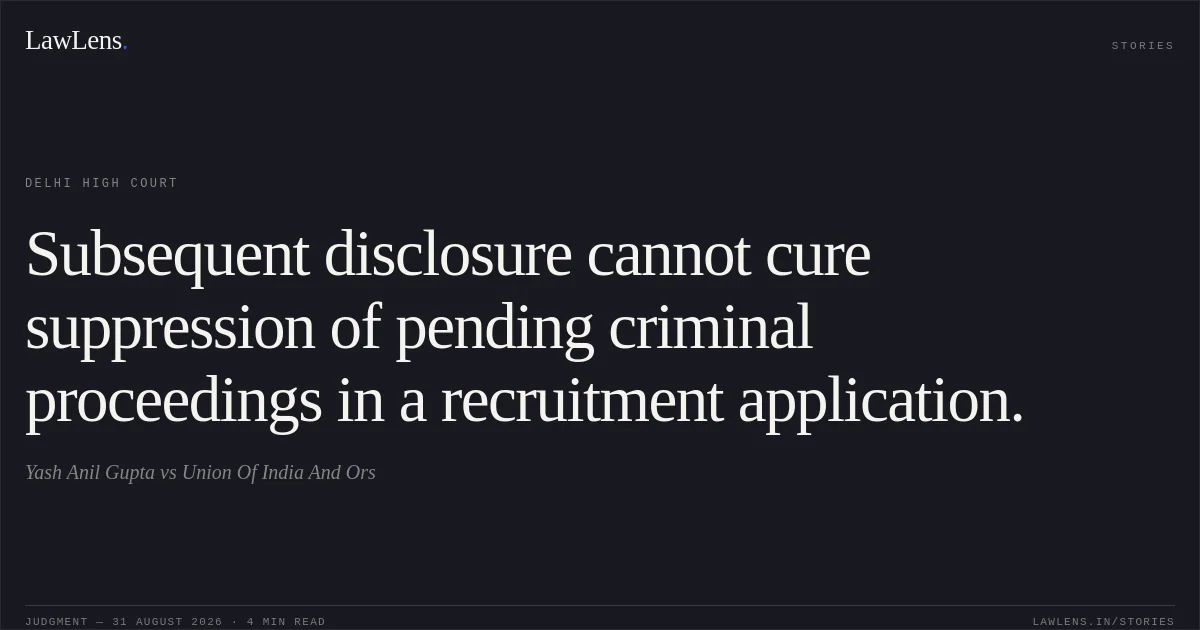
Yash Anil GuptavsUnion Of India And Ors
Click to open original judgment
Original judgment, available to read, download and summarize on LawLens.in