Facts
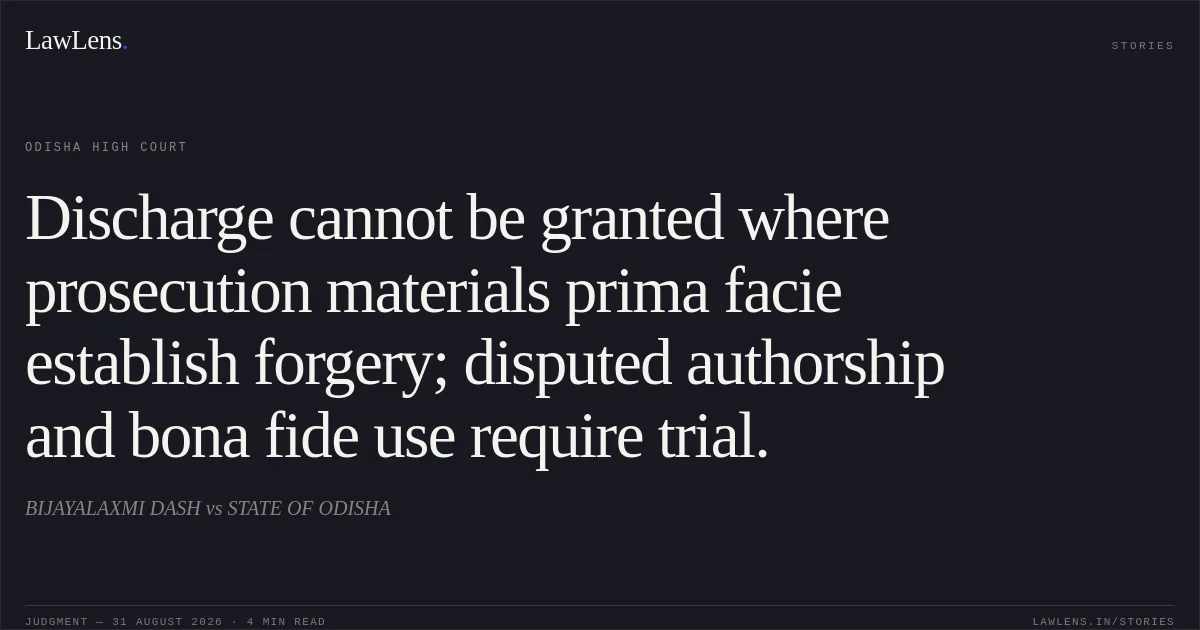
The petitioner, an Assistant Professor at Ravenshaw University, applied for academic leave from 8 April to 20 April 2019 to attend a refresher course at the Central University of Rajasthan. In support of her application, she submitted a letter purportedly issued by the Deputy Election Officer, Cuttack, stating that she had not been allotted election duty.
Source reference: pp. 2–5The District Election Office subsequently reported that Letter No. 742/Elec dated 5 April 2019 had never been issued and that the signature appearing on it was forged. The petitioner was accordingly charge-sheeted under Sections 465, 471 and 473 IPC.
Source reference: pp. 2–7The learned S.D.J.M. discharged her under Section 473 IPC but rejected her prayer for discharge under Sections 465 and 471 IPC and additionally framed a charge under Section 468 IPC.
Source reference: pp. 6–7In revision under Sections 397 and 401 Cr.P.C., the petitioner contended that the alleged forgery was an error of judgment, that she had relied upon a person named Suryamani Tripathy, and that no offence under Section 465 IPC was made out. The State opposed the revision, submitting that the materials disclosed a prima facie case requiring trial.
Source reference: pp. 7–12Issues
Whether the materials on record disclosed a prima facie case under Sections 465 and 471 IPC, warranting refusal of discharge under Section 239 Cr.P.C.?
Source reference: pp. 2, 6–7, 17–19Whether the petitioner’s defence that she innocently relied upon Suryamani Tripathy, or that the forged document was unnecessary because she was not ultimately allotted election duty, could be considered at the stage of discharge?
Source reference: pp. 10–12, 16–18Whether the revisional court should interfere with the Magistrate’s order framing or adding charges, in the absence of a manifest infirmity?
Source reference: pp. 8–10, 17–19Law Applied
The Court applied Section 239 Cr.P.C., under which an accused may be discharged in a warrant case instituted on a police report where the charge is groundless, and Sections 397 and 401 Cr.P.C., governing revisional jurisdiction.
Source reference: pp. 1–2It considered Sections 463, 465, 468, 471 and 473 IPC: Section 463 defines forgery; Sections 465 and 468 prescribe punishment for forgery and forgery for the purpose of cheating; Section 471 criminalises using a forged document as genuine; and Section 473 concerns making or possessing counterfeit seals or instruments for the purpose of committing forgery.
Source reference: pp. 12–13Relying principally on State of Orissa v. Debendra Nath Padhi, (2005) 1 SCC 568, and State by the Inspector of Police, Chennai v. S. Selvi, (2018) 13 SCC 455, the Court held that, at the stage of discharge or framing of charge, the prosecution materials are presumed to be true and the court must determine whether they disclose the ingredients of the alleged offences; it must not conduct a roving inquiry or undertake a mini-trial.
Source reference: pp. 8–10, 17–18The Court also considered Dr. Vimla v. State (NCT of Delhi), AIR 1963 SC 1572, Parminder Kaur v. State of U.P., (2010) 1 SCC 322, and Jupally Lakshmikantha Reddy v. State of A.P., 2025 SCC OnLine SC 1950, which concern the requirement of fraudulent or dishonest intention and the materiality of a false representation in cases of forgery and cheating.
Source reference: pp. 12–16Reasoning
The Court found that the prosecution materials showed that the petitioner had submitted a document which was not issued by the District Election Office and which bore a forged signature.
Source reference: pp. 3–6The document was allegedly used to obtain release from university duties and attend the refresher course, thereby disclosing, at least prima facie, the use of a forged document as genuine under Section 471 IPC and a basis for proceeding on the forgery-related charges.
Source reference: pp. 6, 10–12The fact that the petitioner’s name did not ultimately appear in the election-duty chart did not negate the prima facie accusation, as the Court held that this factual defence could not be conclusively evaluated at the discharge stage.
Source reference: p. 10Similarly, the petitioner’s claim that Suryamani Tripathy had created the forgery and that she had acted bona fide was held to be a matter for trial, not a ground for discharge.
Source reference: pp. 10–12, 16–18The authorities relied upon by the petitioner were distinguished or treated as inapplicable because, unlike those cases, the present materials indicated a possible connection between the allegedly forged document and the benefit obtained by the petitioner.
Source reference: pp. 12–16Since the prosecution evidence, taken at face value, disclosed the essential ingredients of the offences, the revisional court found no jurisdictional or legal infirmity in the Magistrate’s order.
Source reference: pp. 17–19Holding
The High Court held that a prima facie case existed against the petitioner under Sections 465 and 471 IPC and that her explanations concerning the authorship of the forgery, her alleged bona fide belief, and the election-duty chart required examination during trial.
It found no infirmity in the Magistrate’s refusal to discharge her or in the addition of the charge under Section 468 IPC.
Source reference: pp. 17–19The criminal revision was therefore dismissed, and the interim order was vacated.
Source reference: p. 19Acts & Sections Cited
19 provisions across 3 statutes referred to in this judgment. Each provision opens on LawLens.
Code of Criminal Procedure, 19736
Bharatiya Nyaya Sanhita, 20235
Indian Penal Code, 18608
Original Court PDF
BIJAYALAXMI DASHvsSTATE OF ODISHA
Click to open original judgment
Original judgment, available to read, download and summarize on LawLens.in