Facts
The applicants, a Driver and a Conductor employed by the Delhi Transport Corporation (DTC), were charge-sheeted on 05.01.2015 for allegedly falsifying trip records and causing financial loss to the Corporation
Source reference: para 2An Inquiry Officer (IO) concluded that the primary charges of misconduct were "not proved," though a procedural charge regarding the refusal to accept a charge memo was "partially proved"
Source reference: para 3Consequently, the Disciplinary Authority (DA) imposed a penalty of "Reprimand" on 25.05.2015
Source reference: para 4However, in January 2016, the Regional Manager (Reviewing Authority) initiated a suo motu review, asserting that the penalty was not commensurate with the gravity of the alleged offence
Source reference: para 5This led to the issuance of show-cause notices and subsequent orders dated 30.01.2016 and 13.02.2016, dismissing both applicants from service
Source reference: para 6The applicants challenged these dismissal orders before the Tribunal as being void ab initio.
Source reference: no citationIssues
1. Whether, under the Rules and Regulations governing DTC employees, the Appellate or Reviewing Authority has the power to suo motu review an order of the Disciplinary Authority and enhance the punishment
Source reference: para 1Law Applied
DTC Standing Orders and the principles established in Mardan Singh vs. D.T.C. & Anr (2000), which held that an Appellate Authority can only enhance punishment if an appeal is pending before it; it possesses no suo motu power to review or reopen a case once punishment is imposed
Source reference: para 7.IRam Naresh v. DTC (2006), which emphasized that the actions of a statutory authority like DTC must be backed by express statutory provisions and that quasi-judicial powers cannot be exercised based on administrative whims
Source reference: para 7.IISection 12 of the Road Transport Corporation Act, 1950, regarding the delegation of powers
Source reference: para 9Reasoning
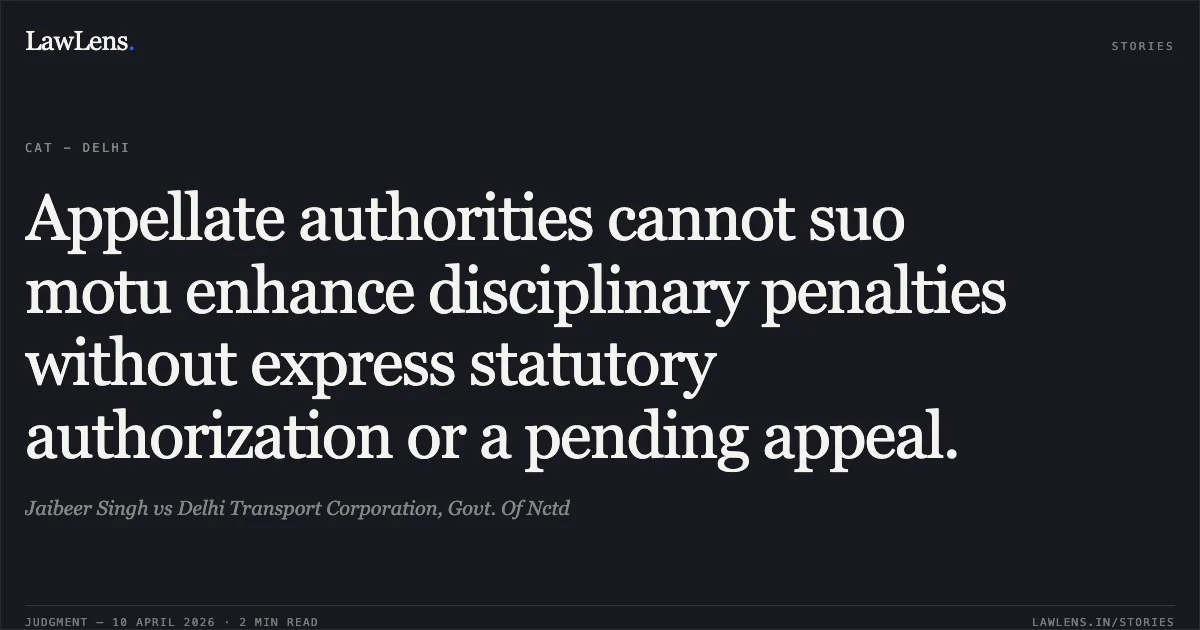
The Tribunal observed that the Regional Manager acted unilaterally to enhance the penalty from a "reprimand" to "dismissal" without identifying any specific rule granting such suo motu revisionary powers
Source reference: para 5Although the respondents argued that the Chairman had delegated review powers to the Regional Manager under the Road Transport Corporation Act and CVC guidelines, they failed to produce any post-2000 rule amendment that superseded the High Court's ruling in Mardan Singh, which expressly prohibited such actions
Source reference: para 8-10The Tribunal reasoned that in the absence of an active appeal by the employee, the Reviewing Authority is not vested with the jurisdiction to reconsider the gravity of misconduct or the quantum of punishment already settled by the Disciplinary Authority
Source reference: para 13Consequently, the Tribunal found the enhancement of punishment to be legally unsustainable and a violation of established service jurisprudence
Source reference: para 13Holding
The Tribunal held that the Reviewing Authority lacked the legal provision to suo motu enhance the applicants' punishment
It quashed and set aside the dismissal orders dated 30.01.2016 and 13.02.2016
Source reference: para 13The applicants were restored to their positions and held entitled to all admissible consequential benefits
Source reference: para 13The Respondent-DTC was directed to implement the judgment within six weeks of receipt
Source reference: para 14Acts & Sections Cited
3 provisions across 2 statutes referred to in this judgment. Each provision opens on LawLens.
Administrative Tribunals Act, 19852
Road Transport Corporations Act, 19501
Original Court PDF
Jaibeer SinghvsDelhi Transport Corporation, Govt. Of Nctd
Click to open original judgment
Original judgment, available to read, download and summarize on LawLens.in


