Facts
The petitioner, an employee of the M.P. Industrial Development Corporation (MPIDC), was dismissed from service on 09.06.2023 following a departmental enquiry report dated 18.10.2022.
Source reference: para. 4 & 9The petitioner challenged the dismissal before the appellate authority. On 20.09.2023, the appellate authority set aside the dismissal order and remanded the matter back for a de novo enquiry, citing procedural deficiencies such as the non-examination of key witnesses and an insufficiently detailed enquiry report.
Source reference: para. 4, 9 & 12The petitioner subsequently filed this writ petition under Article 226 of the Constitution of India, contending that a de novo enquiry is legally impermissible under the M.P. Civil Services (Classification, Control and Appeal) Rules, 1966.
Source reference: para. 1-2Issues
1. Whether the appellate authority has the power to order a de novo enquiry and appoint a new enquiry officer under the M.P. Civil Services (Classification, Control and Appeal) Rules, 1966.
Source reference: para. 9 & 122. Whether the restrictions placed on a Disciplinary Authority regarding de novo enquiries under Rule 15 also apply to the Appellate Authority under Rule 27.
Source reference: para. 12Law Applied
The court primarily interpreted Rule 15 and Rule 27 of the M.P. Civil Services (Classification, Control and Appeal) Rules, 1966.
Source reference: para. 10Rule 15 governs the Disciplinary Authority’s power to remit a case for "further enquiry" rather than a de novo enquiry.
Source reference: para. 11Rule 27(2)(c)(ii) provides the Appellate Authority with broader powers to remit a case to the original authority or "any other authority" with "such direction as it may deem fit".
Source reference: para. 12The court distinguished the precedent in Prafulla Kumar v. State of M.P. (2009), which restricted Disciplinary Authorities from ordering de novo enquiries, noting it did not curtail the wider statutory powers of an Appellate Authority.
Source reference: para. 7 & 12Reasoning
The court reasoned that there is a distinct legal difference between the powers of a Disciplinary Authority and an Appellate Authority under the 1966 Rules. While Rule 15 limits the Disciplinary Authority to remitting cases for "further enquiry" based on specific disagreements, Rule 27(2)(c)(ii) grants the Appellate Authority "wider" discretion to remit matters with any directions deemed appropriate under the circumstances.
Source reference: para. 11 & 12The court found that the appellate authority had recorded valid reasons—specifically, the failure to examine key witnesses and the lack of detail in the original findings—to justify the remand.
Source reference: para. 12It clarified that while de novo enquiries are not permissible for minor reasons, they are legally valid when serious procedural lapses or "failure of justice" occur.
Source reference: para. 13Holding
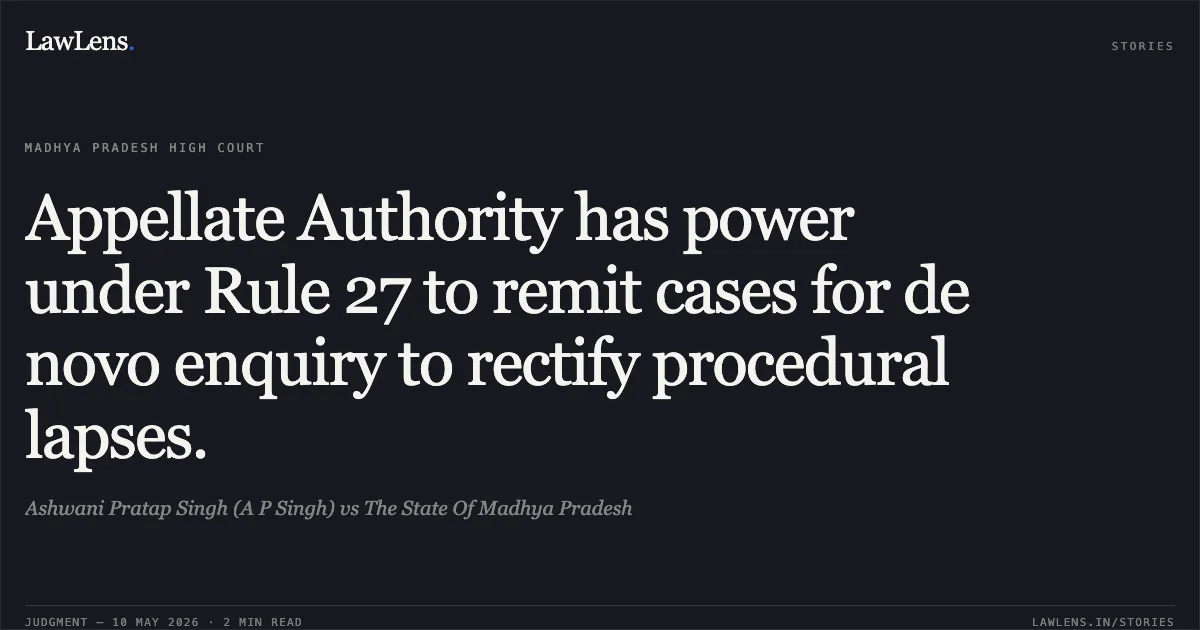
The court held that there is no absolute bar in the Service Rules against a de novo enquiry when ordered by an Appellate Authority under Rule 27, provided it is supported by written reasons and addresses serious procedural irregularities.
The court found no merit in the petitioner's challenge as the appellate authority acted within its jurisdiction to rectify substantial defects in the initial enquiry. Consequently, the Writ Petition was dismissed.
Source reference: para. 13 & 14Original Court PDF
Ashwani Pratap Singh (A P Singh)vsThe State Of Madhya Pradesh
Click to open original judgment
Original judgment, available to read, download and summarize on LawLens.in


