Facts
The second respondents had worked in the petitioner Sangh’s printing department at a factory in Khadi Gramam.
Source reference: pp. 4–6After the factory closed in 2001, they were retrenched.
Source reference: pp. 4–6The Labour Court set aside the retrenchments and directed the Sangh to provide alternative employment; they were subsequently offered work at the Akkaraipalayam branch.
Source reference: pp. 4–6Following disciplinary proceedings, they were dismissed in 2014.
Source reference: pp. 4–6They later appealed under the Tamil Nadu Shops and Establishments Act, 1947.
Source reference: pp. 4–6The Sangh filed interim applications challenging the appeals’ maintainability, arguing that it was a factory and the workers’ remedy lay under the Industrial Disputes Act, 1947.
Source reference: pp. 4–6The Appellate Authority rejected those applications, reasoning that the Sangh had not proved it was a factory.
Source reference: pp. 4–6The Sangh challenged those orders by writ petitions.
Source reference: pp. 4–6Issues
1. Whether the Appellate Authority could reject the Sangh’s maintainability applications without giving it an opportunity to prove that it was a factory.
Source reference: pp. 5–62. Whether the workers’ appeals under the Tamil Nadu Shops and Establishments Act were maintainable, or whether their remedy lay under the Industrial Disputes Act.
Source reference: pp. 5–6Law Applied
The Court considered the Tamil Nadu Shops and Establishments Act, 1947, the Factories Act and the Industrial Disputes Act, 1947, as the statutory frameworks relevant to the maintainability dispute.
Source reference: pp. 5–6It did not identify a specific statutory provision, cite precedent, or finally state the governing test for determining whether the Sangh was a factory.
Source reference: pp. 5–6The decision applies the procedural principle that a party should be afforded an opportunity to establish a material factual basis for its objection before that objection is determined.
Source reference: p. 6Reasoning
The Appellate Authority had rejected the Sangh’s applications because it had not produced proof that it was a factory.
Source reference: pp. 6–7The High Court considered the Sangh’s factory status central to deciding whether the appeals under the Shops and Establishments Act could proceed, particularly given the workers’ earlier employment at the factory and their subsequent placement at another branch.
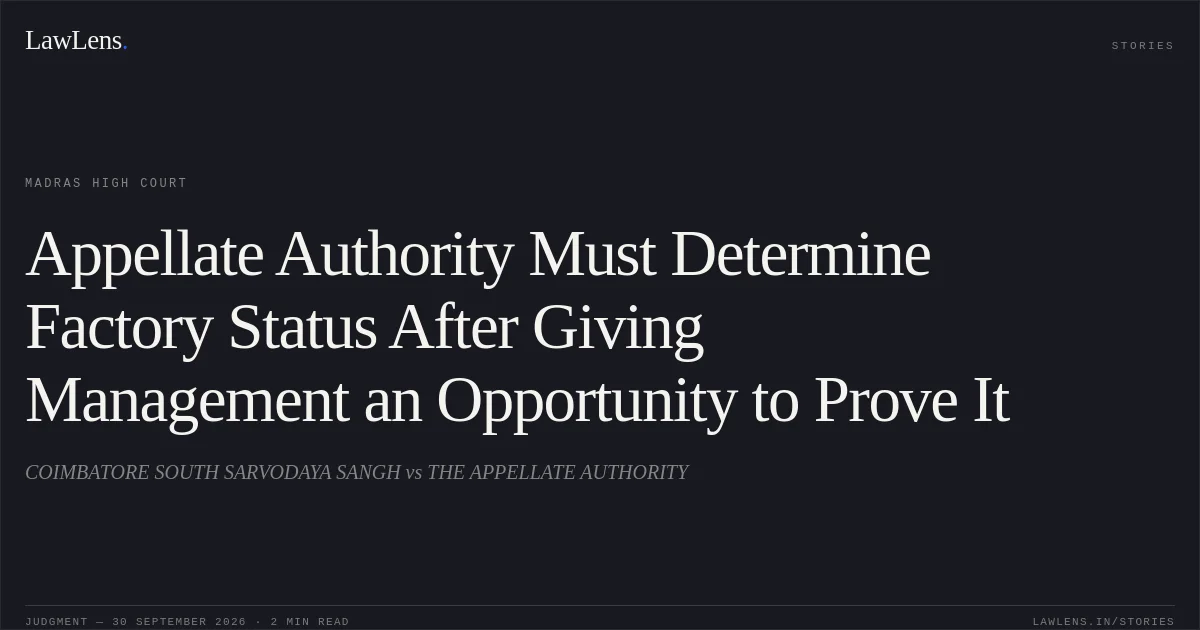
Source reference: pp. 6–7Because the Sangh had not been given an opportunity to prove that status, the Court set aside the orders and directed the Authority to hear the Sangh and decide the applications afresh.
Source reference: p. 7It did not itself resolve the appeals’ maintainability.
Source reference: p. 7Holding
The High Court allowed the writ petitions and set aside the Appellate Authority’s orders dated 19 November 2024.
It directed the Authority to give the Sangh an opportunity to prove whether it was a factory and thereafter pass fresh orders on the relevant interim applications.
Source reference: p. 7No costs were awarded, and the connected miscellaneous petitions were closed.
Source reference: p. 7Original Court PDF
COIMBATORE SOUTH SARVODAYA SANGHvsTHE APPELLATE AUTHORITY
Click to open original judgment
Original judgment, available to read, download and summarize on LawLens.in