Facts
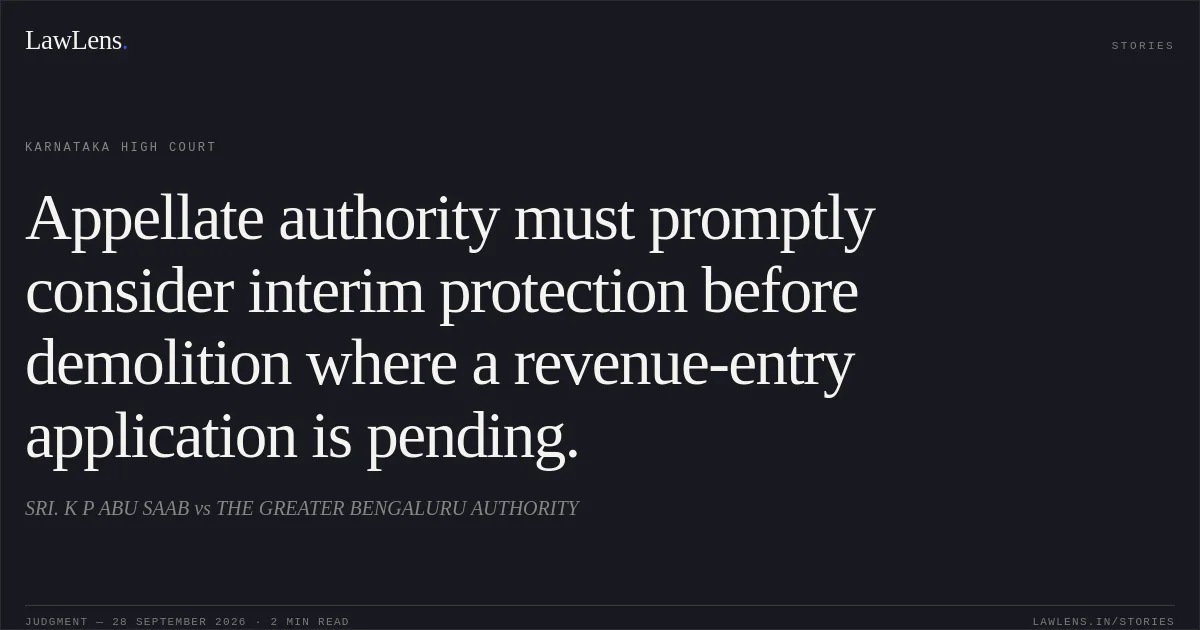
The petitioner challenged a provisional order and show-cause notice dated 23 June 2026, and an undated confirmation/demolition order, issued under Sections 243 and 244 of the Greater Bengaluru Governance Act, 2024 (“GBG Act”) in respect of his property.
Source reference: p. 2–3He contended that he had purchased a constructed property reflected in Form-B revenue entries, had applied for Form-A entries, and that his application was pending; he also alleged that the proceedings arose from a civil dispute with another person.
Source reference: p. 3–4The respondents submitted that the petitioner could pursue the statutory appeal under Section 250, where the relevant matters could be considered.
Source reference: p. 4–5The petitioner agreed to pursue that remedy but sought protection against demolition while his request for interim relief was considered.
Source reference: p. 5Issues
1. Whether the petitioner should be relegated to the statutory appellate remedy under Section 250 of the GBG Act to challenge the provisional and confirmation orders.
Source reference: p. 4–62. Whether coercive action against the property should be restrained temporarily while the petitioner pursued the appeal and sought interim protection.
Source reference: p. 5–7Law Applied
Sections 243(3)(c), 243(3)(d), and 243(3)(e), and Section 244(1) of the GBG Act provide the statutory basis for the impugned proceedings and orders; Section 250 provides an appellate remedy against the relevant order.
Source reference: p. 2–3, 6The Court applied the principle that where an adequate statutory remedy is available, the petitioner should ordinarily pursue that remedy, leaving the issues for consideration by the appellate authority.
Source reference: p. 5–6The Court did not decide the merits of the impugned orders or the petitioner’s entitlement to revenue entries or building approval.
Source reference: p. 5–6Reasoning
The Court considered the availability of the Section 250 appeal and the respondents’ submission that the issues could be examined by the appellate authority.
Source reference: p. 4–5It also noted the undisputed possibility that the petitioner had applied for Form-A revenue entries and that, if admitted to those entries, his request for approval of the standing structure could be considered.
Source reference: p. 5–6In view of those circumstances, the Court left the merits—including whether the application had been filed and whether it affected the confirmation order—to the appellate authority, while recognizing the need to prevent coercive action from defeating the petitioner’s position before his interim request could be considered.
Source reference: p. 6–7Holding
The petition was disposed of, with liberty to the petitioner to challenge the provisional and confirmation orders by appeal under Section 250 of the GBG Act; all questions were left open for consideration in that appeal.
The petitioner was permitted to seek interim protection, and the authorities were called upon to desist from coercive measures for two months, with the appellate authority directed to consider the petitioner’s interim request at the earliest.
Source reference: p. 7Acts & Sections Cited
3 provisions across 1 statute referred to in this judgment. Linked provisions open on LawLens.
Greater Bengaluru Governance Act, 20243
Original Court PDF
SRI. K P ABU SAABvsTHE GREATER BENGALURU AUTHORITY
Click to open original judgment
Original judgment, available to read, download and summarize on LawLens.in