Facts
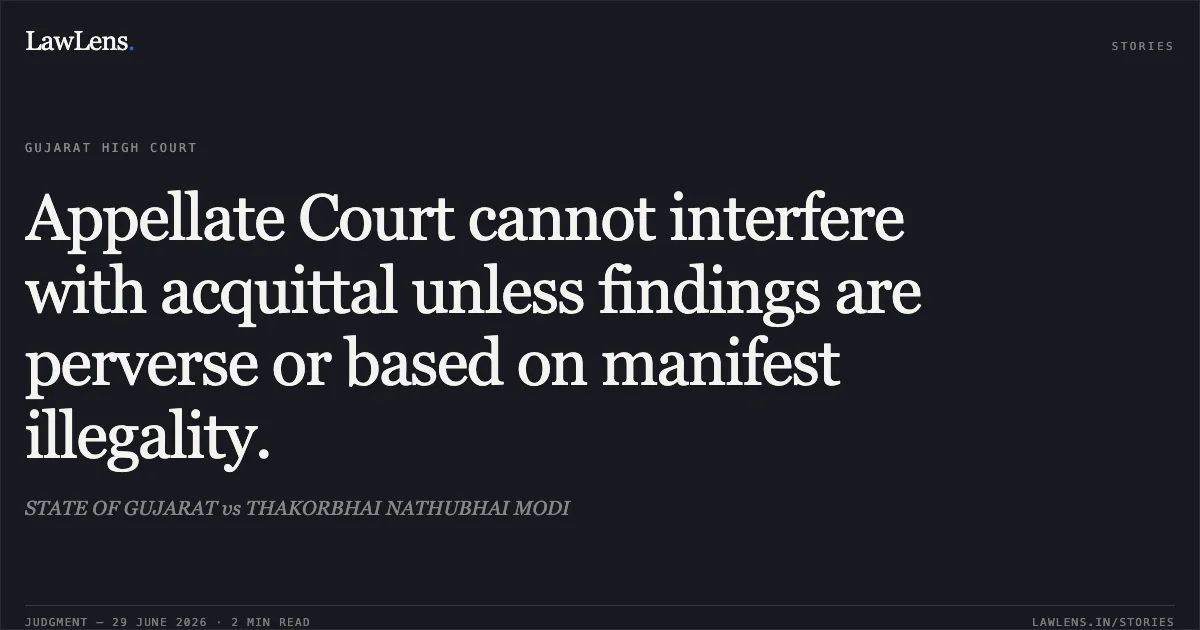
The State of Gujarat filed an appeal against the judgment dated 26.02.2009 passed by the Additional Sessions Judge, Bharuch, which acquitted the respondents of offences under Sections 420, 471, and 114 of the IPC
Source reference: p. 1The case originated from an FIR lodged in 2003 by an officer of the Central Bank of India, alleging financial fraud involving a forged draft
Source reference: p. 2The Trial Court had initially convicted Respondent Nos. 1 and 2, sentencing them to three years of simple imprisonment
Source reference: p. 2-3During the pendency of the appeal, both Respondent No. 1 and Respondent No. 2 expired, leading the appeal to abate against them
Source reference: p. 3Issues
1. Whether the Appellate Court erred in law and fact by reversing the Trial Court’s conviction and acquitting the respondents of charges under Sections 420, 471, and 114 IPC
Source reference: p. 42. Whether the prosecution proved the guilt of the accused beyond reasonable doubt, specifically regarding their knowledge of the forged nature of the bank draft
Source reference: p. 63. Whether there is any manifest illegality or perversity in the Appellate Court's findings that would warrant interference by the High Court
Source reference: p. 7Law Applied
The court applied the fundamental principles of criminal jurisprudence, specifically the "double presumption of innocence" which is reinforced upon an acquittal
Source reference: p. 7It relied on the standard of proof "beyond reasonable doubt."
Source reference: no citationThe court cited the landmark precedent Chandrappa and others v. State of Karnataka (2007) regarding the scope of appellate interference in acquittals, emphasizing that if two reasonable conclusions are possible, the one in favor of the accused must be preferred
Source reference: p. 8-9It further integrated principles from Rajesh Prasad v. State of Bihar (2022) and Babu Sahebagouda Rudragoudar v. State of Karnataka (2024) regarding the necessity of identifying "manifest illegality" or "perversity" to overturn an acquittal
Source reference: p. 8Reasoning
The High Court observed that the prosecution failed to provide sufficient evidence to establish a direct link between the respondents and the alleged fraud beyond their status as joint account holders
Source reference: p. 6The court noted a significant lacuna in the prosecution's case, observing that bank officers failed in their duty to verify the validity of the draft before crediting the account
Source reference: p. 6Applying the Chandrappa doctrine, the court reasoned that the Appellate Court's decision was based on a thorough appreciation of the evidence and that the Trial Court had "miserably failed" to account for these evidentiary gaps
Source reference: p. 6Since the findings of the lower appellate court were not perverse or illegal, and because the respondents had since expired, there were no "firm and weighty grounds" to disturb the acquittal
Source reference: p. 9-10Holding
The High Court dismissed the appeal and confirmed the judgment of acquittal passed by the Additional Sessions Judge
The Court held that the prosecution failed to prove the charges beyond reasonable doubt and that the Appellate Court’s findings were legally sustainable
Source reference: p. 10Consequently, the bail bonds were cancelled
Source reference: p. 10Acts & Sections Cited
6 provisions across 2 statutes referred to in this judgment. Each provision opens on LawLens.
Code of Criminal Procedure, 19731
Indian Penal Code, 18605
Original Court PDF
STATE OF GUJARATvsTHAKORBHAI NATHUBHAI MODI
Click to open original judgment
Original judgment, available to read, download and summarize on LawLens.in