Facts
The dispute arose from a 2008 work order for the construction of a Guest House for Academic Staff
Source reference: para. 2Due to a lack of funds, the University failed to clear bills, leading the respondent to stop work and submit final bills
Source reference: para. 2.1A dispute emerged over a balance sum of ₹2,26,617/- after the respondent accepted a part-payment under protest
Source reference: para. 2.1Following a Section 11(6) application, a sole arbitrator was appointed on 15.05.2019, who passed an award in favor of the respondent on 31.12.2021
Source reference: para. 2.2The University challenged the award under Section 34 of the Arbitration and Conciliation Act, 1996 ("the Act"), which the Commercial Court, Jodhpur, dismissed on 06.11.2024
Source reference: para. 1, 2.2The University then filed this appeal under Section 37 of the Act.
Source reference: no citationIssues
1. Whether the claims raised by the respondent were barred by the law of limitation.
Source reference: para. 3.3, 4.12. Whether the Arbitral Tribunal exceeded its jurisdiction by misinterpreting Clause 6 of the agreement regarding re-measurements.
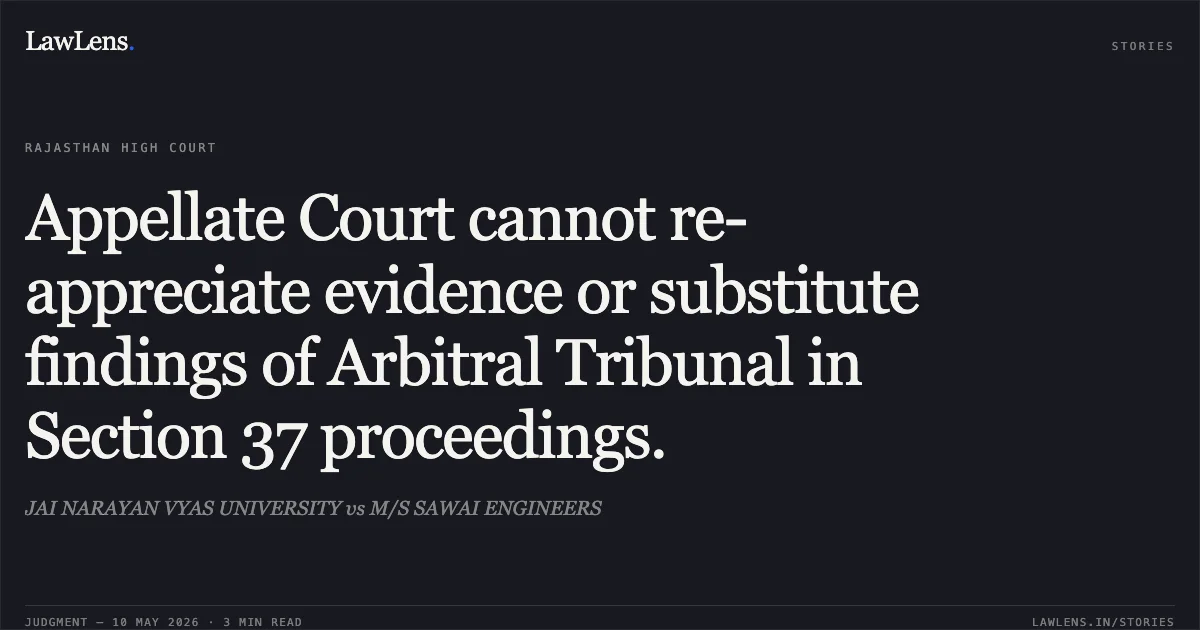
Source reference: para. 3.13. Whether the High Court, in an appeal under Section 37, can re-appreciate evidence or substitute its view for that of the Arbitrator.
Source reference: para. 8, 13Law Applied
The Court applied the restrictive scope of judicial interference under Section 34 and Section 37 of the Arbitration and Conciliation Act, 1996, emphasizing that an award can only be set aside if it is vitiated by patent illegality, conflict with public policy, or a fundamental error of jurisdiction
Source reference: para. 8, 22It relied on the principle that the Arbitrator is the sole judge of the quality and quantity of evidence and that contractual interpretation falls within the Arbitrator's domain
Source reference: para. 10Regarding limitation, the Court followed the principle that for running accounts, limitation starts from the date of the final rejection of a claim or the last payment
Source reference: para. 4.1The Court distinguished BSNL v. Nortel Networks India Pvt. Ltd., noting it applies only where claims are "ex facie" or "hopelessly" time-barred
Source reference: para. 15Reasoning
The Court observed that its jurisdiction under Section 37 is even narrower than the limited scope under Section 34
Source reference: para. 8It rejected the appellant's argument on limitation, agreeing with the Arbitrator’s finding that because the account was a "running account" and final rejection occurred in late 2012, the 2015 invocation was within time
Source reference: para. 4.1, 14On the interpretation of Clause 6, the Court held that even if an alternative interpretation were possible, the Arbitrator’s view was a "plausible" one and did not constitute patent illegality
Source reference: para. 10The Court found that the Commercial Court had not "mechanically" dismissed the Section 34 petition but had properly applied the standards of minimal judicial interference
Source reference: para. 9The Court concluded that the appellants were essentially asking for a re-appreciation of evidence regarding "idle machinery" and "project abandonment," which is impermissible under Section 37
Source reference: para. 12, 13Holding
The High Court dismissed the appeal and upheld the judgment of the Commercial Court and the Arbitral Award
The Court held that the findings on limitation and contractual interpretation were well-reasoned and based on material evidence
Source reference: para. 14, 24It reaffirmed that a Section 37 court cannot sit as a court of appeal to reassess factual findings unless there is manifest perversity, which was not established in this case
Source reference: para. 8, 23All pending applications were disposed of accordingly
Source reference: para. 17Acts & Sections Cited
4 provisions across 1 statute referred to in this judgment. Each provision opens on LawLens.
Arbitration and Conciliation Act, 19964
Original Court PDF
JAI NARAYAN VYAS UNIVERSITYvsM/S SAWAI ENGINEERS
Click to open original judgment
Original judgment, available to read, download and summarize on LawLens.in


