01Facts
The accused, driver of KSRTC bus KA-19/F-2719, allegedly drove at high speed and in a rash and negligent manner near Panakaje mosque on the Mangaluru–Dharmasthala National Highway on 08.09.2013 at about 7:00 p.m.
¶ 3(a)The bus collided with motorcycle KA-20/H-8447 coming from the opposite direction. The rider, Goutham, died on the way to hospital.
¶ 3(a)A charge sheet was filed under Sections 279 and 304A IPC. The accused pleaded not guilty.
¶ 3(b)The prosecution examined 12 witnesses (PWs 1–12) and marked 14 documents (Exs. P1–P14).
¶ 3(b)The accused gave a Section 313 CrPC statement, denied the evidence, and led no defence evidence.
¶ 3(c)The Additional Civil Judge and JMFC, Belthangady, acquitted the accused on 08.01.2016 in C.C. No. 1148/2013.
¶ 3(d)The State appealed under Section 378(1) and (3) CrPC. Counsel for the respondent was absent and arguments were treated as nil.
¶ 502Issues
i.1. Whether the State has made out grounds to interfere with the trial court's judgment of acquittal under Sections 279 and 304A IPC.
¶ 6(1)03Law Applied
The court applied the settled principles governing appeals against acquittal under Section 378 CrPC, as laid down in Constable 907 Surendra Singh v. State of Uttarakhand (2025) 5 SCC 433, Babu Sahebgouda Rudragoudar v. State of Karnataka (2024) 8 SCC 149, Chandrappa v. State of Karnataka (2007) 4 SCC 415, and H.D. Sundara v. State of Karnataka (2023) 9 SCC 581.
¶ 8Under these authorities, an acquittal strengthens the presumption of innocence.
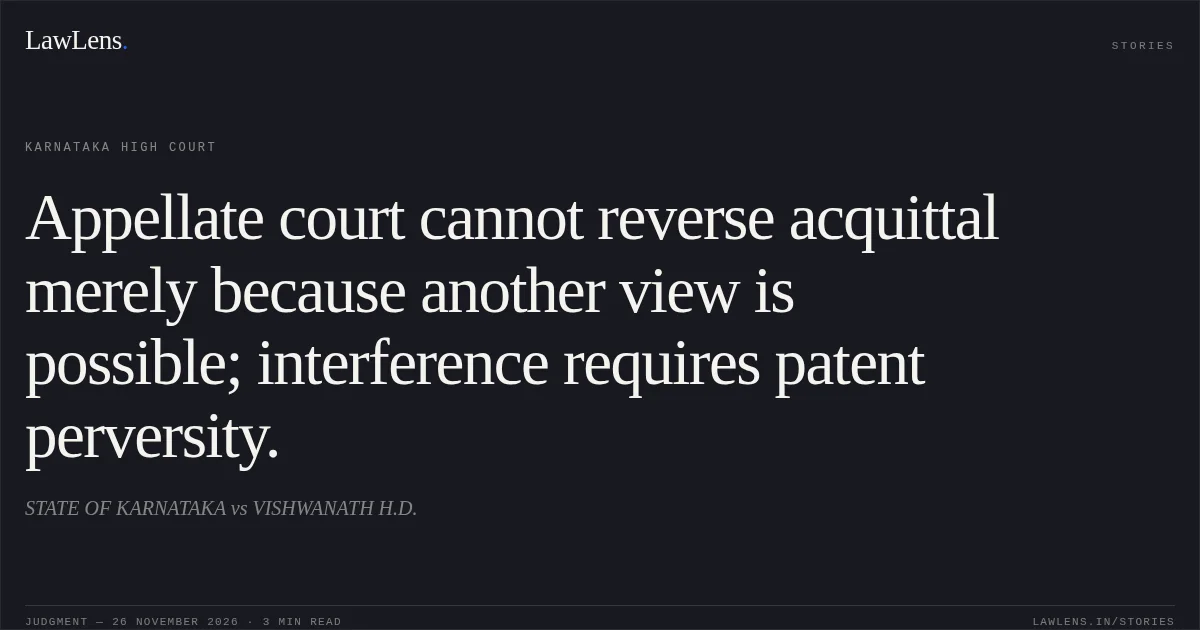
¶ 8The appellate court may re-appreciate the evidence, but it must ask whether the trial court's view is a possible one. If it is, the acquittal cannot be reversed merely because another view is also possible.
¶ 8Interference is warranted only where the acquittal suffers from patent perversity, misreading or omission of material evidence, or where only the guilt-consistent view is possible on the record.
¶ 8The substantive offences are rash or negligent driving endangering human life under Section 279 IPC and causing death by negligence under Section 304A IPC.
¶ 3(a) · ¶ 10Provisions in the judgment · 3 · Linked ones open on LawLens
Code of Criminal Procedure, 1973 Section 378Section 313
Indian Penal Code, 1860 Section 279
04Reasoning
The court re-examined the prosecution witnesses. PW-1, the deceased's father, was not an eyewitness and could not say how the accused drove or whose fault caused the accident. PW-2, the mahazar witness, did not know the contents of the mahazar he signed, and admitted that the bus was on its left side while the motorcycle occupied only about 2 feet of the road on the right. PW-3 admitted he did not witness the incident and could not attribute fault. PW-4, the deceased's childhood friend, conceded that the road was 30 feet wide, with 20 feet of asphalt, and stated that the accused occupied 17 feet and the deceased rode on the remaining 3 feet. PW-5 admitted that the two witnesses he relied upon were not at the spot and that he had only informed them by telephone.
¶ 10Measured against the Surendra Singh and Chandrappa standard, the court found that the trial court's conclusion, that the prosecution failed to prove rash or negligent driving causally linked to the death, was a possible and reasonable view on the evidence. The State had not shown perversity, misreading, or omission of material evidence. Mere availability of a second view was not a ground to reverse the acquittal.
¶ 8 · ¶ 10–1105Holding
The court answered Point No. 1 in the negative. It held that the State failed to show any legal or factual error in the trial court's acquittal and had not placed materials sufficient to interfere with it.
¶ 11The Criminal Appeal is dismissed. The Registry is directed to send a copy of the judgment along with the TCR to the trial court. The acquittal of the accused under Sections 279 and 304A IPC stands.
¶ 12Original Court PDF
STATE OF KARNATAKAvsVISHWANATH H.D.
Click to open original judgment
Original judgment, available to read, download and summarize on LawLens.in