01Facts
Respondent No. 2, a Field Worker with the District Child Protection Unit, Chikkodi, lodged a complaint alleging that Petitioner No. 1 married Respondent No. 3, a minor girl, and that the other petitioners (Accused Nos. 2–5) performed or facilitated the marriage.
p. 13Crime No. 164/2026 was registered at Chikkodi Police Station, and CC No. 1302/2026 is pending before the Principal Civil Judge and JMFC, Chikkodi, for offences under Sections 9, 10 and 11 of the Prohibition of Child Marriage Act, 2006 (PCMA).
pp. 1–2The matter had reached the trial stage.
p. 2The petitioners filed Crl.P. under Section 482 CrPC / Section 528 BNSS seeking quashing.
p. 2The parties then filed a joint compromise petition under Section 359 r/w Section 528 BNSS for compounding, stating that the dispute was settled through elders.
pp. 4–5Respondent No. 3 filed an affidavit stating she has attained majority, is living happily with her husband, and that the offences are non-compoundable.
pp. 6–7The petitioners' affidavit affirmed that the compromise was free from fraud, coercion or undue influence.
p. 6Respondent No. 3's affidavit and the compromise petition reference the petitioners' and victim's settlement, and the court records that the victim intends to withdraw the case to maintain peace and harmony.
p. 1302Issues
i.1. Whether the High Court can quash criminal proceedings under Section 482 CrPC / Section 528 BNSS for offences under Sections 9, 10 and 11 of the PCMA, which are non-compoundable, on the basis of a settlement between the accused and the victim who has attained majority.
pp. 1–2 · pp. 6–7ii.2. Whether the present case falls within the category of predominantly civil or family disputes in which the High Court may quash proceedings on settlement, as laid down in Narinder Singh v. State of Punjab.
pp. 8–10 · p. 13iii.3. Whether the chances of conviction are remote and bleak, such that continuation of the proceedings would be unnecessary and oppressive.
p. 1303Law Applied
The court relied on Section 482 CrPC / Section 528 BNSS, which preserves the High Court's inherent power to prevent abuse of process and secure the ends of justice.
pp. 1–2It also relied on Section 359 r/w Section 528 BNSS for the compounding request.
pp. 3–4Its principal authority was Narinder Singh & Ors. v. State of Punjab & Anr., (2014) 6 SCC 466, which holds that: (I) the inherent power under Section 482 is distinct from statutory compounding and may quash even non-compoundable offences, but must be exercised sparingly.
p. 8Narinder Singh holds that: (II) the guiding considerations are ends of justice and prevention of abuse of process.
p. 8Narinder Singh holds that: (III) the power must not be used for heinous or serious offences of mental depravity, such as murder or rape, or for offences under special statutes, which are not private in nature.
p. 8Narinder Singh holds that: (IV) cases of predominantly civil or family character may be quashed where the parties have resolved their disputes.
p. 9Narinder Singh holds that: (V) the court must assess whether the possibility of conviction is remote and whether continuation would cause oppression or injustice.
p. 9The court also referred to the requirement that such a power is exercised with caution and that the stage of proceedings is relevant.
p. 10The PCMA provisions (Sections 9–11) criminalize, respectively, an adult male contracting a child marriage, solemnizing it, and promoting or permitting it.
Provisions in the judgment · 11 · Linked ones open on LawLens
Code of Criminal Procedure, 1973 Section 482Section 320
Bharatiya Nagarik Suraksha Sanhita, 2023 Section 528Section 359
Prohibition of Child Marriage Act, 2006 Section 9Section 10Section 11
Indian Penal Code, 1860 Section 307Section 324Section 323Section 34
04Reasoning
The court adopted the Narinder Singh framework and held that the dispute, though arising from a marriage, was predominantly family and social in character.
p. 13It reasoned that the victim had attained majority, was cohabiting with Petitioner No. 1, and had reconciled through village elders, which in its view advanced peace and harmony between the families.
p. 13It further held that, following the compromise, further investigation would not arise, and that witnesses were unlikely to support the prosecution, so conviction appeared "very remote".
p. 13Applying principles (IV) and (V), the court concluded that continuing the trial would be unnecessary and would constitute an abuse of process.
p. 13The judgment does not separately analyse the gravity of PCMA offences, whether the offences are social-welfare offences affecting minors as a class rather than only the individual victim, or whether the victim's subsequent consent can cure an offence complete at the time of marriage.
The judgment also does not record the State's position on the compromise, although the HCGP appeared for Respondent No. 1.
p. 205Holding
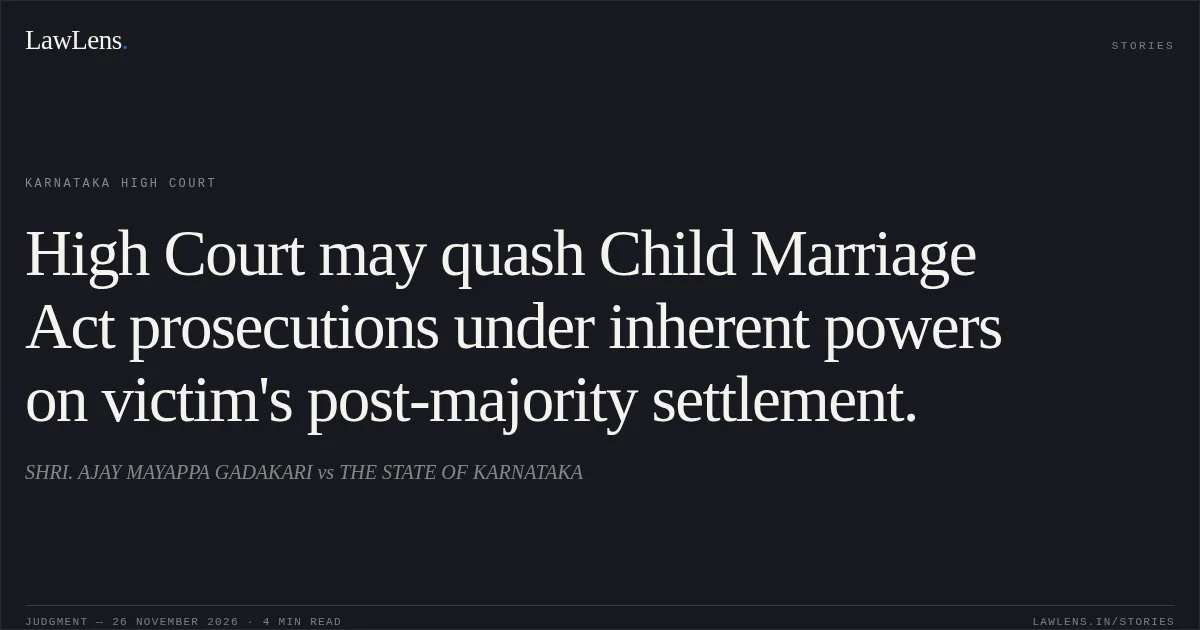
The High Court answered the issues in the affirmative and allowed the criminal petition.
p. 14It accepted the compromise petition and quashed the proceedings in CC No. 1302/2026, arising from Crime No. 164/2026 at Chikkodi Police Station, against the petitioners for offences under Sections 9, 10 and 11 of the PCMA.
p. 14Pending I.A.s were disposed of as not surviving for consideration.
p. 14The judgment is a decision on a settlement-based quashing, which is limited to the petitioners and does not expressly address whether non-compoundable PCMA offences may be compounded in general.
pp. 13–14Original Court PDF
SHRI. AJAY MAYAPPA GADAKARIvsTHE STATE OF KARNATAKA
Click to open original judgment
Original judgment, available to read, download and summarize on LawLens.in