Facts
On November 8, 1993, while the informant (Ramdeo Yadav) was cultivating land as a court-appointed Receiver, the appellants and others interceded.
Source reference: p. 2-3Appellant Awadh Singh allegedly fired a rifle, while Birju Singh and Naro Singh (deceased) assaulted the informant with a *lathi* and *garasa*, causing a hand fracture and cut injuries.
Source reference: p. 3The Trial Court convicted Awadh and Naro under Section 324 IPC and Birju under Section 325 IPC on November 22, 2003.
Source reference: p. 1-2Awadh was also convicted under Section 27 of the Arms Act.
Source reference: p. 1The appellants challenged the conviction on grounds of non-recovery of weapons/pellets and the absence of independent witnesses.
Source reference: p. 5-6Issues
1. Whether the prosecution successfully established the ingredients of "voluntarily causing hurt by dangerous weapons" under Section 324 of the IPC despite the non-recovery of the firearm.
Source reference: p. 112. Whether the sentence of maximum rigorous imprisonment was justified given the nature of the injuries and the advanced age of the appellants.
Source reference: p. 15-16Law Applied
The Court primarily applied Section 324 of the IPC, which penalizes voluntarily causing hurt by instruments of shooting, stabbing, or cutting.
Source reference: p. 9It relied on the precedent *Anuj Singh v. State of Bihar (2022)*, which defines the essential ingredients of Section 324 IPC as voluntary hurt caused by dangerous instruments likely to cause death.
Source reference: p. 9-10Regarding sentencing, the Court followed *State of Rajasthan v. Mohan Lal (2018)*, which mandates that sentences must be proportionate, taking into account the seriousness of the offence, the motive, and the offender's condition (deterrence vs. rehabilitation).
Source reference: p. 11-15Reasoning
The Court found the convictions sound because the medical evidence (P.W.-5) and the injury report corroborated the informant’s testimony regarding "grievous injuries" caused by deadly weapons.
Source reference: p. 11The Court noted that the informant was lawfully cultivating the land as a Receiver, making the appellants the aggressors.
Source reference: p. 11However, regarding the sentence, the Court observed that the Trial Court failed to provide cogent reasons for imposing the maximum statutory punishment.
Source reference: p. 15The Court highlighted that the primary assailant (Naro Singh) had died, and the surviving appellants, Awadh and Birju, are now approximately 80 years old and in a "senile condition".
Source reference: p. 16Under the principle of proportionality, the Court determined that the lengthy 2003 sentence required modification given the passage of 20 years and the appellants' physical state.
Source reference: p. 15-16Holding
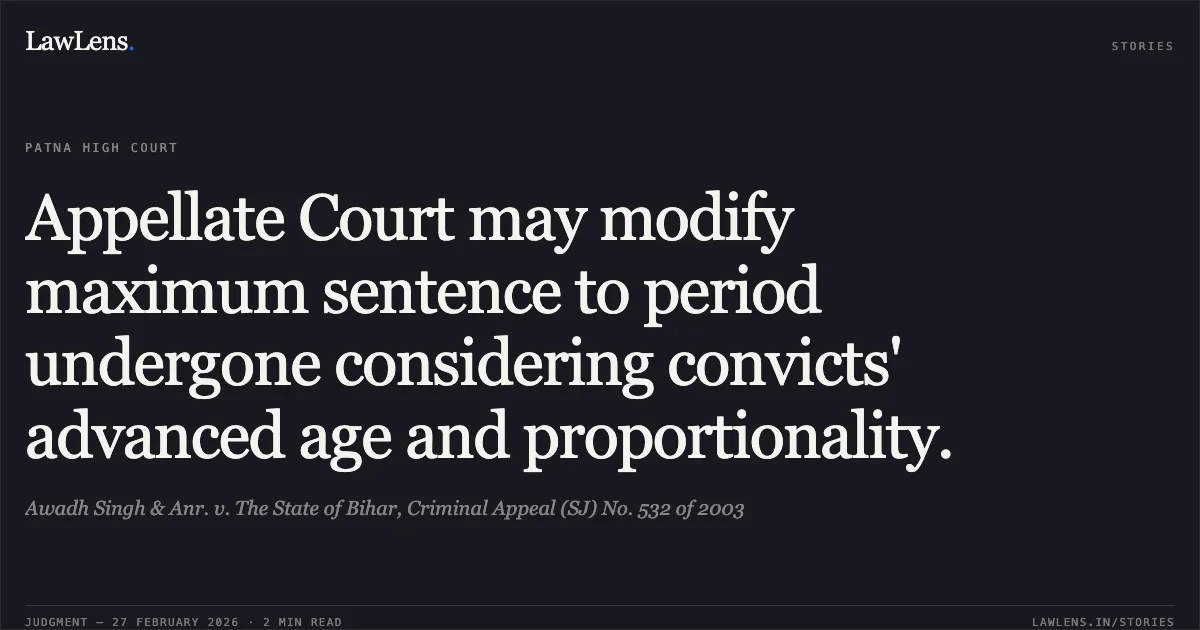
The High Court upheld the judgment of conviction but modified the order of sentence.
The substantive sentence of rigorous imprisonment was reduced to the period already undergone.
Source reference: p. 16In lieu of further jail time, the Court imposed a fine of ₹25,000 each on Awadh Singh and Birju Singh, to be paid as compensation to the informant or his legal heirs.
Source reference: p. 16Failure to pay the fine will result in one month of simple imprisonment.
Source reference: p. 16The appeal was partly allowed.
Source reference: p. 17Acts & Sections Cited
14 provisions across 3 statutes referred to in this judgment. Each provision opens on LawLens.
Code of Criminal Procedure, 19734
Indian Penal Code, 1860
Arms Act, 19591
Original Court PDF
Awadh Singh & Anr. v. The State of Bihar, Criminal Appeal (SJ) No. 532 of 2003
Click to open original judgment
Original judgment, available to read, download and summarize on LawLens.in


