01Facts
The accused, M. Mahadevaswamy, was a Kshetra Samanvaya Adhikari (Cluster Resource Coordinator) in the Sarvajanika Shikshana Abhiyana, Periyapatna Taluk, Mysuru District, before 08.09.2011.
¶ 3The prosecution alleged that he demanded a bribe of Rs. 2,000 from the complainant (PW1) for submitting his LPC and Service Register and for releasing fifteen years of increment arrears.
¶ 3He reduced the demand to Rs. 1,000, accepted Rs. 700 in advance, and on 08.09.2011 accepted the balance of Rs. 300.
¶ 13The Lokayukta Police charged him under Sections 7 and 13(1)(d) r/w 13(2) of the Prevention of Corruption Act, 1988.
¶ 3–4The prosecution examined seven witnesses and marked 30 documents and 12 material objects.
¶ 5The accused examined himself as DW1 and produced 20 documents.
¶ 5His defence was that the complainant had been subject to disciplinary action for unauthorized work, sub-standard construction, and non-submission of asset statements, and that the money was forced into his shirt pocket on 08.09.2011.
¶ 15The trial court (III Addl. Sessions and Special Judge, Mysuru, Spl. C. No. 105/2012, judgment dated 15.05.2015) acquitted him.
¶ 1, 6, 18The trial court found that the voice recording was not proved under Section 65B of the Indian Evidence Act and was not considered.
¶ 18The trial court found that the shadow witness PW2 did not support the demand and was treated as hostile.
¶ 17, 18The trial court found that the complainant's and PW5/PW7's accounts conflicted on whether the accused's hand was dipped in sodium carbonate before or after the money was recovered.
¶ 18, 23The State appealed under Section 378(1) and (3) CrPC.
¶ 1, 702Issues
i.1. Whether the Special Court was justified in acquitting the accused of the offences under Sections 7 and 13(1)(d) r/w 13(2) of the Prevention of Corruption Act, 1988, such that the acquittal warrants interference by the appellate court.
¶ 1003Law Applied
The court applied Section 378 CrPC, which governs appeals against acquittal.
¶ 1The court relied on Constable 907 Surendra Singh v. State of Uttarakhand, (2025) 5 SCC 433; Babu Sahebgouda Rudragoudar v. State of Karnataka, (2024) 8 SCC 149; Chandrappa v. State of Karnataka, (2007) 4 SCC 415; and H.D. Sundara v. State of Karnataka, (2023) 9 SCC 581, which set out the appellate standard in acquittal appeals.
¶ 12An acquittal reinforces the presumption of innocence.
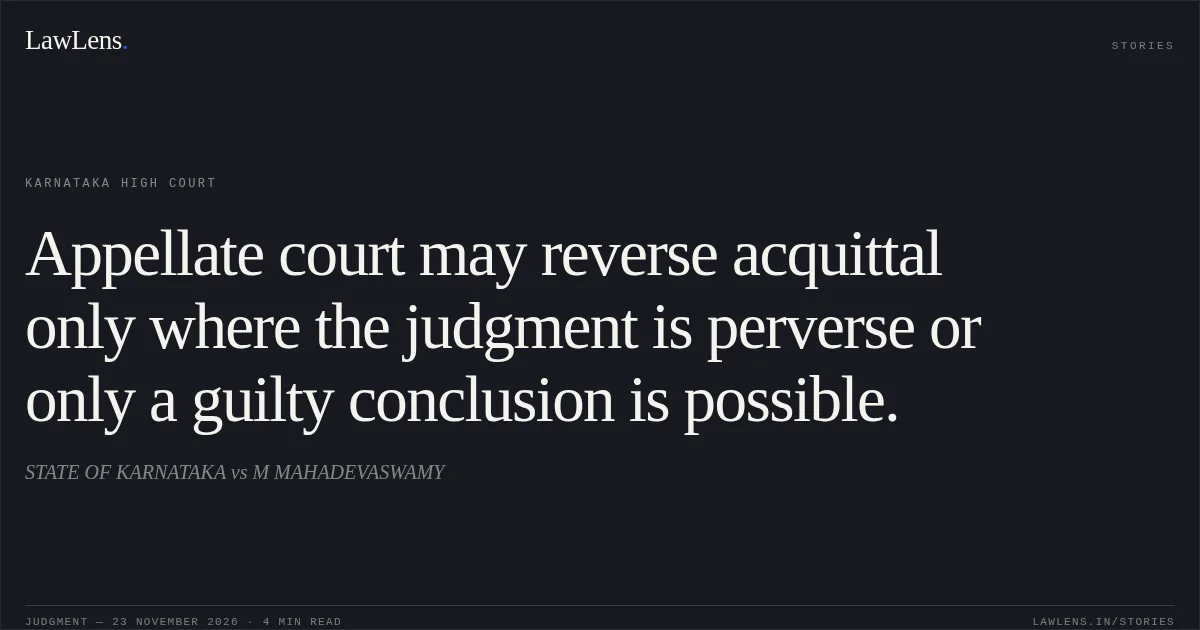
¶ 12The appellate court may re-appreciate the evidence, but it may interfere only where the trial court's view is not a possible one, and where the only reasonable conclusion on the evidence is proof of guilt beyond reasonable doubt.
¶ 12Interference requires patent perversity, misreading or omission to consider material evidence, or the absence of any reasonable view other than guilt.
¶ 12The court referred to Section 65B of the Indian Evidence Act, which governs admissibility of electronic records, as the basis for excluding the voice recording.
¶ 18The appellant relied on Section 20 PC Act, which concerns the presumption where gratification is accepted.
¶ 8Provisions in the judgment · 5 · Linked ones open on LawLens
Code of Criminal Procedure, 1973 Section 378Section 313
Prevention of Corruption Act, 1988 Section 7Section 13Section 20
04Reasoning
The court re-examined the entire record and held that the trial court committed no legal or factual error.
¶ 19The court accepted the trial court's findings that the shadow witness PW2 did not prove the demand and was hostile.
¶ 17, 18The court noted the conflict between PW1, PW5 and PW7 on the sequence of the sodium carbonate test relative to recovery of the currency notes.
¶ 18, 23The court agreed that the defence version, that the money was thrust into the accused's pocket, was rendered probable by this contradiction.
¶ 16, 24Applying the Chandrappa and H.D. Sundara standard, the court treated the trial court's view as a possible view on the evidence and did not find that the only reasonable conclusion was guilt.
¶ 12, 19The acquittal was sustained on the ground that the prosecution's core evidence of demand and acceptance was not clear, corroborative and consistent.
¶ 25The judgment does not separately discuss whether the voice recording could be admitted without a Section 65B certificate, nor does it address the Section 20 PC Act presumption raised by the appellant.
05Holding
The court answered Point No. 1 in the affirmative, holding that the Special Court was justified in acquitting the accused, and that the appellate court found no perversity or misreading of evidence warranting interference.
¶ 19, 11The appeal is dismissed, and the acquittal dated 15.05.2015 in Spl. C. No. 105/2012 stands.
¶ 20The Registry is directed to send a copy of the judgment along with the trial court records to the concerned court.
¶ 20Original Court PDF
STATE OF KARNATAKAvsM MAHADEVASWAMY
Click to open original judgment
Original judgment, available to read, download and summarize on LawLens.in



