Facts
The State of Gujarat appealed an acquittal order dated 12.06.2012 passed by the 4th (Ad-hoc) Additional Sessions Judge, Surat, in Sessions Case No. 6 of 2008
Source reference: p. 1The prosecution's case was initiated by a complaint from Rajubhai Laxmanbhai Mene, father of the deceased Punamben. It was alleged that the respondents subjected the deceased to physical and mental harassment, doubting her character and physically assaulting her, which led her to commit suicide by consuming poison on 22.09.2007
Source reference: p. 2The respondents were charged under Sections 498A, 323, 306, and 114 of the Indian Penal Code
Source reference: p. 2Issues
1. Whether the trial Court was justified in passing the judgment and order of acquittal based on the evidence on record
Source reference: p. 6 / para. 112. Whether the trial Court correctly appreciated the oral and documentary evidence led by the prosecution
Source reference: p. 6 / para. 113. Whether there is any manifest illegality, irregularity, or perversity in the impugned judgment
Source reference: p. 6 / para. 11Law Applied
The court applied Section 378(1)(3) of the Code of Criminal Procedure regarding appeals against acquittal
Source reference: p. 1Legally, it relied on the "double presumption" of innocence: first, the fundamental principle that an accused is innocent until proven guilty, and second, that an acquittal reinforces this presumption
Source reference: para. 13The court followed principles from Chandrappa v. State of Karnataka (2007), Rajesh Prasad v. State of Bihar (2022), and Babu Sahebagouda Rudragoudar v. State of Karnataka (2024), which establish that an appellate court should not disturb an acquittal if two reasonable views are possible and the trial court’s view is not perverse
Source reference: para. 15-16Reasoning
The High Court observed that the primary prosecution witnesses, including the father (PW-4) and brothers (PW-5, PW-6) of the deceased, failed to support the prosecution’s theory of cruelty or dowry demands
Source reference: para. 12PW-4 admitted in cross-examination that he had not mentioned the alleged demand for Rs. 50,000 in the FIR and that the deceased had never complained of ill-treatment prior to the incident
Source reference: para. 12Furthermore, it was admitted that the FIR was filed only after consultation with community leaders, and witness statements were recorded collectively after mutual consultation, undermining their reliability
Source reference: para. 12The court noted that a prior Accidental Death (A.D.) inquiry found no incriminating evidence against the respondents
Source reference: para. 12Consequently, the High Court found that the prosecution failed to establish the bridge between the alleged harassment and the act of suicide.
Source reference: no citationHolding
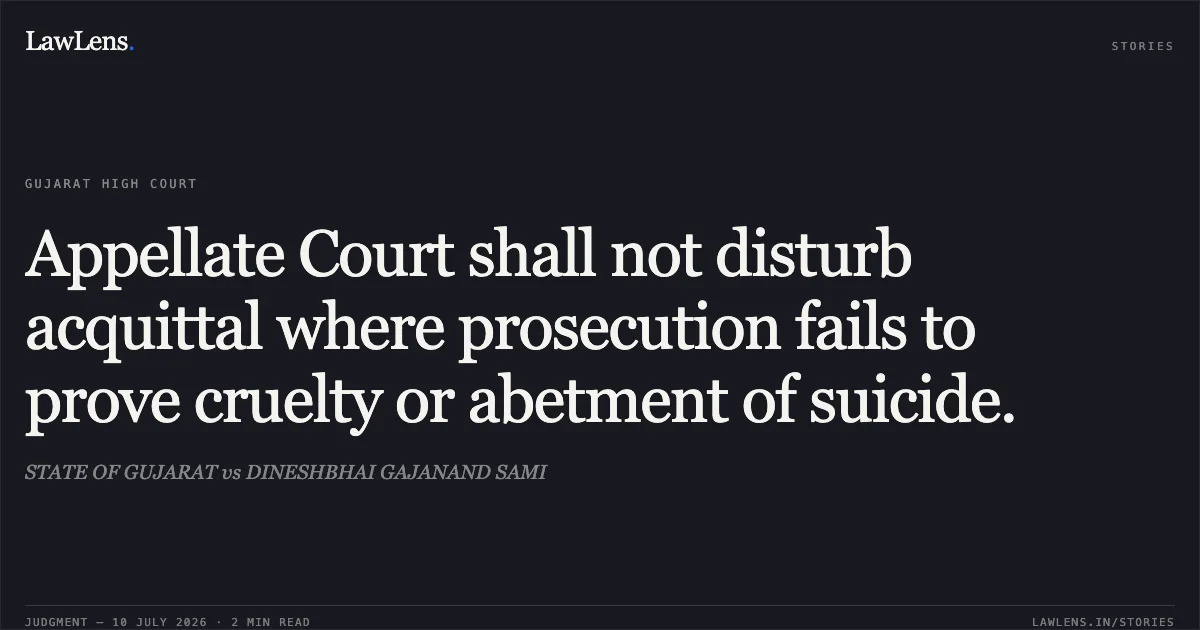
The High Court held that the prosecution miserably failed to prove the charges beyond a reasonable doubt
The court answered the issues in the negative regarding perversity, finding that the trial court's appreciation of evidence was cogent and well-reasoned
Source reference: para. 18The appeal by the State was dismissed, the judgment of acquittal was confirmed, and the bail bonds of the respondents were cancelled
Source reference: p. 12 / para. 19Acts & Sections Cited
6 provisions across 2 statutes referred to in this judgment. Each provision opens on LawLens.
Code of Criminal Procedure, 19733
Indian Penal Code, 18603
Original Court PDF
STATE OF GUJARATvsDINESHBHAI GAJANAND SAMI
Click to open original judgment
Original judgment, available to read, download and summarize on LawLens.in