Facts
On January 13, 2013, the informant (Sahil) and the victim (Saurabh) were returning from a nursery when some mud accidentally fell near the respondent’s house. It is alleged that the respondent abused Sahil, assaulted him with a stick (injuring his left elbow), and instigated a pet dog to bite Saurabh’s right knee
Source reference: para 2The Trial Court (JMFC Anuppur) acquitted the respondent of charges under Sections 294, 323, 324, and 506 of the IPC on July 20, 2017
Source reference: para 1The State filed this petition under Section 378(3) of the Cr.P.C. seeking leave to appeal, contending that the evidence was not appreciated in the proper perspective
Source reference: para 1, 3Issues
1. Whether the Trial Court’s findings were perverse or palpably wrong so as to warrant interference in an order of acquittal by the High Court.
Source reference: para 6, 92. Whether the prosecution proved the guilt of the accused beyond reasonable doubt in light of delayed FIR and lack of medical corroboration.
Source reference: para 5Law Applied
The Court applied the principles governing appeals against acquittal under Section 378 of the Cr.P.C.
Source reference: no citationRamesh Babulal Doshi v. State of Gujarat, which mandates that an appellate court must first determine if trial findings are "palpably wrong" or "manifestly erroneous" before disturbing an acquittal
Source reference: para 6Ajit Savant Majagvai v. State of Karnataka, establishing that the presumption of innocence is reinforced by an acquittal and that if two reasonable views exist, the one favoring the accused must be adopted
Source reference: para 7Nikhil Chandra Mondal v. State of W.B., affirming that interference is impermissible unless findings are impossible or illegal
Source reference: para 8Reasoning
The High Court observed that there was an unexplained delay of two days in lodging the FIR, despite the police station being only 10 km away
Source reference: para 5The medical testimony of the doctor failed to corroborate the injuries alleged by the complainant
Source reference: para 5The Court noted that the complainant was a tenant of the respondent’s brother-in-law and that there was a history of "previous enmity" between the parties, suggesting a motive for false implication
Source reference: para 5There were also material contradictions and omissions in the statements of the prosecution witnesses
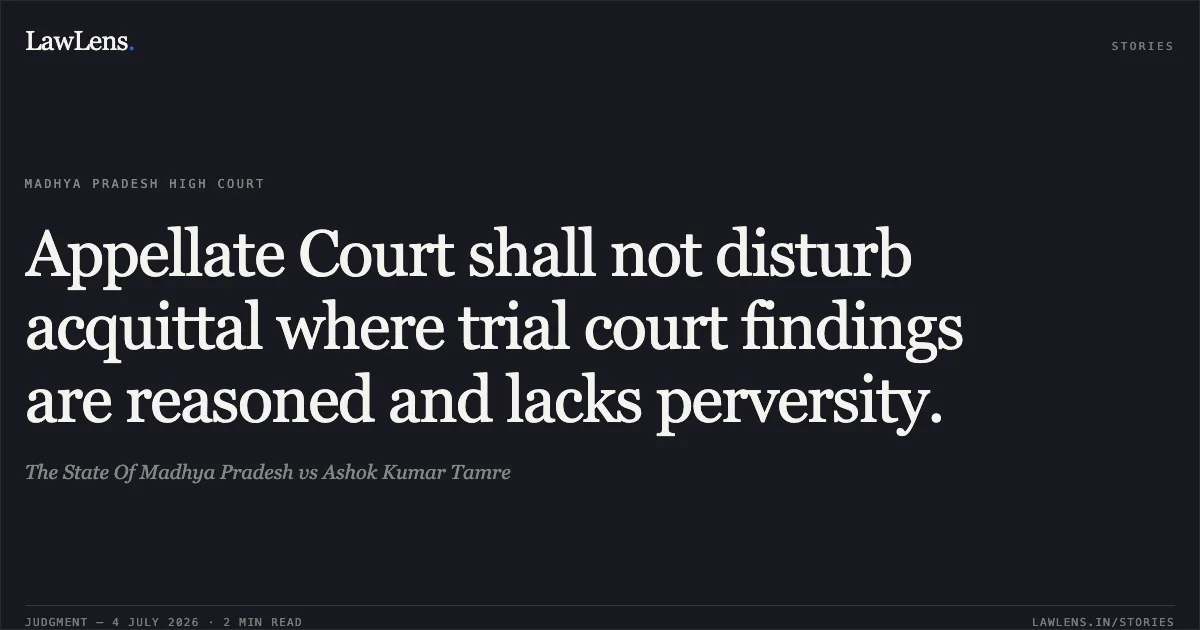
Source reference: para 5Applying the cited precedents, the Court found that the Trial Court had assigned "cogent reasons" for disbelieving the evidence and that the view taken by the trial court was a "reasonable" one that did not suffer from perversity
Source reference: para 5, 9Holding
The High Court answered both issues in the negative, holding that the prosecution failed to prove the charges beyond reasonable doubt and that the Trial Court's judgment was well-reasoned
The Court upheld the double presumption of innocence in favor of the respondent and found no illegality in the impugned judgment. Consequently, the petition was dismissed
Source reference: para 8, 9, 10Acts & Sections Cited
5 provisions across 2 statutes referred to in this judgment. Each provision opens on LawLens.
Code of Criminal Procedure, 19731
Indian Penal Code, 18604
Original Court PDF
The State Of Madhya PradeshvsAshok Kumar Tamre
Click to open original judgment
Original judgment, available to read, download and summarize on LawLens.in