Facts
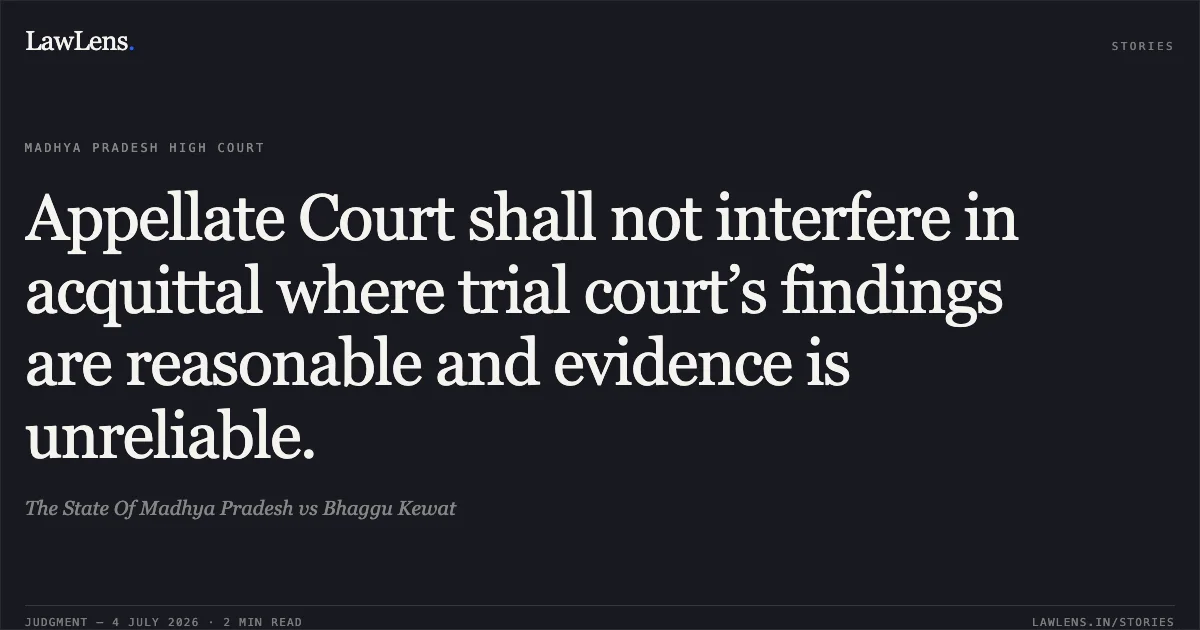
The State filed an application for leave to appeal under Section 378(3) of the CrPC against an order of acquittal dated August 24, 2017.
Source reference: para. 1The prosecution alleged that the respondent molested the victim on April 5, 2016; however, the FIR was not lodged until April 16, 2016.
Source reference: para. 2The trial court acquitted the respondent of charges under Section 354 of the IPC and Section 3(1)(b)(1) of the SC/ST (Prevention of Atrocities) Act.
Source reference: para. 3The State challenged this finding, arguing that the 11-day delay was justified by the death of the victim’s sister and that the evidence was sufficient for conviction.
Source reference: para. 3Issues
1. Whether the trial court committed a manifest error or perversity in its appreciation of evidence that warrants interference with the order of acquittal.
Source reference: para. 5-62. Whether the prosecution successfully explained the delay in filing the FIR and proved its case beyond a reasonable doubt.
Source reference: para. 5Law Applied
The court applied Section 378 of the CrPC regarding appeals against acquittal.
Source reference: para. 1Ramesh Babulal Doshi v. State of Gujarat mandates that an acquittal should not be disturbed unless the finding is "palpably wrong" or "manifestly erroneous".
Source reference: para. 6The court cited Ajit Savant Majagvai v. State of Karnataka and Nikhil Chandra Mondal v. State of W.B., establishing that the presumption of innocence is reinforced by an acquittal and that if two reasonable views are possible, the view favoring the accused must be adopted.
Source reference: para. 7-8Reasoning
The High Court observed that the prosecution failed to examine independent witnesses and provided no explanation for the two-day gap between the incident and the death of the victim's sister.
Source reference: para. 5The Court noted that the victim’s testimony appeared exaggerated and unreliable when compared to the trial record, which suggested the case was a "counterblast" or false report following a financial dispute involving the accused's grandson.
Source reference: para. 5Applying the principles of appellate review, the Court found that the trial court’s decision was based on "cogent reasons" and proper appreciation of evidence, meaning there was no illegality or perversity to justify reversing the acquittal.
Source reference: para. 9Holding
The Court held that there was no ground to interfere with the well-reasoned judgment of the trial court as the findings were neither perverse nor impossible.
The petition for leave to appeal was dismissed, affirming the acquittal of the respondent.
Source reference: para. 10Acts & Sections Cited
3 provisions across 3 statutes referred to in this judgment. Each provision opens on LawLens.
Code of Criminal Procedure, 19731
Indian Penal Code, 18601
Scheduled Castes and the Scheduled Tribes (Prevention of Atrocities) Act, 19891
Original Court PDF
The State Of Madhya PradeshvsBhaggu Kewat
Click to open original judgment
Original judgment, available to read, download and summarize on LawLens.in