Facts
The State of Madhya Pradesh appealed against the judgment dated July 26, 2017, passed by the JMFC, Goharganj, which acquitted the respondents of charges under Sections 341, 294, 323, and 506 Part-II of the IPC.
Source reference: para. 1The prosecution alleged that on April 23, 2016, the accused intercepted the victims at a wedding, used abusive language, and physically assaulted them—specifically alleging that accused Kalu bit the thumb of the complainant, Pappu.
Source reference: para. 2The trial court acquitted the accused due to material contradictions, lack of weapon recovery, and medical evidence contradicting ocular testimony.
Source reference: para. 9-10Issues
1. Whether the trial court committed a patent perversity or error of law in acquitting the accused despite the testimonies of injured witnesses.
Source reference: para. 6, 102. Whether the appellate court can interfere with an order of acquittal when the view taken by the trial court is a "possible view" based on the evidence on record.
Source reference: para. 11Law Applied
The court applied Section 378 of the Code of Criminal Procedure (CrPC), governing appeals against acquittal.
Source reference: para. 1Presumption of innocence is reinforced by an acquittal, and an appellate court should only interfere if the judgment is perverse, based on a misreading of evidence, or if no two reasonable views are possible, as established in H.D. Sundara v. State of Karnataka (2023) and Babu Sahebagouda Rudragoudar v. State of Karnataka (2024).
Source reference: para. 11-12Necessity of a comprehensive appreciation of evidence as cited in Mallappa v. State of Karnataka (2024).
Source reference: para. 15Reasoning
The High Court observed significant disparities between the prosecution's ocular evidence and the medical reports. While witnesses (PW-1, PW-2, PW-4) claimed the victim's thumb was "chewed" by the accused, the medical witness (PW-6) explicitly denied this possibility, stating the injury was a mere abrasion that could not be caused by a human bite.
Source reference: para. 8While witnesses alleged the use of stones and lathis, no such weapons were seized by the police.
Source reference: para. 9The court noted that the incident occurred during a wedding melee involving a mob, making the individual roles of the accused doubtful, especially since the complainant (PW-1) admitted he had never seen the accused before the incident.
Source reference: para. 9The court reasoned that since the trial court's findings were supported by a plausible interpretation of these contradictions, there was no ground for reversal under the restrictive scope of Section 378.
Source reference: para. 10, 16Holding
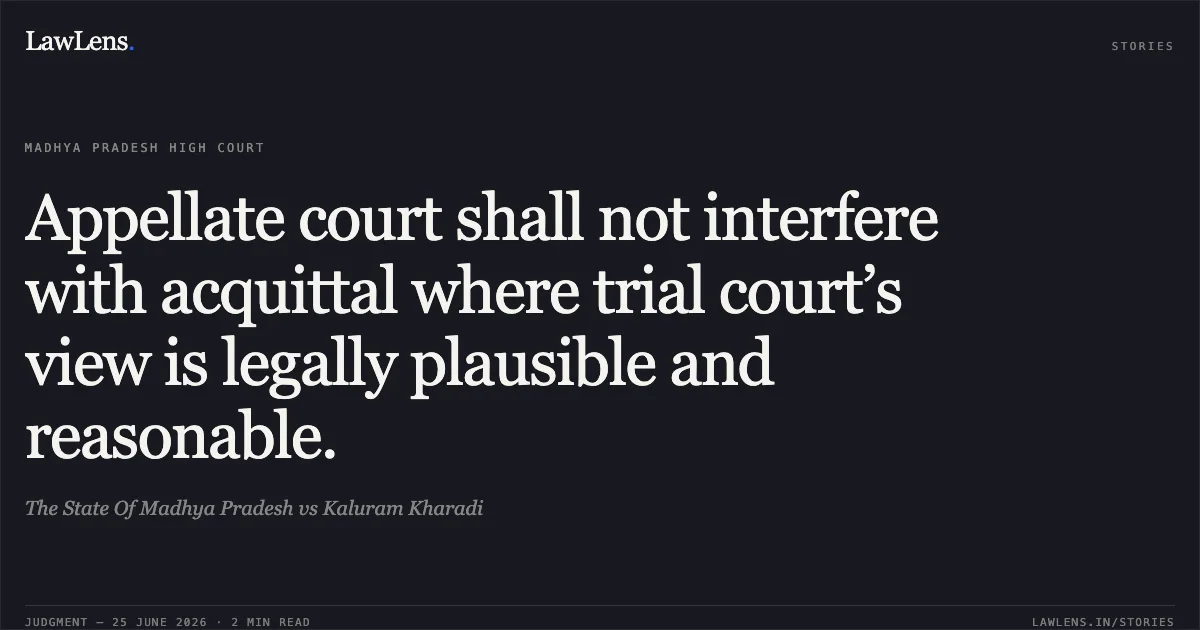
The High Court answered both issues in the negative and held that the trial court's view was legally plausible and not perverse.
The court affirmed the acquittal of the respondents and dismissed the State's appeal, ruling that an appellate court cannot substitute its own view for that of the trial court if the latter is a "possible view".
Source reference: para. 11, 17Acts & Sections Cited
6 provisions across 2 statutes referred to in this judgment. Each provision opens on LawLens.
Code of Criminal Procedure, 19732
Indian Penal Code, 18604
Original Court PDF
The State Of Madhya PradeshvsKaluram Kharadi
Click to open original judgment
Original judgment, available to read, download and summarize on LawLens.in