Facts
On 12 January 2008, Vivek Chhabra visited the Indo-Chin Bar, Lado Sarai, with friends.
Source reference: pp.1–2After the bar closed, an altercation occurred in the parking area involving Surinder Singh, who was sitting in a car owned by Mayank Lakhani.
Source reference: pp.1–2According to Chhabra, Singh fired a pistol first in the air and then at his leg.
Source reference: pp.1–2A police investigation followed the recording of Chhabra’s statement and registration of FIR No. 39/2008 under Section 307 IPC and Section 27 of the Arms Act.
Source reference: pp.1–2Singh was arrested, and a pistol, five live cartridges, and its licence were seized.
Source reference: pp.1–2The prosecution examined 16 witnesses.
Source reference: pp.2, 5Of the six cited eyewitnesses, only Nand Kishore, Vivek Chhabra, and Mayank Lakhani claimed to have witnessed the incident; the remaining public witnesses did not support the prosecution’s version.
Source reference: pp.2, 5The Trial Court found material contradictions in the eyewitness testimony and acquitted Singh of the offences under Sections 307 IPC and 27 of the Arms Act on 3 October 2011.
Source reference: pp.2–3The State preferred the present appeal against acquittal.
Source reference: pp.2–3Issues
Whether the Trial Court’s acquittal of the respondent under Section 307 IPC was sustainable despite the complainant’s allegation that the respondent intentionally fired at his leg?
Source reference: paras. 15–24; pp.5–12Whether the prosecution proved beyond reasonable doubt that the respondent used his licensed firearm in contravention of the Arms Act so as to attract Section 27 of the Arms Act?
Source reference: paras. 9, 23–24; pp.2–3, 11–12Whether the appellate court, in an appeal against acquittal under Section 378 CrPC, could interfere with the Trial Court’s view merely because another view of the evidence was possible?
Source reference: paras. 11–12; pp.3–5Law Applied
The Court considered Section 378 CrPC governing appeals against acquittal, and Sections 307 IPC and 27 of the Arms Act, which require proof of the requisite intent and of the accused’s unlawful use of the firearm, respectively.
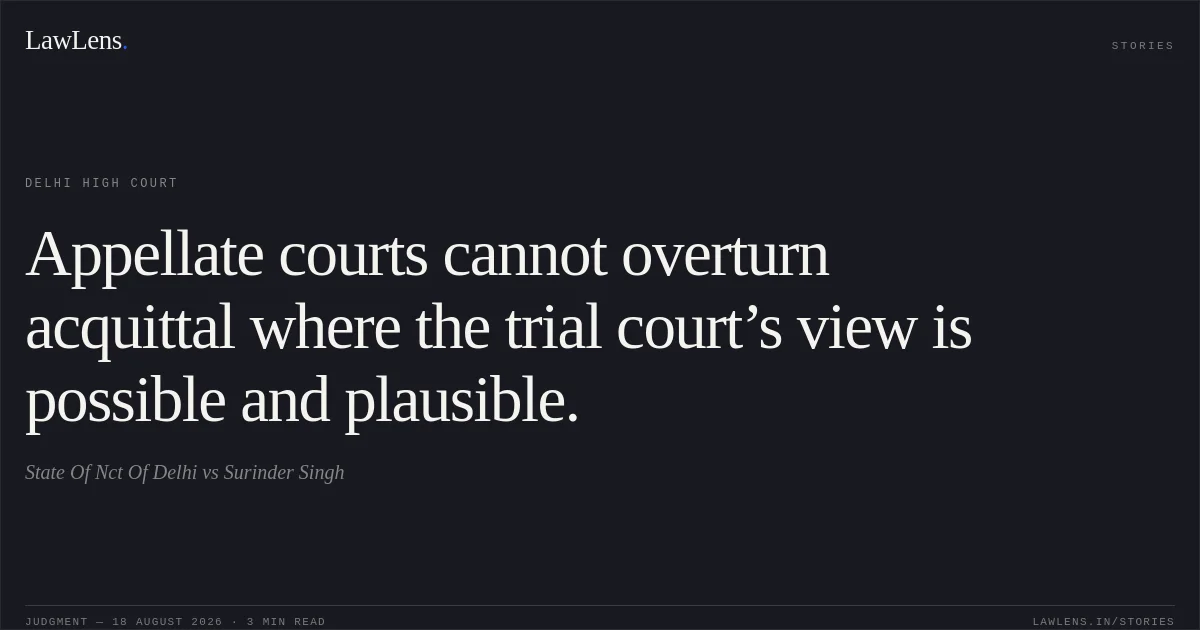
Source reference: paras. 2, 7, 9Relying on H.D. Sundara v. State of Karnataka, (2023) 9 SCC 581, the Court reiterated that an acquittal strengthens the presumption of innocence; an appellate court may reappreciate the evidence but cannot reverse an acquittal if the Trial Court’s view is a possible and plausible one.
Source reference: para. 11; pp.3–4Interference is justified only where the evidence admits of the sole conclusion that guilt was proved beyond reasonable doubt.
Source reference: para. 11; pp.3–4The Court also noted the Trial Court’s advantage in observing witness demeanour while recording testimony.
Source reference: para. 12; p.4Reasoning
The Court held that the prosecution evidence disclosed two materially inconsistent accounts.
Source reference: paras. 16–17; pp.5–6Chhabra alleged that Singh deliberately fired at him, whereas independent eyewitness Nand Kishore stated that the pistol was snatched from Singh during a scuffle and that the shot was fired during the ensuing struggle.
Source reference: paras. 16–17; pp.5–6Lakhani’s testimony was closer to Nand Kishore’s version, as he stated that Chhabra was grappling with Singh and that Singh was attempting to recover the pistol.
Source reference: para. 18; pp.6–7The other public witnesses did not witness the shooting and did not support the prosecution case.
Source reference: para. 14; p.5The medical evidence also did not conclusively establish an injury sufficient to cause death in the ordinary course of nature; the injury was below the knee and the doctor ultimately accepted that the injury in the present case could not itself have caused death.
Source reference: para. 21; p.7Since the evidence did not reliably establish that Singh fired the shot causing Chhabra’s injury, the prosecution failed to prove the ingredients of Section 307 IPC beyond reasonable doubt.
Source reference: paras. 9, 23–24; pp.2–3, 11–12For the same reason, it could not prove that Singh used the firearm in contravention of the Arms Act, notwithstanding the seizure of the licensed pistol.
Source reference: paras. 9, 23–24; pp.2–3, 11–12The Trial Court’s view was therefore a possible and plausible view, attracting the restriction on appellate interference in an appeal against acquittal.
Source reference: para. 24; p.11Holding
The Delhi High Court answered the issues against the State.
It held that the prosecution failed to establish beyond reasonable doubt that Surinder Singh intentionally fired at Vivek Chhabra or that he used the firearm in contravention of the Arms Act.
Source reference: paras. 23–24; pp.11–12The Trial Court’s acquittal under Sections 307 IPC and 27 of the Arms Act was found to be neither perverse nor legally unsustainable.
Source reference: paras. 23–24; pp.11–12Accordingly, the State’s appeal was dismissed, and the respondent’s acquittal was affirmed.
Source reference: para. 25; p.12Acts & Sections Cited
6 provisions across 3 statutes referred to in this judgment. Each provision opens on LawLens.
Indian Penal Code, 18601
Arms Act, 19592
Code of Criminal Procedure, 19733
Original Court PDF
State Of Nct Of DelhivsSurinder Singh
Click to open original judgment
Original judgment, available to read, download and summarize on LawLens.in