Facts
Devinder Singh, who had established various family-owned companies, LLPs and trusts, died on 05.12.2009. His widow, Sita Chaudhary, claimed succession under a Will dated 26.03.2004, while competing claims were based on a subsequent Will dated 04.10.2008 and intestacy.
Source reference: paras. 4–5Between December 2018 and June 2019, Sita Chaudhary transferred substantial shareholding and LLP interests to her granddaughter, Suna Nina Singh, and related parties. She also sold a farmhouse and advanced substantial interest-free loans, which were allegedly used to acquire various properties and assets.
Source reference: paras. 5–6Sita Chaudhary subsequently instituted CS(OS) No. 589 of 2021, alleging that Suna Nina Singh and Ajay Kadyan had procured the transfers through fraud and undue influence exercised upon her as an elderly widow, and sought cancellation of the transfers, restoration of the shareholding and LLP interests, and restraint against alienation of the disputed properties.
Source reference: para. 8The learned Single Judge initially directed maintenance of status quo and, by order dated 29.07.2022, granted an interim injunction restraining alienation of the properties, shareholding and LLP interests in question.
Source reference: paras. 9–11The defendants appealed under Order XLIII Rule 1(r) of the Code of Civil Procedure, 1908. By judgment dated 20.03.2026, the Division Bench set aside the injunction, holding, inter alia, that the Single Judge had inadequately assessed the Will, the plaintiff’s conduct, Section 89 of the Companies Act, 2013, and the alleged nexus between the disputed transfers and the properties restrained.
Source reference: paras. 12–14Issues
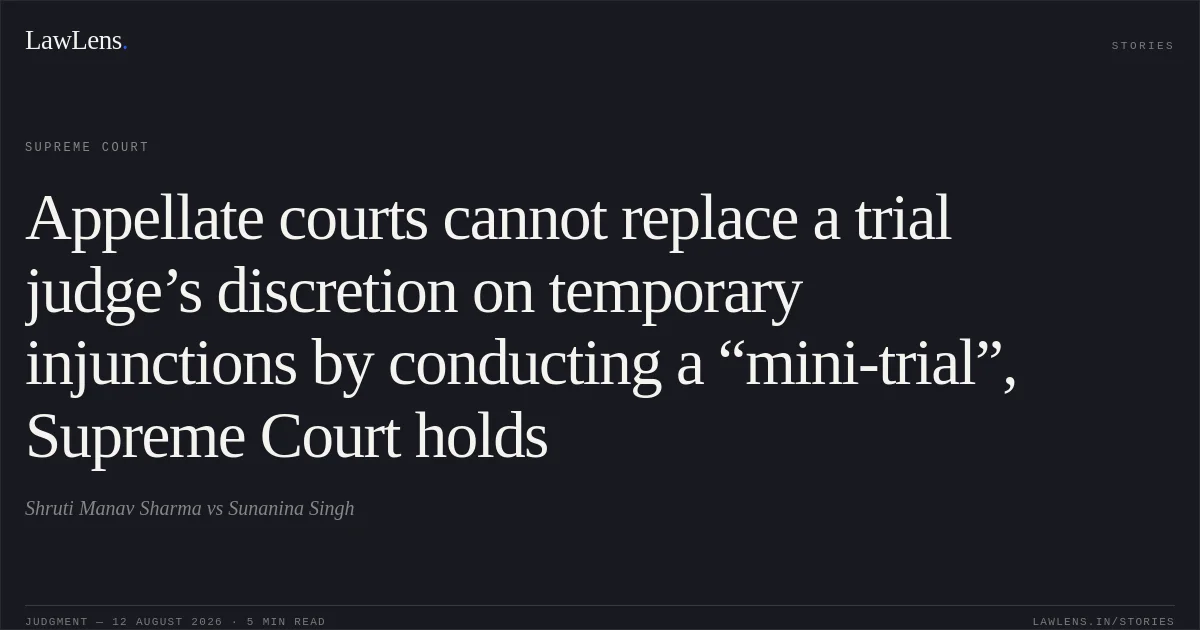
Whether the Division Bench, while exercising appellate jurisdiction under Order XLIII Rule 1(r) of the Code, was justified in substituting its own view for the discretionary order of the learned Single Judge granting a temporary injunction.
Source reference: para. 2Whether the learned Single Judge had correctly found a prima facie case, balance of convenience and irreparable injury warranting interim protection of the disputed shareholding, LLP interests and properties.
Source reference: paras. 23–35Whether the Division Bench impermissibly conducted a merits-based mini-trial concerning the Wills, undue influence, Section 14 of the Hindu Succession Act, 1956, Section 89 of the Companies Act, 2013, and the alleged source of acquisition of the properties.
Source reference: paras. 27, 36–40Law Applied
Temporary injunction jurisdiction, though statutory in form, is equitable in substance and is governed by Sections 36 and 37 of the Specific Relief Act, 1963, Order XXXIX Rules 1 and 2, and Sections 94(c) and 151 of the Code of Civil Procedure.
Source reference: para. 17The applicant must establish the settled trinity of a prima facie case, balance of convenience and irreparable injury; a prima facie case means a substantial and bona fide question requiring trial, not proof of title at the interlocutory stage, as stated in Dalpat Kumar v. Prahlad Singh, Gujarat Bottling Co. Ltd. v. Coca Cola Co., and Anand Prasad Agarwal v. Tarkeshwar Prasad.
Source reference: paras. 24–26The purpose of interim relief is to preserve the subject matter and prevent the eventual decree from becoming ineffectual, as recognised in American Cyanamid Co. v. Ethicon Ltd., Wander Ltd. v. Antox India (P) Ltd., and Zenit Mataplast Pvt. Ltd. v. State of Maharashtra.
Source reference: paras. 20–22In an appeal against a discretionary injunction order, the appellate court must not substitute its own discretion merely because another view is possible; interference is warranted only where the discretion is arbitrary, capricious, perverse, mala fide, based on irrelevant considerations, or contrary to settled legal principles, in accordance with Wander Ltd. and subsequent authorities.
Source reference: para. 36Courts should also avoid conducting a mini-trial or deciding disputed questions of fact and difficult questions of law at the interlocutory stage.
Source reference: paras. 37–40Reasoning
The Supreme Court held that the plaintiff’s claim raised serious, non-frivolous questions concerning the nature of her interest under the 26.03.2004 Will, the effect of the subsequently propounded Will, and whether the transfers were procured through undue influence while she was an elderly widow residing with the defendants. These issues established a prima facie case without requiring a final determination of title or validity.
Source reference: para. 27The disputed shareholding, LLP interests and properties constituted the subject matter of the suit, and their further alienation could create third-party rights incapable of being effectively undone by a later decree.
Source reference: para. 23The balance of convenience therefore favoured preservation, particularly because the defendants remained free to possess and enjoy the assets, while the injunction did not entirely halt business activity, including the permitted sale of developed plots by defendant No. 13.
Source reference: para. 30The potential loss of controlling shareholding and specific properties was also irreparable and not adequately compensable by damages.
Source reference: paras. 33–34The Single Judge’s order was consequently a reasoned exercise of discretion based on the settled principles. The Division Bench, however, re-examined the Will, the plaintiff’s admissions and delay, Section 89 of the Companies Act, and the traceability of funds to particular properties, thereby undertaking a merits-based mini-trial and substituting its own appreciation for that of the Single Judge.
Source reference: paras. 36–40Such interference exceeded the restricted appellate jurisdiction under Order XLIII Rule 1(r).
Source reference: paras. 36–40Holding
The appeals were allowed. The Supreme Court set aside the Division Bench judgment dated 20.03.2026 and restored the Single Judge’s interim injunction dated 29.07.2022.
The interim injunction restrained creation of third-party interests in the properties of defendant Nos. 13 to 17 and restrained defendant Nos. 4 and 9 from transferring or encumbering the specified properties, subject to the exception permitting defendant No. 13 to sell or transfer developed plots in Madhuban Colony.
Source reference: para. 41(a); see also para. 11The Court clarified that its findings were confined to the existence of a serious dispute requiring trial and expressed no final opinion on the Wills, succession, undue influence, fraud, Section 14 of the Hindu Succession Act, Section 89 of the Companies Act, or the alleged self-acquisition of the properties.
Source reference: para. 41(b)–(c)The injunction was to continue until further orders of the learned Single Judge; the appellants were directed to maintain or renew their undertaking as to damages, and the suit was directed to be disposed of expeditiously, preferably within eight months.
Source reference: para. 41(d)–(e)Acts & Sections Cited
6 provisions across 4 statutes referred to in this judgment. Each provision opens on LawLens.
Hindu Succession Act, 19561
Companies Act, 20131
Specific Relief Act, 19632
Code of Civil Procedure, 19082
Original Court PDF
Shruti Manav SharmavsSunanina Singh
Click to open original judgment
Original judgment, available to read, download and summarize on LawLens.in