Facts
The State challenged the trial court’s acquittal of Gajanand Sen of offences under Sections 376, 450 and 506 of the IPC.
Source reference: para. 4The prosecution alleged that, on 12 March 2020, the respondent sexually assaulted the complainant while she was attending a marriage function and threatened her against disclosing the incident.
Source reference: para. 4–9She reported the incident on 31 March 2020, after returning home and later informing her husband.
Source reference: para. 4–9The trial court acquitted the respondent after assessing the testimony and other evidence; the State sought leave to appeal against that acquittal.
Source reference: para. 4–9The High Court condoned a 31-day delay and considered the matter at the admission stage.
Source reference: para. 1–3Issues
1. Whether the trial court’s assessment of the complainant’s testimony and the corroborative evidence was perverse so as to warrant interference with the acquittal
Source reference: para. 12–192. Whether the acquittal disclosed an error meeting the threshold for appellate interference and leave to appeal
Source reference: para. 20–21Law Applied
The Court applied the principles in Santosh Prasad v. State of Bihar, 2020 (3) SCC 443, that a complainant’s testimony may sustain a conviction without corroboration if it is of sterling quality, but material inconsistencies or deficiencies may prevent reliance on it without supporting evidence.
Source reference: para. 17It also relied on Nirmal Premkumar v. State represented by Inspector of Police, (2024) 20 SCC 293, which states that where a witness is neither wholly reliable nor wholly unreliable, the court must assess the true genesis of the incident and may act on a victim’s testimony alone only where its quality and credibility are exceptionally high and it remains consistent in material respects.
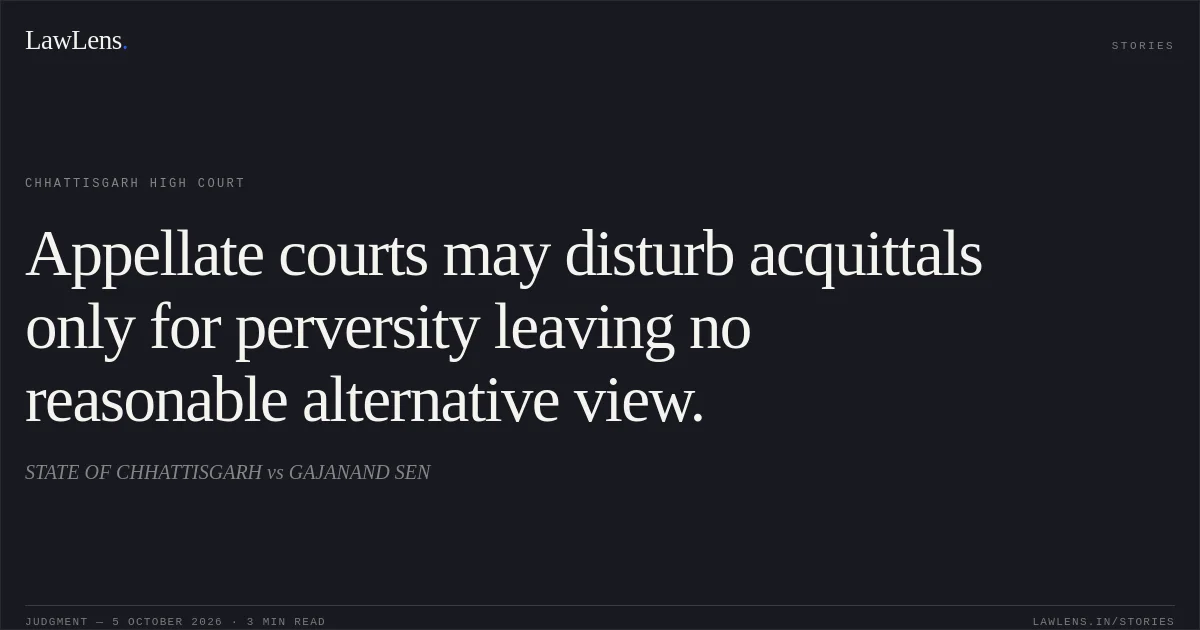
Source reference: para. 18Under Constable 907 Surendra Singh v. State of Uttarakhand, 2025 INSC 11410, interference with an acquittal is warranted only where the decision suffers from patent perversity, misreads or omits material evidence, and no two reasonable views are possible.
Source reference: para. 20The prosecution had charged the respondent under Sections 376, 450 and 506 of the IPC.
Source reference: para. 4Reasoning
The High Court considered the complainant’s evidence alongside her delay in disclosure, the evidence of her husband and sister-in-law, and the medical and forensic material.
Source reference: para. 14–16, 19It noted that she did not raise an alarm or otherwise resist during the alleged incident and did not disclose it for about 20 days, including to family members with whom she lived; her husband’s evidence was that he learned of the alleged relationship from others before questioning her.
Source reference: para. 14–16, 19The medical examination found no external injuries and gave no definite opinion on rape or intercourse; although human sperm was found on the victim’s slide, there was no matching report attributing it to the respondent.
Source reference: para. 6, 19On that record, the Court accepted the trial court’s view that the complainant’s testimony was not of sterling quality and that the evidence did not establish the respondent’s identity as the perpetrator.
Source reference: para. 19–21It found no perversity or other basis meeting the threshold for appellate interference.
Source reference: para. 19–21Holding
The Court held that the trial court’s acquittal was neither perverse nor affected by a patent illegality, misappreciation of evidence or manifest error of law.
It declined to grant leave to appeal and dismissed the CRMP in limine, without notice to the respondent.
Source reference: para. 21–22Acts & Sections Cited
4 provisions across 2 statutes referred to in this judgment. Each provision opens on LawLens.
Indian Penal Code, 18603
Code of Criminal Procedure, 19731
Original Court PDF
STATE OF CHHATTISGARHvsGAJANAND SEN
Click to open original judgment
Original judgment, available to read, download and summarize on LawLens.in