Facts
The Petitioner, a company purchasing diesel from Respondent No. 2, issued three cheques for Rs. 1,13,176/- each in September 2017.
Source reference: para. 6(i)-(ii)These cheques were dishonored for "Funds Insufficient," leading to three complaints under Section 138 of the Negotiable Instruments (NI) Act.
Source reference: para. 6(ii)-(iv)The Trial Court convicted the Petitioner, sentencing him to three months' imprisonment and a fine of Rs. 1,60,000/- per case.
Source reference: para. 6(v)During the appeal, the Petitioner deposited the full fine amount (Rs. 1,60,000/-) and later applied for acquittal, offering additional sums to settle the matter.
Source reference: para. 6(vi)-(viii)The Appellate Court rejected the applications because the complainant refused to consent to the compounding, citing insufficient compensation.
Source reference: para. 3, 6(ix)Issues
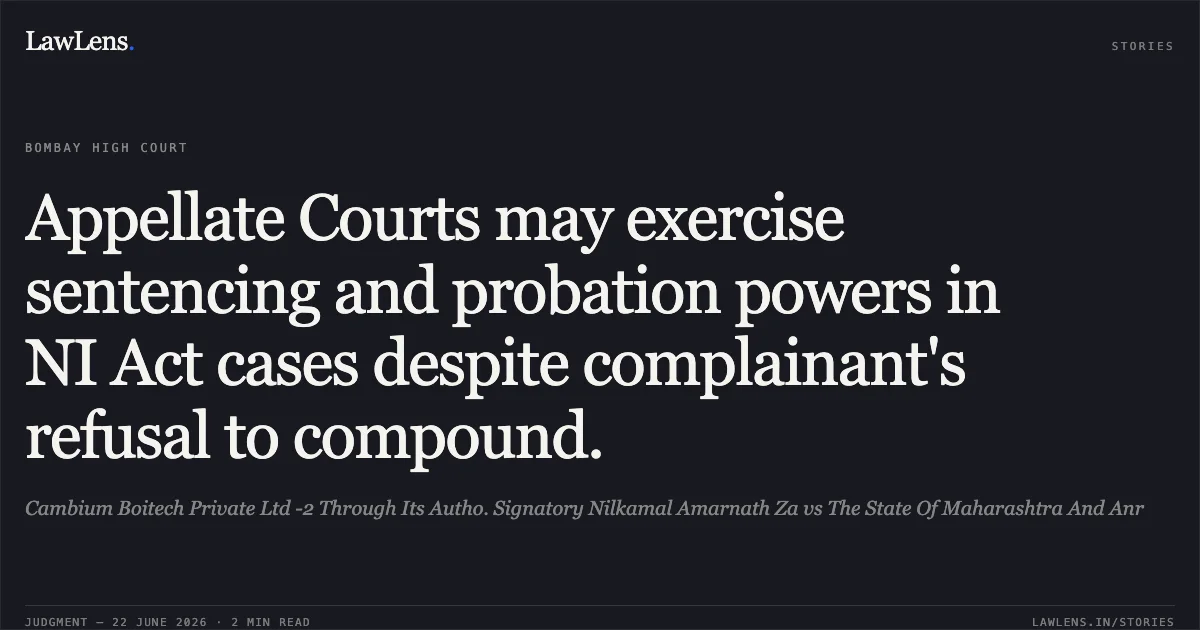
1. Whether an Appellate Court can exercise powers to acquit or grant relief under the Probation of Offenders Act when the complainant refuses to consent to compounding under the NI Act.
Source reference: para. 9-112. Whether the modified compounding guidelines established by the Supreme Court apply to proceedings at the appellate stage.
Source reference: para. 11Law Applied
Section 138 of the Negotiable Instruments Act, 1981, regarding the penalties for cheque dishonor.
Source reference: para. 5Supreme Court precedent in Damodar S. Prabhu v. Sayed Babalal H. (2010), which established graded costs for compounding.
Source reference: para. 8Supreme Court decision in Sanjabij Tari v. Kishore S. Borcar (2025), which modified the compounding guidelines.
Source reference: para. 9Section 255(2) and 255(3) of the Cr.P.C. (or Section 278 of the BNSS, 2023) regarding sentencing upon a plea of guilt, and the provisions of the Probation of Offenders Act, 1958.
Source reference: para. 9-11Reasoning
The Court reasoned that while Section 138 of the NI Act allows for imprisonment and heavy fines, the primary objective is compensatory.
Source reference: para. 5, 9Following Sanjabij Tari, the Court noted that if an accused is willing to pay the cheque amount plus specified costs (7.5% at the appellate stage), the court has the discretion to act even if the complainant withheld consent.
Source reference: para. 9-10The Court clarified that the directions in Sanjabij Tari—suggesting a plea of guilt followed by the exercise of discretionary sentencing powers or the benefit of the Probation of Offenders Act—are not restricted to the Magistrate but are equally applicable to the Appellate Court.
Source reference: para. 11The Court found that the lower court erred by rejecting the applications solely on the basis of the complainant's lack of consent without considering these judicial guidelines.
Source reference: para. 11-12Holding
The High Court quashed the impugned orders and restored the applications for reconsideration, holding that the Appellate Court must apply the principles of Sanjabij Tari.
The Petitioner was directed to deposit an additional Rs. 30,000/- per appeal; and if the Petitioner pleads guilty, the Appellate Court should consider exercising powers under Section 255 Cr.P.C. or the Probation of Offenders Act, while ensuring the complainant receives the deposited amounts as compensation.
Source reference: para. 12(ii)-(iv)Acts & Sections Cited
5 provisions across 3 statutes referred to in this judgment. Each provision opens on LawLens.
Negotiable Instruments Act, 18811
Code of Criminal Procedure, 19733
Bharatiya Nagarik Suraksha Sanhita, 20231
Original Court PDF
Cambium Boitech Private Ltd -2 Through Its Autho. Signatory Nilkamal Amarnath ZavsThe State Of Maharashtra And Anr
Click to open original judgment
Original judgment, available to read, download and summarize on LawLens.in