Facts
The appellant was convicted by the Special Judge, (PC Act) (CBI)-18, Rouse Avenue Courts, New Delhi, for offences under Sections 120-B read with Sections 302, 307 and 398 IPC, and Sections 302, 307, 398 and 201 IPC, along with Sections 25 and 27 of the Arms Act.
Source reference: p.1He was sentenced to life imprisonment for the offences relating to conspiracy and murder, with the remaining sentences to run concurrently.
Source reference: pp.2–3The prosecution alleged that, on 13 April 2015, the appellant and his co-accused followed the deceased, Ankit Chauhan, and his friend Gagan Dudhoria in a Toyota Fortuner, attempted to rob the vehicle, and fired several shots at them.
Source reference: pp.3–6Ankit Chauhan sustained gunshot injuries and subsequently died.
Source reference: pp.3–6The investigation was transferred from the Uttar Pradesh Police to the CBI pursuant to an order of the Allahabad High Court, and the trial was later transferred to Delhi by the Supreme Court.
Source reference: pp.4–6The appellant sought suspension of sentence under Section 430 of the Bharatiya Nagarik Suraksha Sanhita, 2023, during the pendency of his appeal.
Source reference: p.1He had remained in custody for approximately eight years and eleven months, had satisfactory jail conduct, and had no serious criminal antecedents apart from proceedings under the Negotiable Instruments Act, 1881.
Source reference: para.49The prosecution principally relied on Gagan Dudhoria, the sole surviving eyewitness, CCTV footage, evidence concerning preparation of fake number plates, and other corroborative material.
Source reference: paras.50–62Issues
Whether the appellant’s sentence ought to be suspended during the pendency of his criminal appeal, notwithstanding his conviction for offences including murder and life imprisonment?
Source reference: paras.47–49, 75–83Whether the inconsistencies between the eyewitness account and the medical/scientific evidence, together with the length of incarceration and the likely delay in hearing the appeal, justified interim release?
Source reference: paras.63–76If suspension of sentence were granted, what conditions were necessary to protect the administration of justice, the witnesses, and societal interests?
Source reference: paras.79–83Law Applied
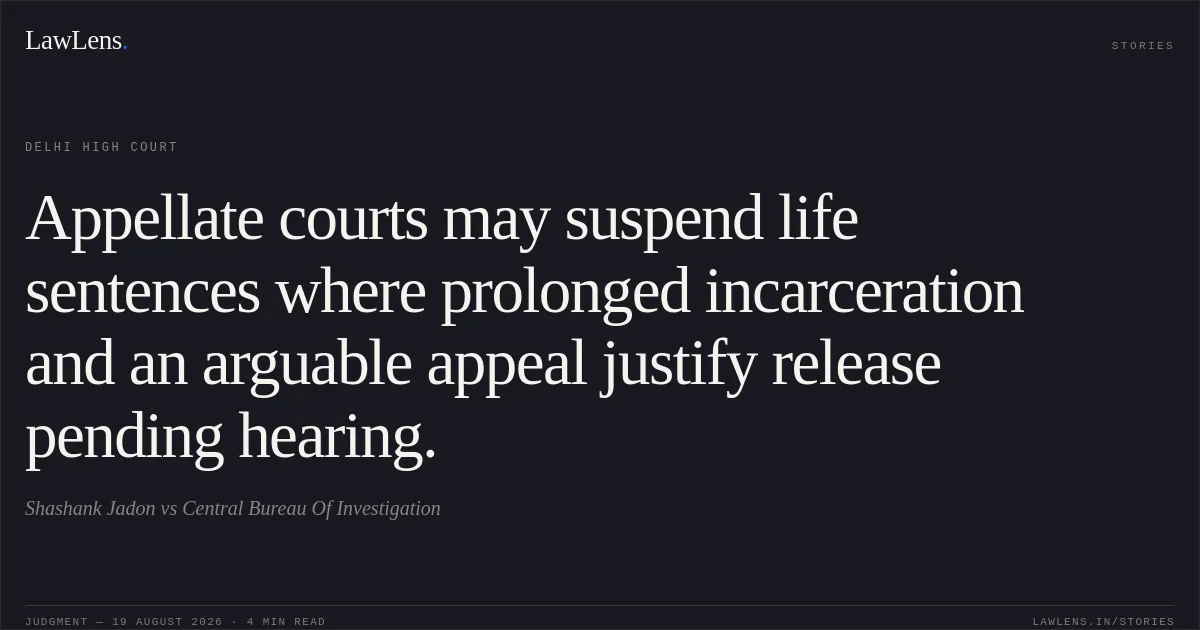
The Court exercised its appellate power under Section 430 of the Bharatiya Nagarik Suraksha Sanhita, 2023, corresponding to Section 389 of the Code of Criminal Procedure, to suspend the execution of the sentence during the pendency of an appeal.
Source reference: paras.2, 47The Court relied on Kashmira Singh v. State of Punjab, (1977) 4 SCC 291, which holds that the rule against releasing a person sentenced to life imprisonment cannot operate rigidly where the appeal is unlikely to be heard within a reasonable time and prolonged incarceration may cause serious injustice.
Source reference: para.79It also relied on Afjal Ansari v. State of Uttar Pradesh, (2024) 2 SCC 187, recognising that appellate courts must balance the convict’s rights against societal interest and may grant relief where continued operation of the conviction or sentence may produce irreparable consequences.
Source reference: para.80The Court further considered the principle that medical and ballistic evidence must be consistent with the prosecution’s account of the manner and distance of firing; material contradictions may create a prima facie doubt regarding the prosecution case, as illustrated by Pankaj v. State of Rajasthan, (2016) 16 SCC 192.
Source reference: paras.65–67Suspension of sentence does not amount to a final finding on the appellant’s innocence or guilt.
Source reference: para.78Reasoning
The Court found that the eyewitness, Gagan Dudhoria, alleged that the appellant fired the shots from a distance, including shots that first passed through the vehicle’s windscreen or window before striking the deceased.
Source reference: paras.56–59, 68–69However, the post-mortem report recorded blackening around several gunshot injuries, a circumstance which, according to the medical and forensic material relied upon by the appellant, was generally associated with firing from a comparatively close range.
Source reference: paras.63–69This inconsistency raised a prima facie question regarding the precise manner and distance of firing.
Source reference: paras.63–69The Court also noted that the deceased’s father had, in the earlier writ petition seeking transfer of investigation, expressed suspicion regarding the eyewitness and the deceased’s wife, and had alleged that the possibility of a pre-planned murder had not been properly investigated.
Source reference: paras.70–72Further, the appellant’s claim that he was in Faridabad at the relevant time could potentially be tested through call-detail records, although it was unclear whether those records had been fully produced and analysed at trial.
Source reference: paras.73–74These matters were not treated as a final assessment of the appeal, but they demonstrated that the appeal was not wholly devoid of merit and required deeper examination.
Source reference: para.82Against this prima facie uncertainty, the Court considered the appellant’s age at the time of the incident, his nearly nine years of incarceration, satisfactory conduct, lack of serious antecedents, prior compliance with bail orders, educational background, family circumstances, and the likelihood that the appeal would take several years to reach final hearing.
Source reference: paras.48–49, 75–81Balancing these factors against the seriousness of the offence and societal concerns, the Court considered suspension of sentence appropriate, subject to stringent safeguards.
Source reference: para.83Holding
The Court allowed the application and suspended the appellant’s sentence during the pendency of the appeal.
The appellant was directed to be released on a personal bond of ₹1 lakh with one surety of the same amount, subject to conditions including surrender of his passport, furnishing his address and mobile number, not leaving India without permission, reporting monthly to the CBI, refraining from criminal activity, and not contacting the deceased’s family or any prosecution witness.
Source reference: para.83The Court clarified that its observations were confined to the suspension-of-sentence application and would not affect the final adjudication of the criminal appeal.
Source reference: para.85The appeal was directed to be listed in due course.
Source reference: para.88Acts & Sections Cited
10 provisions across 4 statutes referred to in this judgment. Each provision opens on LawLens.
Bharatiya Nagarik Suraksha Sanhita, 20231
Indian Penal Code, 18605
Arms Act, 19592
Code of Criminal Procedure, 19732
Original Court PDF
Shashank JadonvsCentral Bureau Of Investigation
Click to open original judgment
Original judgment, available to read, download and summarize on LawLens.in