01Facts
The applicant was convicted in Case No. SC/NIA/12972/2007 and subsequently filed an appeal along with an application for suspension of sentence under the BNSS.
¶ 2On 11.03.2026, the appellate court suspended the sentence on the condition that the applicant deposit 25% of the compensation amount as per Section 148 of the Negotiable Instruments (NI) Act, 1881.
¶ 2The applicant deposited Rs. 62,500/- but sought an extension of time for the balance, citing his age (66 years), medical ailments, and financial hardship.
¶ 2The appellate court rejected the extension on 22.04.2026, and consequently, the Trial Court (JMFC) cancelled the applicant's bail bonds and issued an arrest warrant on 25.04.2026.
¶ 2The applicant moved the High Court under Section 528 of the BNSS to quash these orders.
¶ 102Issues
i.1. Whether the appellate court was justified in strictly enforcing the 25% deposit condition and denying an extension of time without considering the applicant's exceptional circumstances
¶ 5ii.2. Whether the consequential cancellation of bail bonds and issuance of an arrest warrant by the JMFC was legally sustainable in light of the applicant's partial compliance and bona fide intentions
¶ 3, 603Law Applied
Section 148 of the Negotiable Instruments Act, 1881, which grants appellate courts the power to order a deposit of a minimum of 20% of the fine or compensation.
¶ 2, 5Jamboo Bhandari v. M.P. State Industrial Development Corporation Ltd. (2023) 10 SCC 446, which clarified that the deposit under Section 148 is a discretionary power and not an inflexible rule; exceptional circumstances may justify a relaxation or waiver of this condition.
¶ 3, 5Section 528 of the Bharatiya Nagarik Suraksha Sanhita (BNSS), 2023.
¶ 1Provisions in the judgment · 4 · Linked ones open on LawLens
Bharatiya Nagarik Suraksha Sanhita, 2023 Section 528Section 415Section 430
Negotiable Instruments Act, 1881 Section 148
04Reasoning
The High Court observed that while the initial order to deposit 25% was lawful, the power under Section 148 of the NI Act is discretionary rather than mandatory in every circumstance.
¶ 5The court found that the appellate court, in its order dated 22.04.2026, failed to "extensively examine" the specific grounds of advanced age, medical condition, and financial hardship pleaded by the applicant.
¶ 5By depositing a substantial portion (Rs. 62,500/-), the applicant demonstrated a bona fide intention to comply.
¶ 3The court reasoned that the ends of justice require a balance between the statutory objectives of the NI Act and the applicant's right to prosecute his appeal.
¶ 6The court determined that the JMFC’s immediate issuance of an arrest warrant was premature as the applicant was not absconding and had shown partial compliance.
¶ 3, 605Holding
The High Court partly allowed the petition.
¶ 6It declined to quash the original suspension order dated 11.03.2026 but set aside the order denying the extension (22.04.2026) and the consequential order issuing the arrest warrant (25.04.2026).
¶ 6The matter was remanded to the 27th Additional Sessions Judge, Jabalpur, for fresh consideration of the extension application, specifically accounting for the applicant's age, health, and financial status.
¶ 6The court ordered that the arrest warrant remain stayed until such reconsideration, provided the applicant appears before the appellate court on 05.08.2026.
¶ 6Original Court PDF
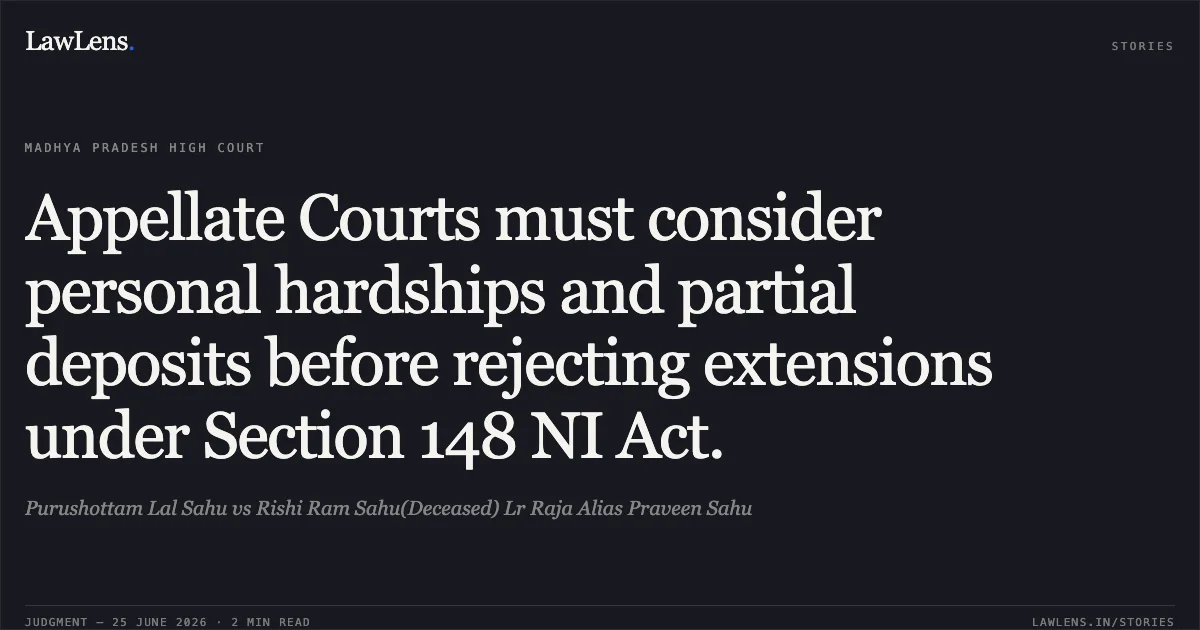
Purushottam Lal SahuvsRishi Ram Sahu(Deceased) Lr Raja Alias Praveen Sahu
Click to open original judgment
Original judgment, available to read, download and summarize on LawLens.in