Facts
The respondents instituted O.S. No. 143 of 2015 seeking partition and separate possession of five schedule properties and a declaration that the sale deed dated 28 June 1982, executed by Madiwalappa in favour of Defendant No. 2 (the appellant), concerning Item No. 5, was illegal, void, sham, and not binding on their shares.
Source reference: para. 3The appellant contended that the sale was validly executed for family legal necessity, including repayment of marriage-related and bank loans, and that he had remained in exclusive possession since the sale.
Source reference: para. 4.1The Trial Court decreed the suit in respect of Items Nos. 1–4 but rejected the challenge to Item No. 5, holding that the registered sale deed was valid, supported by consideration and legal necessity, and that the claim was barred by limitation.
Source reference: paras. 6–7.6On appeal, the High Court affirmed the findings concerning Items Nos. 1–4 but reversed the decision regarding Item No. 5 and remanded the matter to the Trial Court to frame additional issues and permit further evidence on the character of the sale deed, limitation, and possession.
Source reference: para. 8The appellant challenged the remand before the Supreme Court.
Source reference: para. 9Issues
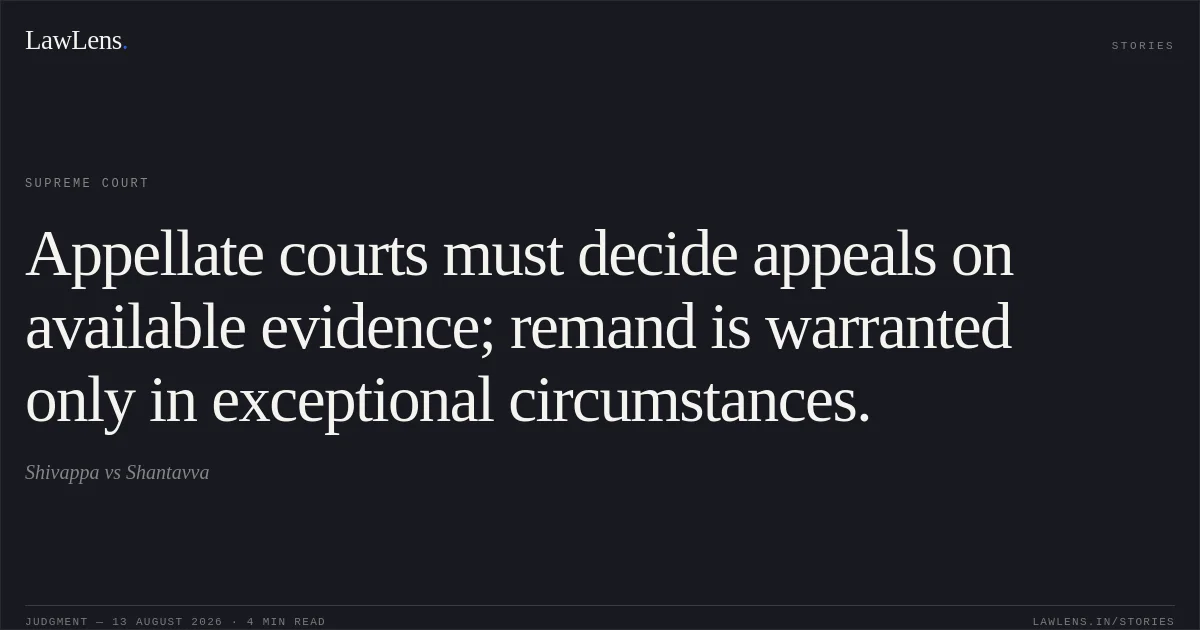
Whether the High Court was justified in remanding the dispute concerning Item No. 5 to the Trial Court for framing additional issues and recording further evidence.
Source reference: paras. 2, 13Whether the issues already framed by the Trial Court, particularly Issues Nos. 2 and 3, sufficiently covered the alleged partition, validity and binding nature of the sale deed, and the parties’ respective claims.
Source reference: paras. 5, 15–16Whether the absence of a separate issue on limitation, possession, or whether the sale deed was sham and nominal warranted remand rather than a decision by the First Appellate Court on the existing record.
Source reference: paras. 8.1–8.5, 15–16Law Applied
The Court applied Sections 107 and 3 of the Code of Civil Procedure, 1908, and Order XLI Rules 23 and 24, which empower an appellate court to remand a matter or, where the evidence on record is sufficient, determine the case finally.
Source reference: para. 14.1Remand is not to be ordered as a matter of course merely because the Trial Court’s reasoning is considered erroneous; the appellate court should itself decide the appeal where the material necessary for adjudication is available.
Source reference: para. 14.1The Court relied on Ashwini Kumar K. Patel v. Upendra J. Patel , which cautions against unnecessary remand; P. Purushottam Reddy v. Pratap Steels Ltd. , which holds that the First Appellate Court can decide questions of fact and law even where a specific issue was not framed if the matter was within the parties’ pleadings and evidence; and Zarif Ahmad v. Mohd. Farooq , which states that remand should be reserved for rare cases and that additional evidence may instead be taken under the appellate court’s powers.
Source reference: para. 14.1The Court also recognised the court’s duty under Section 3 of the Limitation Act, 1963, to examine limitation even if not pleaded, with Articles 58, 59 and 109 being relevant to the limitation analysis.
Source reference: paras. 7.6, 8.2, 8.4, 15Reasoning
The Supreme Court held that the Trial Court had not adjudicated the suit in the absence of relevant issues.
Source reference: para. 16Issue No. 2 addressed the alleged partition dated 4 January 1980, while Issue No. 3 comprehensively covered the sale of Item No. 5 and its validity, thereby encompassing the parties’ dispute concerning the sale deed.
Source reference: para. 16Although separate issues concerning limitation and possession could have been framed, the parties had already led oral and documentary evidence on the relevant matters, and the Trial Court had recorded findings on the validity of the registered sale deed, consideration, legal necessity, possession, and limitation.
Source reference: paras. 7.1–7.6Consequently, the High Court, as the First Appellate Court, possessed sufficient material and jurisdiction to determine the appeal itself.
Source reference: paras. 14.1, 16The mere absence of separately worded issues did not justify reopening the trial, particularly when the proposed remand would cause avoidable delay and prolong the litigation.
Source reference: paras. 14.1, 16The Court clarified that an appellate court may, where necessary, allow additional evidence under Order XLI Rule 27 CPC, but remand is permissible only when imminently warranted by the circumstances.
Source reference: para. 16Holding
The Supreme Court held that the High Court’s remand of the dispute concerning Item No. 5 was legally unwarranted and reflected an incorrect exercise of appellate discretion.
The findings of the High Court concerning Item No. 5 and its order of remand were set aside, without expressing any opinion on the merits of the parties’ claims.
Source reference: para. 17The appeals were restored to the High Court with a request to decide them afresh on merits.
Source reference: para. 17The civil appeals were accordingly allowed, with no order as to costs.
Source reference: paras. 18–20Acts & Sections Cited
6 provisions across 3 statutes referred to in this judgment. Each provision opens on LawLens.
Limitation Act, 19634
Specific Relief Act, 19631
Code of Civil Procedure, 19081
Original Court PDF
ShivappavsShantavva
Click to open original judgment
Original judgment, available to read, download and summarize on LawLens.in