Facts
Respondent No. 2’s suit for specific performance against respondent No. 1 was partly decreed on 13 November 2017.
Source reference: p. 3–4Respondent No. 1 filed R.A. No. 5028/2022 with an application under Section 5 of the Limitation Act, 1963, seeking condonation of delay. The First Appellate Court kept that application in abeyance until it decided the appeal on the merits.
Source reference: p. 3–4Baswaraj challenged that order under Article 227, contending that the delay application had to be decided first and that execution of the decree could otherwise proceed.
Source reference: p. 3–4, 7Issues
1. Whether the First Appellate Court could keep the application for condonation of delay in abeyance while proceeding to hear the appeal on its merits
Source reference: p. 5–62. Whether the order keeping the delay application in abeyance should be set aside and the application decided before the appeal proceeds
Source reference: p. 6–7Law Applied
Section 5 of the Limitation Act, 1963, permits a court to admit an appeal filed after limitation if the appellant establishes sufficient cause for the delay.
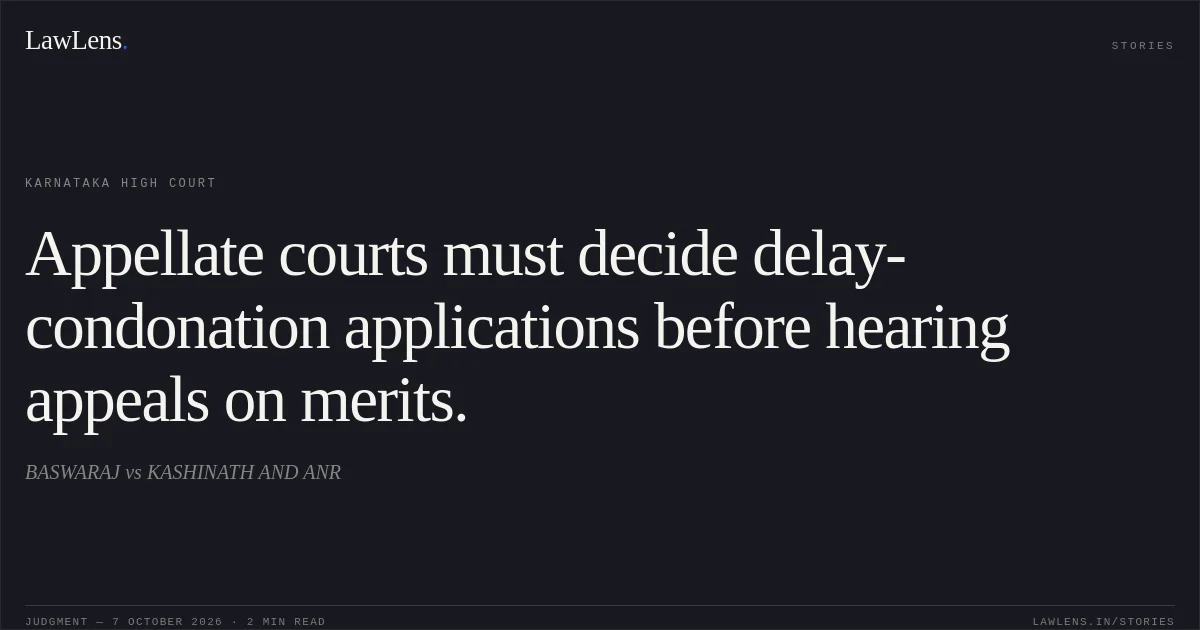
Source reference: p. 5–6The court must decide the condonation application first: it must allow the application if sufficient cause is shown or reject it if sufficient cause is not shown. The appeal may be heard on its merits only if the delay is condoned.
Source reference: p. 5–6The judgment cites no precedent for this principle.
Source reference: p. 5–6Reasoning
The First Appellate Court had deferred the Section 5 application until its decision on the merits, effectively proceeding without first determining whether the delayed appeal could be admitted.
Source reference: p. 5–6The High Court held that this reversed the required sequence: the appellate court had to determine whether sufficient cause existed before hearing the appeal. It therefore found the impugned order illegal and liable to be set aside.
Source reference: p. 5–6Holding
The High Court allowed the writ petition and set aside the order dated 12 November 2024.
It directed the First Appellate Court to decide I.A. No. 1 within one month of receiving a certified copy of the order.
Source reference: p. 6–7If the delay is condoned, the court must then hear the appeal on its merits and decide it in accordance with law.
Source reference: p. 6–7Acts & Sections Cited
1 provisions across 1 statute referred to in this judgment. Each provision opens on LawLens.
Limitation Act, 19631
Original Court PDF
BASWARAJvsKASHINATH AND ANR
Click to open original judgment
Original judgment, available to read, download and summarize on LawLens.in