Facts
The State challenged the judgment dated 18 July 2017 of the VII Additional Sessions Judge, Bhopal, concerning an incident in which the prosecutrix alleged that, on 20 June 2014, the accused caught hold of her hand while she was going to a nearby shop.
Source reference: para. 1–2, 5The trial court acquitted the accused of the charge under Section 354 IPC, alternatively Sections 7/8 of the POCSO Act.
Source reference: para. 1–2, 5The High Court’s order also records that the accused was convicted under Section 354-A(1)(i) and (ii) IPC, alternatively Sections 11(1)/12 of the POCSO Act, and sentenced to the period already undergone with a fine.
Source reference: para. 1–2, 5The State’s petition under Section 378(3) CrPC sought to set aside the acquittal, contending that the trial court had wrongly rejected the prosecutrix’s evidence.
Source reference: para. 3Issues
1. Whether the trial court’s acquittal of the accused under Section 354 IPC, alternatively Sections 7/8 of the POCSO Act, was perverse or otherwise liable to be set aside.
Source reference: para. 7–8, 112. Whether the State had shown sufficient grounds for the High Court to interfere with the acquittal under the principles governing appellate review of acquittals.
Source reference: para. 8–10Law Applied
Section 378(3) CrPC governs an application for leave to appeal against acquittal.
Source reference: para. 1In Ramesh Babulal Doshi v. State of Gujarat, (1996) 9 SCC 225, the Supreme Court held that an appellate court should first determine whether the acquittal is palpably wrong, manifestly erroneous or demonstrably unsustainable; only if it is may the court reappraise the evidence.
Source reference: para. 8Ajit Savant Majagvai v. State of Karnataka, (1997) 7 SCC 110, recognises the appellate court’s power to reconsider the evidence, while requiring it to respect the reinforced presumption of innocence and adopt a reasonable view favouring the accused.
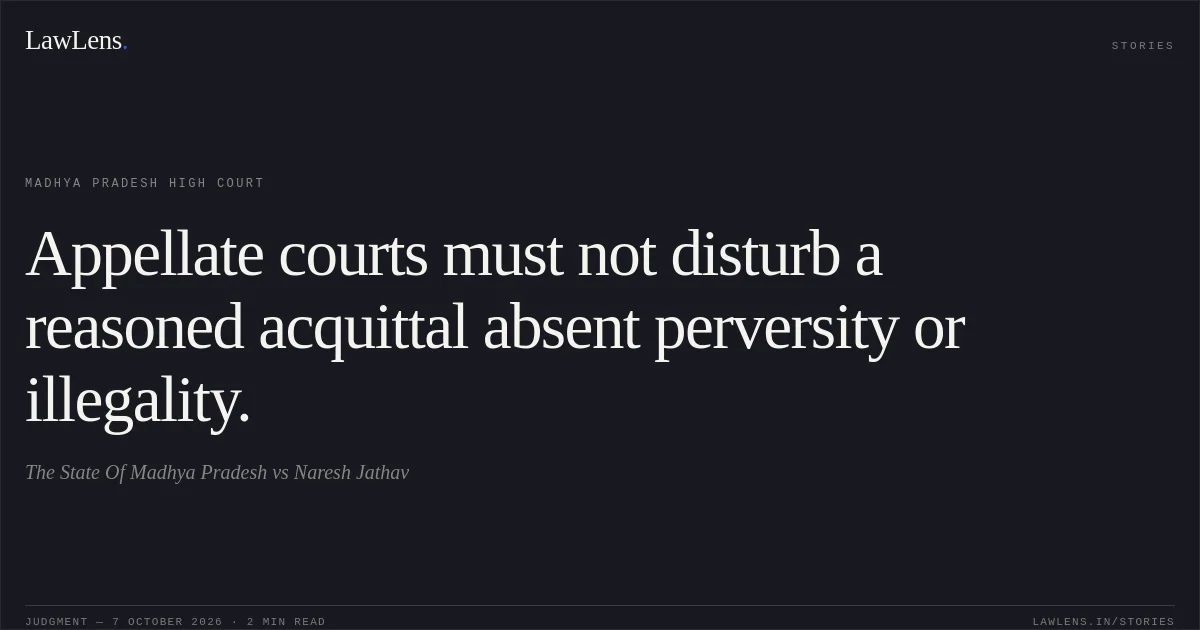
Source reference: para. 9Nikhil Chandra Mondal v. State of W.B., (2023) 6 SCC 605, reiterates that an acquittal should not be disturbed unless it is perverse, illegal or impossible, and that where two reasonable views are available, the acquittal should stand.
Source reference: para. 10Reasoning
The High Court found that the prosecutrix had not stated in her Section 164 CrPC statement that the accused caught hold of her hand, and that the two independent witnesses did not support her on this material point and were declared hostile.
Source reference: para. 6It accepted that the trial court had carefully assessed the evidence, identified the material weakness in the prosecution case and given cogent reasons for extending the benefit of doubt.
Source reference: para. 7Applying the principles governing review of acquittals, the High Court found no illegality or perversity warranting interference.
Source reference: para. 8–11Holding
The High Court held that the State had not established grounds to disturb the trial court’s acquittal on the challenged charges.
It dismissed the petition.
Source reference: para. 11–12Acts & Sections Cited
6 provisions across 3 statutes referred to in this judgment. Each provision opens on LawLens.
Code of Criminal Procedure, 19731
Indian Penal Code, 18601
Protection of Children from Sexual Offences Act, 20124
Original Court PDF
The State Of Madhya PradeshvsNaresh Jathav
Click to open original judgment
Original judgment, available to read, download and summarize on LawLens.in