Facts
The appellant-victim alleged that the accused had maintained an intimate relationship with her for several years and had established sexual relations with her on the promise of marriage.
Source reference: p.2–3, paras. 3–4She submitted a written information on 9 April 2022, leading to registration of Sahiyara P.S. Case No. 47 of 2022 under Sections 376 and 506 IPC.
Source reference: p.2–3, paras. 3–4The police subsequently filed a chargesheet under Sections 376 and 504 IPC, and charges were framed under Sections 376, 504 and 506 IPC.
Source reference: p.3–4, paras. 4–5The prosecution examined seven witnesses, including the victim, her relatives, two doctors and the investigating officer; the accused adduced no defence evidence and denied the allegations under Section 313 CrPC.
Source reference: p.4–5, paras. 6–8The trial court acquitted the accused, holding that the victim was a major, had maintained a consensual relationship with him over a prolonged period, and that the prosecution failed to establish consent obtained by coercion or misconception of fact.
Source reference: p.5–6, paras. 9–10The victim challenged the acquittal under the proviso to Section 413 BNSS.
Source reference: p.2, para. 2Issues
Whether the evidence established that the victim’s consent to the sexual relationship was obtained under coercion or misconception of fact so as to constitute rape under Section 376 IPC?
Source reference: p.9–10, paras. 22–25Whether the prosecution proved the essential ingredients of the offences under Sections 504 and 506 IPC beyond reasonable doubt?
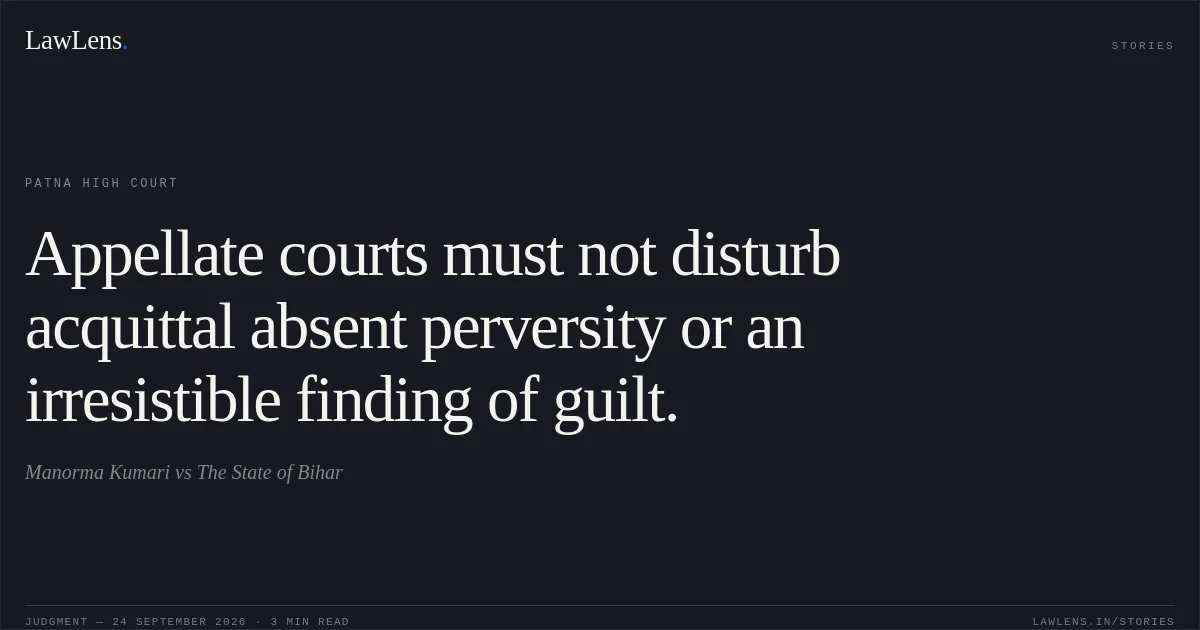
Source reference: p.5–6, para. 10Whether the trial court’s acquittal was perverse or otherwise warranted interference in an appeal against acquittal?
Source reference: p.11, para. 26Law Applied
The Court applied Section 376 IPC, requiring proof that the sexual act was committed without valid consent or pursuant to consent vitiated by coercion or misconception of fact.
Source reference: p.9–10, paras. 22–23It applied the principle that a promise to marry does not, by itself, establish rape where the relationship was prolonged and consensual and the alleged misconception was not proximate to the sexual act.
Source reference: p.9–10, paras. 22–23The Court relied on XXXX v. State of Madhya Pradesh & Anr., Criminal Appeal No. 3431 of 2023, reported in 2024 (3) SCC 496; Om Prakash Mishra v. State of Bihar, 2018 SCC OnLine Pat 507; Deelip Singh @ Dilip Kumar v. State of Bihar, AIR 2005 SC 203; and Pradeep Kumar @ Pradeep Kumar Verma v. State of Bihar, (2007) 7 SCC 413, concerning consent and misconception of fact.
Source reference: p.9–10, para. 22Sections 504 and 506 IPC require proof respectively of intentional insult likely to provoke breach of peace and criminal intimidation; the prosecution must establish the material particulars and circumstances of those offences.
Source reference: p.5–6, para. 10In an appeal against acquittal, appellate interference is justified only where the acquittal is perverse or the evidence leads to an irresistible conclusion of guilt; a reasonable view favouring the accused must not be disturbed.
Source reference: p.11, para. 26Reasoning
The Court found that the victim was an adult and had maintained the relationship with the accused over an extended period, including periods of approximately five years and thereafter two years.
Source reference: p.9–10, paras. 22–23She had not complained during the period of the relationship, and the evidence indicated that the relationship occurred with her knowledge and participation.
Source reference: p.9–10, paras. 22–23The evidence of the victim’s sister showed that she was major when she came in contact with the accused, while the medical evidence placed her age above 22 years.
Source reference: p.7–8, paras. 17–20The Court also noted the absence of supporting material regarding the alleged panchayati, inconsistencies and omissions in the evidence, the alleged consensual abortion, and the medical opinion that it was difficult to determine whether rape had occurred.
Source reference: p.7–10, paras. 14, 18, 24–25These circumstances did not establish that the victim’s consent was vitiated by a legally relevant misconception of fact.
Source reference: p.7–10, paras. 14, 18, 24–25As to Sections 504 and 506 IPC, neither the victim nor the other witnesses specified the date, place or particulars of any insulting or threatening conduct capable of satisfying the statutory requirements.
Source reference: p.5–6, para. 10On reappraisal of the evidence, the High Court concluded that the trial court had adopted a reasonable view supported by the record and that its findings were not perverse.
Source reference: p.11, para. 26Holding
The High Court held that the prosecution failed to prove beyond reasonable doubt that the sexual relationship constituted rape under Section 376 IPC or that the accused committed offences under Sections 504 and 506 IPC.
The trial court’s acquittal was found to be a reasonable and non-perverse view of the evidence.
Source reference: p.11, paras. 26–28Consequently, the appeal was dismissed, the judgment of acquittal dated 23 January 2025 was affirmed, and the trial court record was directed to be returned to the concerned court.
Source reference: p.11, paras. 26–28Acts & Sections Cited
5 provisions across 3 statutes referred to in this judgment. Each provision opens on LawLens.
Bharatiya Nagarik Suraksha Sanhita, 20231
Indian Penal Code, 18603
Code of Criminal Procedure, 19731
Original Court PDF
Manorma KumarivsThe State of Bihar
Click to open original judgment
Original judgment, available to read, download and summarize on LawLens.in