Facts
On 29 November 2003, officers of the Gujarat Electricity Board allegedly inspected the respondent’s premises at Village Bhatera, Taluka Kathlal, and found the electricity connection permanently disconnected.
Source reference: p.1; para. 2The prosecution alleged that the respondent had illegally connected a black wire to the service line supplying electricity to another premises and thereby committed theft of electricity valued at ₹3,505.65, attracting Section 135(1)(A) of the Electricity Act, 2003.
Source reference: p.4, para. 9A complaint was lodged, a panchnama was prepared, the respondent was arrested, and a chargesheet was filed.
Source reference: p.1–2, para. 2The trial Court framed the charge, recorded the respondent’s denial under Section 313 CrPC, and ultimately acquitted him.
Source reference: p.2, paras. 2.1, 4–5The State preferred the present appeal against acquittal.
Source reference: p.3, para. 6During the proceedings, the respondent allegedly paid the disputed bill and penalty to MGVCL, and the prosecution had also sought permission to withdraw the case.
Source reference: p.5, para. 10Issues
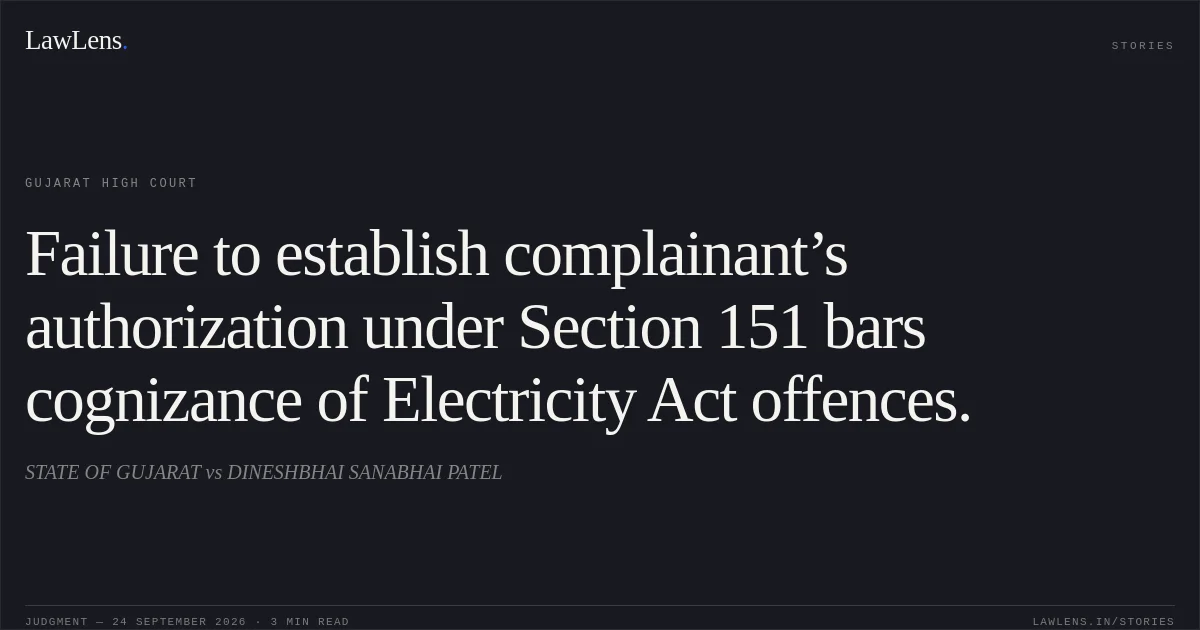
Whether the prosecution validly initiated the proceedings and established compliance with the requirements of Section 151 of the Electricity Act, including the complainant’s authorisation to lodge the complaint?
Source reference: p.5–7, paras. 11–12.1Whether the evidence established beyond reasonable doubt that the respondent had unauthorisedly abstracted electricity and committed an offence under Section 135(1)(A) of the Electricity Act?
Source reference: p.4–5, paras. 9–11; p.12, paras. 21–22Whether the trial Court’s acquittal disclosed such illegality, perversity, or manifest error as would justify interference by the appellate Court in an appeal against acquittal?
Source reference: p.9–11, paras. 17–20Law Applied
The Court applied Section 135(1)(A) of the Electricity Act, 2003, concerning dishonest abstraction or use of electricity.
Source reference: p.4–5, paras. 9–11It relied on Section 151, which restricts cognizance of offences under the Act to a written complaint by the Appropriate Government, authorised officer, licensee, generating company, or other specified authority, subject to the statutory proviso concerning a police report.
Source reference: p.6, para. 12Section 50 concerning the Electricity Supply Code and procedures relating to disconnection, inspection, and removal or maintenance of electrical lines and apparatus was also considered.
Source reference: p.6, para. 12Relying on State of Gujarat v. Mohamad Nathabhai Sumara and other Gujarat High Court decisions, the Court held that non-compliance with the statutory requirements under Section 151 was fatal to the prosecution.
Source reference: p.6–8, paras. 12.1–16The Court further applied the principles in Chandrappa v. State of Karnataka, reaffirmed in Rajesh Prasad v. State of Bihar, Babu Sahebagouda Rudragoudar v. State of Karnataka, and Ramesh v. State of Karnataka: although an appellate Court may reappreciate evidence in an appeal against acquittal, the accused enjoys a reinforced presumption of innocence, and an acquittal should not be disturbed where two reasonable conclusions are possible.
Source reference: p.9–11, paras. 17–20Reasoning
The Court found that the prosecution had not produced documentary material demonstrating that the complainant was authorised under Section 151 of the Electricity Act to institute the proceedings.
Source reference: p.5–7, paras. 11–12.1The prosecution also failed to examine independent witnesses, recover or produce the alleged connecting wire and other muddamal, or otherwise provide sufficiently reliable physical evidence linking the respondent to the alleged theft.
Source reference: p.5, para. 11; p.7–8, paras. 14–15The alleged premises were occupied by the respondent along with other persons, but the proceedings were brought only against him without adequately establishing his exclusive responsibility for the alleged illegal connection.
Source reference: p.5, para. 10In these circumstances, the Court held that the prosecution failed both procedurally and evidentially to prove the charge beyond reasonable doubt.
Source reference: p.8–12, paras. 16–22Applying the heightened appellate restraint applicable to acquittals, it found no perversity or manifest error in the trial Court’s reasoning warranting reversal.
Source reference: p.8–12, paras. 16–22Holding
The High Court answered the issues against the State.
It held that the prosecution failed to establish compliance with Section 151 of the Electricity Act and failed to prove beyond reasonable doubt that the respondent committed theft of electricity under Section 135(1)(A).
Source reference: p.5–8, paras. 11–16; p.12, paras. 21–22The appeal against acquittal was dismissed, the trial Court’s judgment and order of acquittal were confirmed, the respondent’s bail bond was cancelled, and the record and proceedings were directed to be returned to the trial Court.
Source reference: p.12, para. 23Acts & Sections Cited
7 provisions across 2 statutes referred to in this judgment. Each provision opens on LawLens.
Code of Criminal Procedure, 19733
Electricity Act, 20034
Original Court PDF
STATE OF GUJARATvsDINESHBHAI SANABHAI PATEL
Click to open original judgment
Original judgment, available to read, download and summarize on LawLens.in