Facts
On 10 March 1994, between approximately 6:00 p.m. and 6:30 p.m., the accused allegedly formed an unlawful assembly, attempted to assault Raghavbhai Khengarbhai Bharwad, injured Girishbhai Laljibhai Kadiya, and thereafter pursued them into the house of Matubhai Dharamshibhai.
Source reference: p.2, para. 2; p.11, para. 12Matubhai was allegedly assaulted with knives and other weapons and died from his injuries; Jamnaben and others also sustained injuries.
Source reference: p.2, para. 2; p.11, para. 12The prosecution relied on injured eyewitnesses, medical evidence, panchnamas, recovery evidence, and police records.
Source reference: pp.3–6, paras. 3–4The accused were charged under Sections 143, 144, 148, 324, 326, 149, 302 and other provisions of the IPC, and Section 135 of the Bombay Police Act.
Source reference: p.2, paras. 1–2.1; p.6, paras. 5–7The trial court acquitted all accused in Sessions Case No. 111 of 1994 by judgment dated 5 October 1998.
Source reference: p.2, paras. 1–2.1; p.6, paras. 5–7The State preferred the present appeal against acquittal under Section 372 of the Code of Criminal Procedure, 1973.
Source reference: p.2, para. 1Issues
1. Whether the trial court correctly acquitted the accused by holding that the prosecution failed to prove the charged offences beyond reasonable doubt.
Source reference: p.10, para. 11(1)2. Whether the trial court properly appreciated the oral and documentary evidence led by the prosecution.
Source reference: p.10, para. 11(2)3. Whether the acquittal judgment suffered from illegality, irregularity, perversity, or any other infirmity warranting appellate interference.
Source reference: p.10, para. 11(3)4. Whether the prosecution evidence reliably established the accused’s identity, participation in the unlawful assembly, and responsibility for the death of Matubhai and injuries to the other witnesses.
Source reference: pp.11–14, paras. 13–18Law Applied
The Court considered the charged offences under Sections 143, 144, 148, 149, 302, 324 and 326 of the Indian Penal Code and Section 135 of the Bombay Police Act.
Source reference: pp.2, 10–11, paras. 1, 12The prosecution was required to establish the guilt of each accused beyond reasonable doubt.
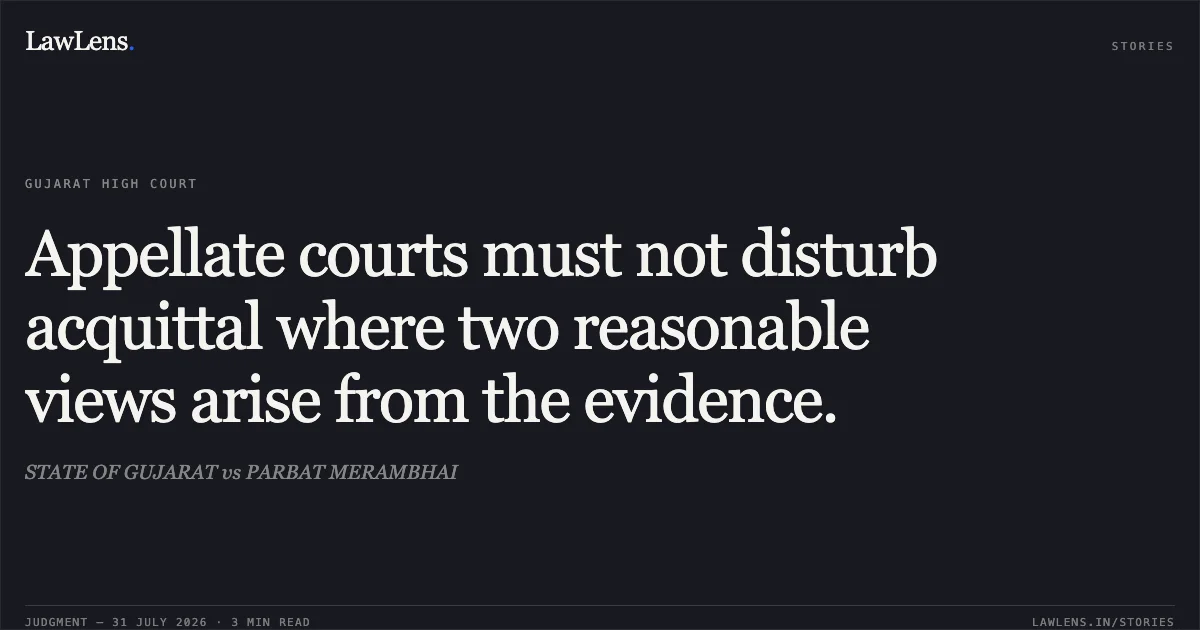
Source reference: no citationIn an appeal against acquittal, the appellate court has full power to review and reappreciate the evidence, but the accused benefit from a strengthened “double presumption” of innocence; where two reasonable views are possible, the acquittal should ordinarily not be disturbed.
Source reference: pp.15–17, paras. 19–22These principles were drawn principally from Chandrappa v. State of Karnataka, (2007) 4 SCC 415; Rajesh Prasad v. State of Bihar, (2022) 3 SCC 471; Babu Sahebagouda Rudragoudar v. State of Karnataka, AIR 2024 SC 2252, (2024) 8 SCC 149; and Ramesh v. State of Karnataka, (2024) 9 SCC 169.
Source reference: pp.15–17, paras. 21–22A conviction could not be sustained where the eyewitness evidence was materially inconsistent, unreliable, or insufficient to connect the accused with the crime.
Source reference: no citationReasoning
The Court found that the principal injured witness, Raghavbhai, did not support the prosecution, while Dilipbhai supported it only against Accused Nos. 1 to 5 and was declared hostile in relation to the others.
Source reference: p.11, paras. 13–14The son of the deceased was not an eyewitness, and the deceased’s wife—who was allegedly present and could have materially corroborated the prosecution—was not examined.
Source reference: p.12, para. 15Although Jamnaben claimed to have witnessed the assault and to have been injured while intervening, her medical evidence did not adequately support the prosecution version.
Source reference: p.12, paras. 16–17Several panch witnesses turned hostile, and the Court found no clinching corroboration from the documentary or recovery evidence.
Source reference: p.13, para. 18Material discrepancies existed regarding the time of occurrence, the identity of the assailants, and the role of the individual accused.
Source reference: p.14, para. 18Jamnaben named only two accused, stated that she did not know the others, and no Test Identification Parade was conducted.
Source reference: p.14, para. 18In light of the admitted hostility between the groups, the possibility of false implication could not be excluded.
Source reference: no citationThe prosecution also failed to examine other material witnesses who allegedly arrived shortly after the occurrence.
Source reference: p.13, para. 18Applying the heightened standard governing appeals against acquittal, the Court held that the trial court’s view was a reasonable view of the evidence and was neither perverse nor manifestly illegal.
Source reference: pp.14–18, paras. 18–25Holding
The High Court answered the issues against the appellant.
It held that the prosecution had failed to prove beyond reasonable doubt that the accused committed the alleged offences or were reliably connected with the death of Matubhai and the injuries to the other witnesses.
Source reference: p.18, para. 24; p.19, para. 25The appeal against acquittal was dismissed, the trial court’s judgment dated 5 October 1998 was confirmed, the bail bonds were cancelled, and the record and proceedings were directed to be returned to the trial court.
Source reference: p.19, para. 25Acts & Sections Cited
11 provisions across 2 statutes referred to in this judgment. Each provision opens on LawLens.
Code of Criminal Procedure, 19732
Original Court PDF
STATE OF GUJARATvsPARBAT MERAMBHAI
Click to open original judgment
Original judgment, available to read, download and summarize on LawLens.in