Facts
The appellant–original complainant claimed rights over agricultural land bearing Revenue Survey No. 66, alleging that the respondents had created false documents and procured unauthorised mutation entries to dispossess him.
Source reference: pp.2–3Following revenue proceedings, which allegedly resulted in an order favourable to the complainant, an FIR was registered alleging offences under Sections 467, 468, 471, 504, 506(2) and 114 of the IPC and the Scheduled Castes and Scheduled Tribes (Prevention of Atrocities) Act, 1989.
Source reference: pp.2–3The prosecution case was that, on 08.05.2013, the accused entered the agricultural land, abused and threatened the complainant and his family members, and insulted the complainant on the basis of his caste.
Source reference: pp.2–3, 10After investigation, charge-sheets were filed against the respondents for offences under Sections 447, 504, 506(2) and 114 of the IPC and Section 3(1)(10) of the Atrocities Act.
Source reference: pp.2–4The trial Court acquitted both accused in Special (Atrocity) Case Nos.15 of 2014 and 21 of 2016 by judgment dated 30.01.2017.
Source reference: pp.2–4The complainant thereafter preferred the present appeals against acquittal under Section 378(2) of the Code of Criminal Procedure, 1973.
Source reference: p.1Issues
Whether the trial Court was justified in acquitting the respondents of the offences under Sections 447, 504, 506(2) and 114 of the IPC and Section 3(1)(10) of the Atrocities Act?
Source reference: para. 11Whether the trial Court had properly appreciated the oral and documentary evidence on record?
Source reference: para. 11Whether the impugned judgment of acquittal suffered from any illegality, irregularity or perversity warranting appellate interference?
Source reference: para. 11Law Applied
The Court applied Sections 447, 504, 506(2) and 114 of the IPC, requiring proof respectively of criminal trespass, intentional insult with the requisite intention or knowledge, criminal intimidation, and abetment/common participation.
Source reference: pp.11–13It also applied Section 3(1)(10) of the Atrocities Act, holding that caste-based insult must be proved to have occurred in a public place and within public view, with the requisite intention to insult the victim on the basis of caste.
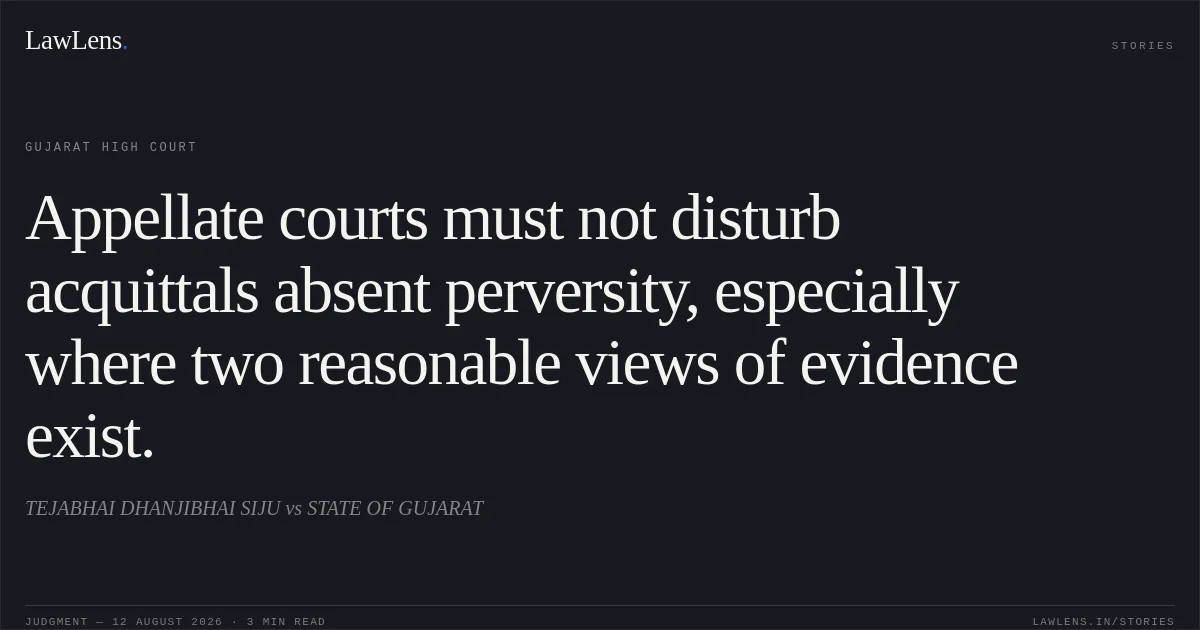
Source reference: p.13In an appeal against acquittal, the appellate court possesses power to reappreciate the evidence, but the accused benefit from a double presumption of innocence; where two reasonable views are possible, the acquittal should not ordinarily be disturbed.
Source reference: paras.17–20These principles were drawn from Chandrappa v. State of Karnataka, (2007) 4 SCC 415; Rajesh Prasad v. State of Bihar, (2022) 3 SCC 471; Babu Sahebagouda Rudragoudar v. State of Karnataka, (2024) 8 SCC 149; and Ramesh v. State of Karnataka, (2024) 9 SCC 169.
Source reference: pp.14–16For the Atrocities Act charge, the Court relied on Shajan Skaria v. State of Kerala, AIR 2024 SC 4557, and Gunjan @ Girija Kumari v. State (NCT of Delhi), 2026 (0) INSC 468, concerning the requirements of public place, public view, caste-based insult and intention.
Source reference: p.13Reasoning
The Court found that the complainant failed to establish that he was in ownership or possession of the disputed land at the relevant time.
Source reference: pp.10–12The respondents relied on revenue records and an earlier oral sale transaction indicating their possession since 1969, while revenue and civil proceedings concerning title and possession were pending.
Source reference: pp.10–12In the absence of proof of the complainant’s possession, the essential ingredient of criminal trespass under Section 447 IPC was not established.
Source reference: pp.10–12The evidence of the complainant’s son contained material omissions and contradictions, and the investigating officer had not examined independent agriculturists allegedly present near the site.
Source reference: pp.11–13Consequently, the allegations of intentional insult and criminal intimidation under Sections 504 and 506(2) IPC were not proved by cogent and reliable evidence.
Source reference: pp.11–13The evidence was also insufficient to establish that the alleged caste-based abuse was uttered in a public place within public view, as required under Section 3(1)(10) of the Atrocities Act.
Source reference: p.13Applying the heightened restraint applicable to an appeal against acquittal, the Court held that the trial Court’s view was a reasonable one and was neither perverse nor manifestly illegal.
Source reference: paras.16–22Holding
The High Court answered all issues against the appellant and held that the prosecution had failed to prove the alleged offences beyond reasonable doubt.
It found no illegality, perversity or infirmity in the trial Court’s acquittal and therefore dismissed both criminal appeals.
Source reference: paras.21–23The judgment and order of acquittal dated 30.01.2017 were confirmed; the bail bonds were cancelled, and the record and proceedings were directed to be returned to the trial Court.
Source reference: paras.21–23Acts & Sections Cited
11 provisions across 3 statutes referred to in this judgment. Each provision opens on LawLens.
Code of Criminal Procedure, 19733
Indian Penal Code, 18607
Scheduled Castes and the Scheduled Tribes (Prevention of Atrocities) Act, 19891
Original Court PDF
TEJABHAI DHANJIBHAI SIJUvsSTATE OF GUJARAT
Click to open original judgment
Original judgment, available to read, download and summarize on LawLens.in