Facts
The prosecution alleged that Kokila, stated in the FIR to be a 13-year-old girl, disappeared from a footpath in Rajkot at approximately 3:00 a.m. on 2 September 2008 while sleeping with her family.
Source reference: pp. 1–4Accused Sunil Shiva Dantaniya, who was allegedly sleeping nearby, was also found missing.
Source reference: pp. 1–4During the search, the complainant allegedly received information that Kokila had stayed at the house of Pratapbhai and thereafter left for Jamnagar.
Source reference: pp. 1–4Sunil was later apprehended near Gondal Railway Station, and the investigation allegedly disclosed the involvement of co-accused Hitesh Shamjibhai Makvana.
Source reference: pp. 1–4The accused were prosecuted under Sections 363A(1) and 114 of the IPC.
Source reference: pp. 1–4Their cases were consolidated and tried together before the Sessions Court, which acquitted both accused on 13 July 2009.
Source reference: pp. 8–9The State preferred an appeal against the acquittal under Section 378(1)(3) of the Cr.P.C.
Source reference: pp. 8–9Issues
Whether the Trial Court committed an error of law or fact in acquitting the respondents of the charges under Sections 363A(1) and 114 of the IPC?
Source reference: p. 8; para. 7Whether the prosecution evidence established, beyond reasonable doubt, that the accused had kidnapped or otherwise dealt with the victim in a manner attracting Section 363A(1) IPC, with the aid of Section 114 IPC?
Source reference: pp. 9–11; paras. 9–12Whether the Trial Court’s judgment of acquittal was illegal, perverse, or based on a material misappreciation of the evidence so as to warrant appellate interference?
Source reference: p. 8; para. 7, pp. 12–16; paras. 16–21Law Applied
The Court applied Sections 363A(1) and 114 of the Indian Penal Code, requiring the prosecution to prove all essential ingredients of the charged offences beyond reasonable doubt, including the victim’s legally relevant age and the accused’s connection with the alleged offence.
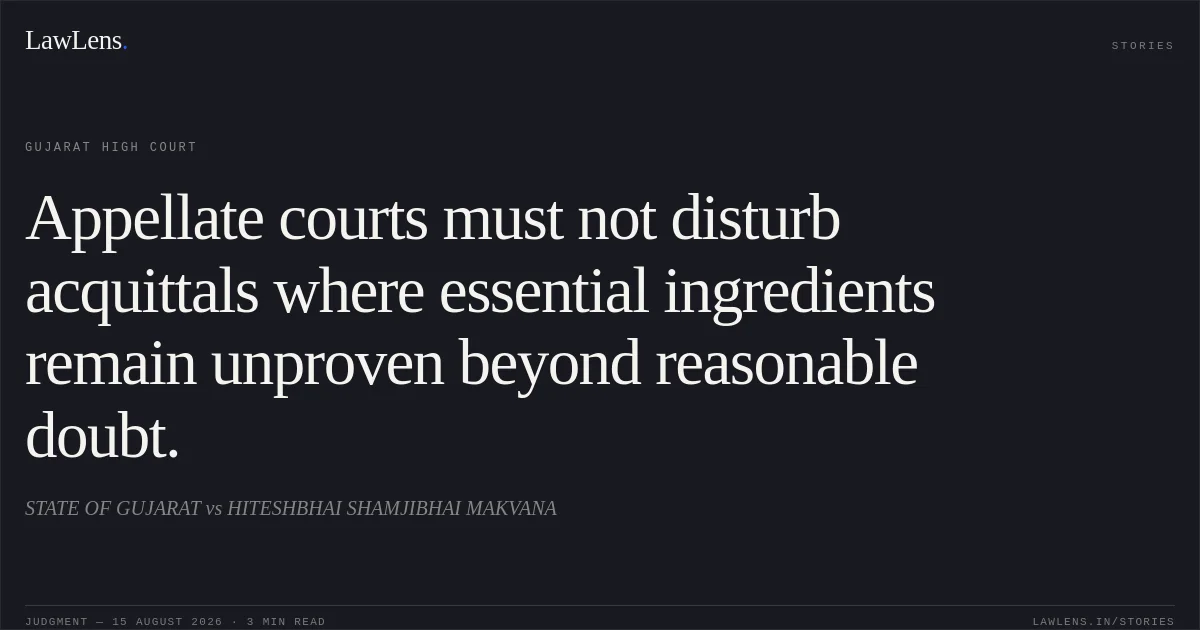
Source reference: pp. 12–16; paras. 16–19In an appeal against acquittal under Section 378 Cr.P.C., the appellate court possesses full power to review and reappreciate the evidence, but must bear in mind the accused’s double presumption of innocence.
Source reference: pp. 12–16; paras. 16–19Where two reasonable views are possible, the acquittal should not ordinarily be disturbed.
Source reference: pp. 12–16; paras. 16–19These principles were drawn from Chandrappa v. State of Karnataka, (2007) 4 SCC 415; Rajesh Prasad v. State of Bihar, (2022) 3 SCC 471; Babu Sahebagouda Rudragoudar v. State of Karnataka, (2024) 8 SCC 149; and Ramesh v. State of Karnataka, (2024) 9 SCC 169.
Source reference: pp. 12–16; paras. 16–19Reasoning
The Court found that the material witnesses—including the victim, PW-2, the relevant witness PW-3, and the victim’s father, PW-4—did not support the prosecution case.
Source reference: pp. 9–10; paras. 9–10The panch witnesses also turned hostile, and the police evidence, when considered with the investigation papers, did not independently establish the charges.
Source reference: pp. 9–10; paras. 9–10The complainant’s testimony alone did not inspire sufficient confidence because the prosecution narrative contained material doubts and inconsistencies.
Source reference: pp. 9–10; paras. 9–10The prosecution also failed to prove the victim’s age: although the FIR described her as 13 years old, the deposition of the complainant and the victim placed her age at approximately 17–18 years.
Source reference: p. 11; para. 11Since age was an essential fact relevant to the alleged offence, this evidentiary failure created reasonable doubt.
Source reference: p. 11; para. 11Additionally, the prosecution did not produce reliable evidence substantiating the circumstances of Sunil’s arrest or the alleged transfer warrant.
Source reference: p. 12; para. 13Applying the restrictive principles governing appellate interference with acquittal, the Court held that the Trial Court’s view was reasonable, supported by the record, and neither perverse nor manifestly illegal.
Source reference: pp. 12–16; paras. 14–21Holding
The High Court answered the issues against the State and held that the prosecution had failed to prove the charges under Sections 363A(1) and 114 IPC beyond reasonable doubt.
The Trial Court had properly appreciated the evidence and its acquittal did not suffer from illegality, perversity, or material error warranting appellate interference.
Source reference: pp. 16–17; paras. 21–22The State’s appeal was accordingly dismissed, the order of acquittal dated 13 July 2009 was confirmed, the bail bonds were cancelled, and the record and proceedings were directed to be returned to the Trial Court.
Source reference: pp. 16–17; paras. 21–22Acts & Sections Cited
4 provisions across 2 statutes referred to in this judgment. Each provision opens on LawLens.
Code of Criminal Procedure, 19733
Indian Penal Code, 18601
Original Court PDF
STATE OF GUJARATvsHITESHBHAI SHAMJIBHAI MAKVANA
Click to open original judgment
Original judgment, available to read, download and summarize on LawLens.in