Facts
Santu was married to the respondent-accused, Kalubhai, approximately six to seven years before the incident, and they had a five-year-old daughter.
Source reference: p.2The prosecution alleged that, after the first year of marriage, the accused subjected Santu to physical and mental cruelty, allegedly on account of an extramarital relationship with his aunt’s daughter, Kana, and frequently assaulted her after consuming alcohol.
Source reference: p.2Shortly before the incident, community elders intervened in the matrimonial dispute and obtained an assurance from the accused that he would not harass Santu.
Source reference: pp.2–3On 5 August 2006, Santu allegedly telephoned her mother and complained that the accused was abusing and beating her.
Source reference: p.3When the complainant reached the matrimonial home at about 8:00 p.m., Santu was found hanging from a ceiling rafter with a dupatta.
Source reference: pp.3–4The accused was prosecuted under Sections 498A and 306 of the Indian Penal Code.
Source reference: pp.4–5After investigation and committal under Section 209 of the Code of Criminal Procedure, the Additional Sessions Judge acquitted him by judgment dated 30 November 2007.
Source reference: pp.4–5The State preferred the present appeal under Section 378(1) and (3) CrPC.
Source reference: para.1Issues
Whether the trial Court was justified in acquitting the respondent of offences under Sections 498A and 306 IPC?
Source reference: para.8(1)Whether the trial Court properly appreciated the oral and documentary evidence led by the prosecution?
Source reference: para.8(2)Whether the impugned judgment of acquittal suffered from any illegality, irregularity, perversity, or manifest error warranting appellate interference?
Source reference: para.8(3)Law Applied
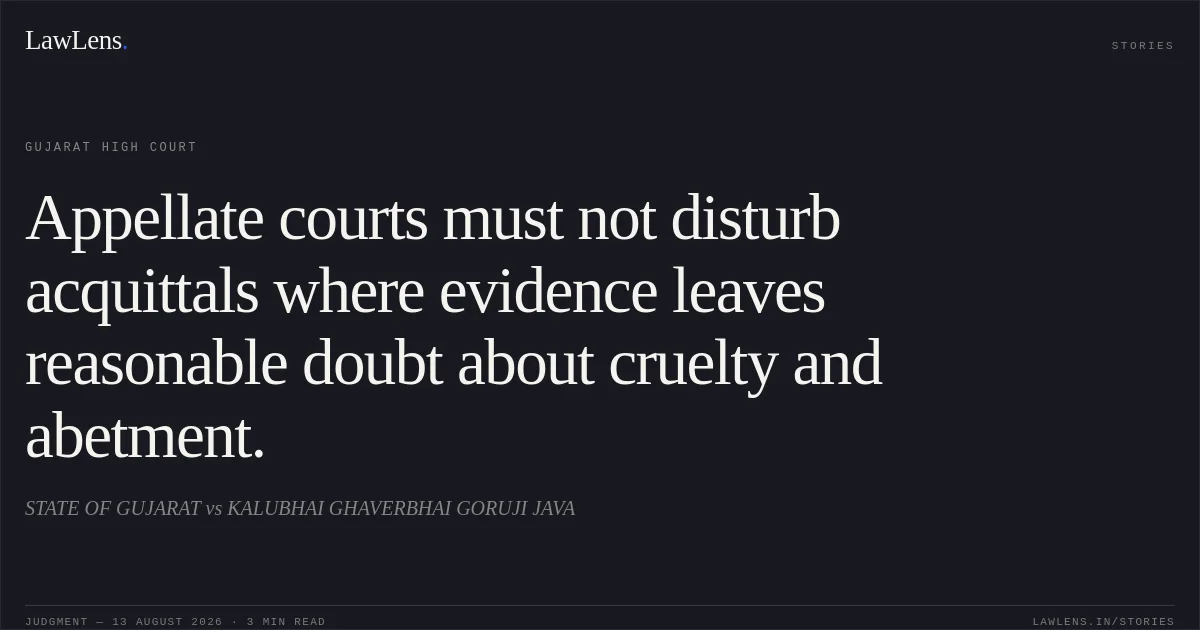
The Court considered the ingredients of Sections 498A and 306 IPC, requiring proof of cruelty by the husband and abetment of suicide, respectively.
Source reference: pp.1, 9–11In an appeal against acquittal under Section 378 CrPC, an appellate court has full power to reappreciate the evidence, but must bear in mind the double presumption of innocence in favour of the accused and should not interfere where two reasonable views are possible.
Source reference: paras.12–15The Court relied on Chandrappa v. State of Karnataka, (2007) 4 SCC 415; Rajesh Prasad v. State of Bihar, (2022) 3 SCC 471; Babu Sahebagouda Rudragoudar v. State of Karnataka, (2024) 8 SCC 149; and Ramesh v. State of Karnataka, (2024) 9 SCC 169, which reiterate that an acquittal should be reversed only where the trial Court’s approach is manifestly illegal, perverse, or unreasonable.
Source reference: paras.12–15Reasoning
The Court found that the prosecution’s allegations of physical assault and cruelty were not sufficiently corroborated.
Source reference: pp.8, 11Although the complainant alleged that the accused had beaten Santu shortly before her death, the post-mortem evidence disclosed no external or internal injuries apart from the ligature mark on the neck.
Source reference: pp.8, 11The prosecution primarily relied on the deceased’s mother and sister, who were interested witnesses, while several material and relatively independent witnesses—including the community elders who allegedly intervened, the accused’s father, and persons allegedly present when the body was lowered—were not examined.
Source reference: p.9The telephone evidence established that calls occurred, but did not, by itself, conclusively prove the statutory elements of cruelty or abetment of suicide.
Source reference: p.8In these circumstances, the Court held that the evidence did not establish beyond reasonable doubt that the accused had subjected Santu to cruelty or abetted her suicide.
Source reference: pp.9–13Since the trial Court’s view was a reasonable one and was not perverse or manifestly erroneous, the principles governing appeals against acquittal precluded interference.
Source reference: pp.9–13Holding
The High Court answered all issues against the State and held that the prosecution had failed to prove the offences under Sections 498A and 306 IPC beyond reasonable doubt.
Finding no illegality, perversity, or infirmity in the trial Court’s judgment, it dismissed the State’s appeal and confirmed the respondent’s acquittal.
Source reference: para.18The bail bond was cancelled, and the record and proceedings were directed to be returned to the concerned trial Court.
Source reference: para.18Acts & Sections Cited
4 provisions across 2 statutes referred to in this judgment. Each provision opens on LawLens.
Code of Criminal Procedure, 19733
Indian Penal Code, 18601
Original Court PDF
STATE OF GUJARATvsKALUBHAI GHAVERBHAI GORUJI JAVA
Click to open original judgment
Original judgment, available to read, download and summarize on LawLens.in