Facts
On 31 October 2005, the complainant alleged that a quarrel arose with the accused when he released his bullock cart for grazing near agricultural land.
Source reference: p.1According to the prosecution, accused Nos. 3 and 4 assaulted him with an iron pipe and stick, while accused Nos. 1, 2 and 5 pelted stones, causing injuries to his head, hand and waist.
Source reference: p.1It was further alleged that accused No. 2 snatched the complainant’s two-tola gold chain.
Source reference: p.1A complaint was registered for offences under Sections 397 and 337 of the Indian Penal Code and Section 135 of the Bombay Police Act.
Source reference: p.1The complainant was initially taken to the Government Hospital, Palitana, and was subsequently examined at Sir T. Hospital, Bhavnagar, where thirteen simple injuries were recorded.
Source reference: pp.5–6The trial Court framed charges, examined seven prosecution witnesses and considered eight documentary exhibits.
Source reference: pp.1–3By judgment dated 30 June 2012 in Sessions Case No. 49 of 2006, it acquitted all the accused.
Source reference: pp.1–3The State preferred the present appeal under Section 378(1) and (3) of the Code of Criminal Procedure, 1973.
Source reference: pp.1–3Issues
Whether the trial Court was justified in acquitting the accused from the offences under Sections 397 and 337 of the IPC and Section 135 of the Bombay Police Act?
Source reference: para.10(1)Whether the trial Court properly appreciated the oral and documentary evidence led by the prosecution?
Source reference: para.10(2)Whether the impugned judgment of acquittal suffered from illegality, irregularity or perversity warranting appellate interference?
Source reference: para.10(3)Law Applied
The Court considered the offences charged under Sections 397 and 337 of the IPC and Section 135 of the Bombay Police Act, together with the State’s appellate remedy under Section 378(1) and (3) of the CrPC.
Source reference: pp.1–2It applied the requirement that the prosecution must establish the accused’s guilt beyond reasonable doubt.
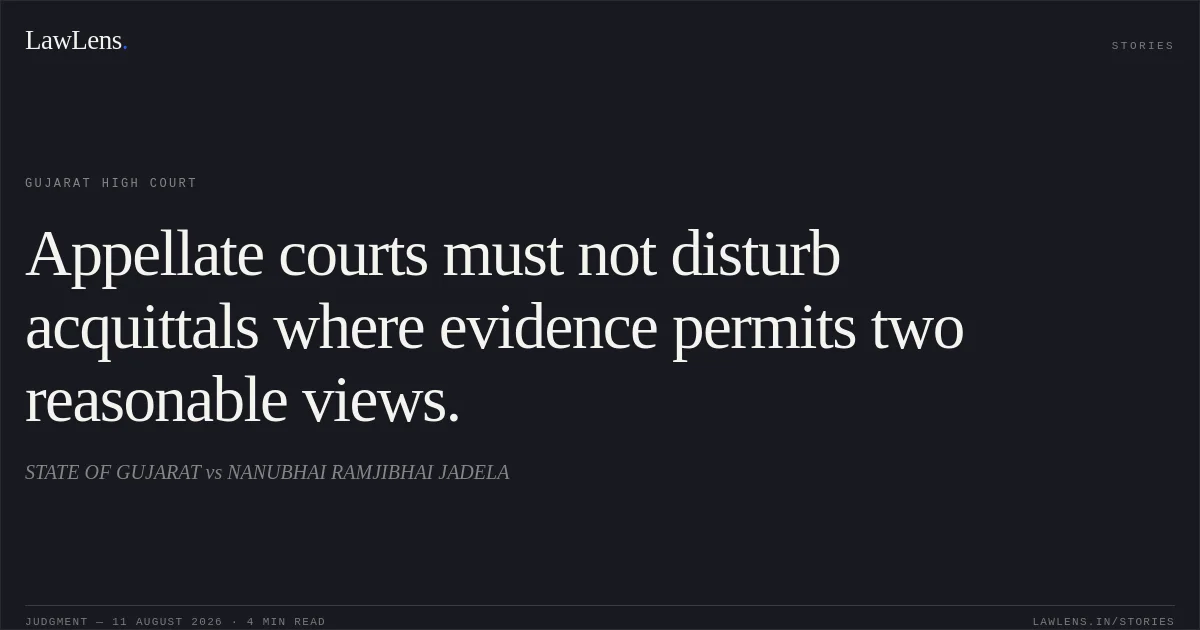
Source reference: no citationIn an appeal against acquittal, an appellate court has full power to reappreciate the evidence, but must account for the double presumption of innocence in favour of the accused; where two reasonable views are possible, the acquittal should ordinarily not be disturbed.
Source reference: paras.18–20These principles were drawn from Chandrappa v. State of Karnataka, (2007) 4 SCC 415, as reaffirmed in Rajesh Prasad v. State of Bihar, (2022) 3 SCC 471, Babu Sahebagouda Rudragoudar v. State of Karnataka, (2024) 8 SCC 149, and Ramesh v. State of Karnataka, (2024) 9 SCC 169.
Source reference: paras.20–21Reasoning
The Court found that the prosecution evidence did not establish the occurrence or the identity and role of the accused beyond reasonable doubt.
Source reference: no citationThe alleged eyewitness, PW-3, turned hostile and was not cross-examined by the prosecution.
Source reference: p.5The evidence of the complainant and his wife was materially inconsistent, particularly regarding the alleged snatching of the gold chain; the chain was never recovered and there was no reliable evidence that the complainant was wearing it.
Source reference: p.5Although medical evidence recorded several injuries, all were simple, and the medical records disclosed inconsistencies: the Palitana certificate contained no history of assault or referral, while the Bhavnagar doctor stated that the complainant had arrived without a police or referral note.
Source reference: pp.6–7The FIR was registered approximately fourteen hours after the alleged incident, despite the complainant’s earlier presence at hospitals where police were available, and the delay was unexplained.
Source reference: p.7The parties were relatives and had an admitted agricultural-land dispute.
Source reference: p.7The scene panchnama indicated that the alleged place of occurrence was land in the respondents’ possession, and the Court held that the possibility of the injuries having resulted from a fall on the adjoining rough road could not be excluded.
Source reference: p.7The complainant and his wife also failed to identify the weapons produced at trial.
Source reference: p.8Further, a subsequent notarised compromise relating to the land dispute, under which the complainant accepted ₹40,000, weakened the prosecution case, particularly as no complaint had been made alleging coercion in executing the document.
Source reference: pp.8–9In light of these circumstances, the trial Court’s view was found to be reasonable and neither perverse nor manifestly illegal.
Source reference: paras.17, 22–23Holding
The High Court answered the issues in favour of the accused.
It held that the prosecution had failed to prove the charged offences beyond reasonable doubt and that the trial Court had correctly appreciated the evidence and granted the benefit of doubt.
Source reference: paras.22–23The State’s appeal was dismissed, the judgment and order of acquittal dated 30 June 2012 were confirmed, the accused’s bail bonds were cancelled, and the record and proceedings were directed to be returned to the trial Court.
Source reference: para.24Acts & Sections Cited
4 provisions across 2 statutes referred to in this judgment. Each provision opens on LawLens.
Code of Criminal Procedure, 19732
Indian Penal Code, 18602
Original Court PDF
STATE OF GUJARATvsNANUBHAI RAMJIBHAI JADELA
Click to open original judgment
Original judgment, available to read, download and summarize on LawLens.in