Facts
On 19 March 2011 at approximately 8:00 a.m., the complainant alleged that, near the Panchayat Office at Village Khanpur, the accused questioned his presence at the office and his operation of the Panchayat water pump, abused him by referring to his caste, threatened to kill him, and chased him while carrying an axe and an iron pipe.
Source reference: p.2; para. 2He further alleged that the accused inflicted kick and fist blows, causing injuries.
Source reference: p.2; para. 2An FIR, C.R. No. II-3045/2011, was registered at Tharad Police Station for offences under Sections 323, 504, 506(2) and 114 of the Indian Penal Code, Section 135 of the Gujarat Police Act, and Section 3(1)(x) of the Scheduled Castes and Scheduled Tribes (Prevention of Atrocities) Act, 1989.
Source reference: p.2; para. 2After investigation, a charge-sheet was filed and charges were framed against the accused, who pleaded not guilty.
Source reference: p.2; para. 2.1The trial court, after recording the prosecution evidence and the accused’s statements under Section 313 of the Code of Criminal Procedure, acquitted all accused by judgment dated 5 April 2013 in Special Case No. 48 of 2010.
Source reference: p.2; paras. 3–5The original complainant preferred the present appeal against acquittal. The State did not independently challenge the acquittal.
Source reference: p.3; para. 7The High Court noted that the prosecution had not produced medical evidence, the complainant had declined medical treatment, the allegations of injury and threat were not satisfactorily corroborated, and the supporting witnesses had relevant prior connections or disputes involving the complainant.
Source reference: pp.8–9; para. 12The record also indicated that an accused had submitted an RTI application concerning alleged irregularities by the complainant, which the defence relied upon as a possible reason for the FIR.
Source reference: p.8; para. 12Issues
Whether the trial court was justified in acquitting the accused of the alleged offences.
Source reference: p.7; para. 11(1)Whether the trial court properly appreciated the oral and documentary evidence led by the prosecution.
Source reference: p.7; para. 11(2)Whether the impugned judgment of acquittal suffered from any illegality, irregularity, or perversity warranting appellate interference.
Source reference: p.7; para. 11(3)Whether the prosecution proved beyond reasonable doubt the essential ingredients of Sections 323, 504, 506(2) and 114 IPC, Section 135 of the Gujarat Police Act, and Section 3(1)(x) of the SC/ST Act.
Source reference: pp.9–10; paras. 13–14Law Applied
The Court applied Sections 323, 504, 506(2) and 114 of the Indian Penal Code, Section 135 of the Gujarat Police Act, and Section 3(1)(x) of the SC/ST Act, requiring the prosecution to establish each statutory ingredient beyond reasonable doubt, including intentional caste-based insult in a place within public view for the atrocity offence.
Source reference: pp.9–10; paras. 13–14The Court relied on Hitesh Verma v. State of Uttarakhand, (2020) 10 SCC 710, and other decisions, including Shajan Skaria v. State of Kerala, AIR 2024 SC 4557, for the requirements of the offence under the SC/ST Act.
Source reference: p.9; para. 13On appellate review of acquittal, the Court applied Chandrappa v. State of Karnataka, (2007) 4 SCC 415; Rajesh Prasad v. State of Bihar, (2022) 3 SCC 471; Babu Sahebagouda Rudragoudar v. State of Karnataka, (2024) 8 SCC 149; and Ramesh v. State of Karnataka, (2024) 9 SCC 169.
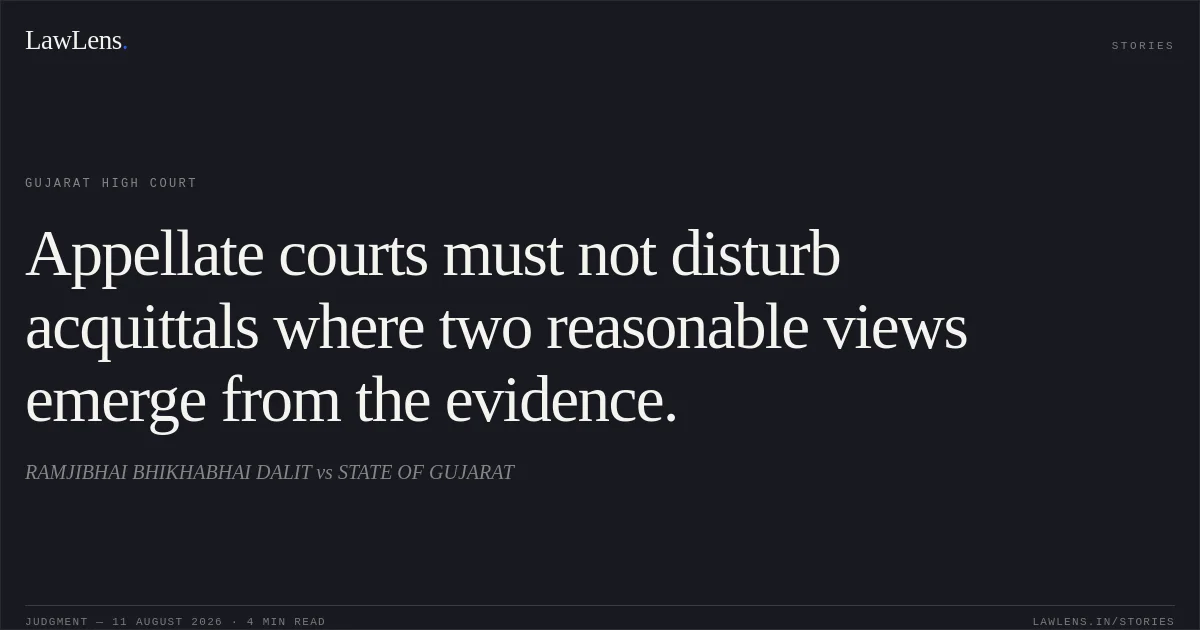
Source reference: pp.10–12; paras. 15–18These authorities establish that an appellate court may fully reappreciate the evidence, but an acquittal carries a strengthened or “double” presumption of innocence, and where two reasonable views are possible, the appellate court should not disturb the acquittal.
Source reference: pp.10–12; paras. 15–18Reasoning
The High Court found that the prosecution evidence did not reliably establish the alleged assault, injuries, criminal intimidation, or caste-based insult.
Source reference: p.8; para. 12The complainant did not obtain medical treatment and no medical evidence was produced, weakening the allegation of bodily injury under Section 323 IPC.
Source reference: p.8; para. 12The allegation of threats was also not proved beyond reasonable doubt.
Source reference: p.8; para. 12With respect to Section 3(1)(x) of the SC/ST Act, the prosecution failed to establish the necessary intentional caste-based insult in a place within public view and in the circumstances required by law.
Source reference: pp.9–10; paras. 13–14The Court further accepted that the trial court had considered the inconsistencies, the background of the prosecution witnesses, their prior involvement in related complaints, and the possible retaliatory motive arising from the RTI application against the complainant.
Source reference: p.8; para. 12Since the trial court’s view was a reasonable assessment of the evidence and was not perverse, illegal, or based on a material misreading of the record, the enhanced presumption in favour of the acquitted accused prevented appellate substitution of another possible view.
Source reference: pp.10–13; paras. 15–20Holding
The High Court answered the issues against the appellant, holding that the prosecution failed to prove the charged offences beyond reasonable doubt and that the trial court had neither committed an error of law nor perversely appreciated the evidence.
The appeal against acquittal was dismissed, the trial court’s judgment dated 5 April 2013 was confirmed, the bail bonds were cancelled, and the record and proceedings were directed to be returned to the trial court.
Source reference: p.13; para. 21Acts & Sections Cited
8 provisions across 4 statutes referred to in this judgment. Each provision opens on LawLens.
Code of Criminal Procedure, 19732
Indian Penal Code, 18604
Gujarat Police Act, 1951.1
Scheduled Castes and the Scheduled Tribes (Prevention of Atrocities) Act, 19891
Original Court PDF
RAMJIBHAI BHIKHABHAI DALITvsSTATE OF GUJARAT
Click to open original judgment
Original judgment, available to read, download and summarize on LawLens.in