Facts
On 12 December 1996, during a marriage function at Pul Prahlad Pur, Delhi, a quarrel allegedly occurred between the respondent and the deceased over drinking water.
Source reference: paras. 1–15After initially leaving the venue, the respondent allegedly returned with a kirpan, assaulted PW-1/Naveen on his right leg when he intervened, and inflicted a stab injury on the deceased, who later died at Safdarjung Hospital.
Source reference: paras. 1–15The respondent was arrested on 13 December 1996, and a kirpan and its cover were allegedly recovered pursuant to his disclosure statement.
Source reference: paras. 1–15He was charged under Sections 302 and 307 IPC and acquitted by the Trial Court on 21 January 2000 due to inconsistencies in the eyewitness accounts, doubtful recovery proceedings, discrepancies in the weapon’s dimensions, and gaps in the chain of custody.
Source reference: paras. 1–15The State preferred the present appeal against acquittal.
Source reference: para. 16Issues
Whether the prosecution proved beyond reasonable doubt that the respondent caused the fatal injury to the deceased and the injury to PW-1/Naveen, thereby committing offences under Sections 302 and 307 IPC?
Source reference: paras. 17–29, 44–60Whether the testimony of the injured witness and the supporting eyewitness was reliable despite material inconsistencies concerning the sequence and place of assault, apprehension of the respondent, and identification of the weapon?
Source reference: paras. 44–53Whether the alleged recovery of the kirpan pursuant to the respondent’s disclosure statement was admissible and sufficiently proved under Section 27 of the Indian Evidence Act?
Source reference: paras. 54–59Whether the Trial Court’s acquittal was perverse, manifestly illegal, or otherwise warranted interference in an appeal against acquittal?
Source reference: paras. 61–64Law Applied
The Court applied Sections 302 and 307 IPC, requiring proof beyond reasonable doubt of the respondent’s criminal liability for murder and attempt to murder.
Source reference: para. 1It considered the principle that the testimony of an injured witness may carry substantial evidentiary weight, but must nevertheless withstand careful scrutiny.
Source reference: paras. 17–20A hostile witness’s evidence is not wholly inadmissible; the reliable portion may be relied upon if corroborated by other evidence, as recognised in Vinod Kumar v. State of Punjab, (2015) 3 SCC 220, and Khujji @ Surendra Tiwari v. State of Madhya Pradesh, (1991) 3 SCC 627.
Source reference: para. 22The Court also recognised that recovery under Section 27 of the Indian Evidence Act is not automatically invalid merely because panch witnesses turn hostile, provided the recovery is otherwise convincingly established, as noted in Uperndra Khare v. State of Madhya Pradesh, 2026 SCC OnLine SC 935.
Source reference: paras. 24, 58In an appeal against acquittal under Sections 378 and 386 CrPC, although the appellate court may reappreciate the evidence, it should interfere only for very substantial and compelling reasons; where two reasonable views are possible, the view favourable to the accused must prevail, in accordance with Ghurey Lal v. State of U.P., (2008) 10 SCC 450, and Chandrappa v. State of Karnataka, (2007) 4 SCC 415.
Source reference: paras. 61–62The Court also relied on Darshan Kumar v. State of Himachal Pradesh for the principle that a plausible or possible view leading to acquittal should not be substituted by another view merely because it is available.
Source reference: para. 63Reasoning
The Court held that the prosecution evidence suffered from material, rather than merely peripheral, inconsistencies.
Source reference: paras. 44–64PW-1/Naveen’s testimony differed from the rukka regarding who was assaulted first, where the incident occurred, and where his statement was recorded; he also admitted that the tent lighting was inadequate and could not clearly describe the assault.
Source reference: paras. 44–48Although PW-3/Mehar Chand supported the allegation of assault, he could not identify the kirpan and stated that he had seen only its cover, which conflicted with the prosecution’s case that the cover was recovered from the respondent’s house.
Source reference: paras. 49–50, 56PW-2/Ravinder Kumar, the complainant whose statement formed the basis of the FIR, completely disowned the complaint and denied witnessing the incident; the prosecution also failed to explain how the respondent’s identity and address came to be mentioned in the rukka or why there was delay in registering the FIR.
Source reference: paras. 51–53The alleged recovery was further weakened because the recovery witness did not support it, the Investigating Officer failed to recover the weapon immediately after the disclosure, the weapon’s dimensions differed from the recovery sketch, the seal remained with the Investigating Officer, and the chain of custody was not established through the relevant malkhana evidence.
Source reference: paras. 54–59The absence of a test identification parade, though not independently fatal, further strengthened the doubt regarding identification.
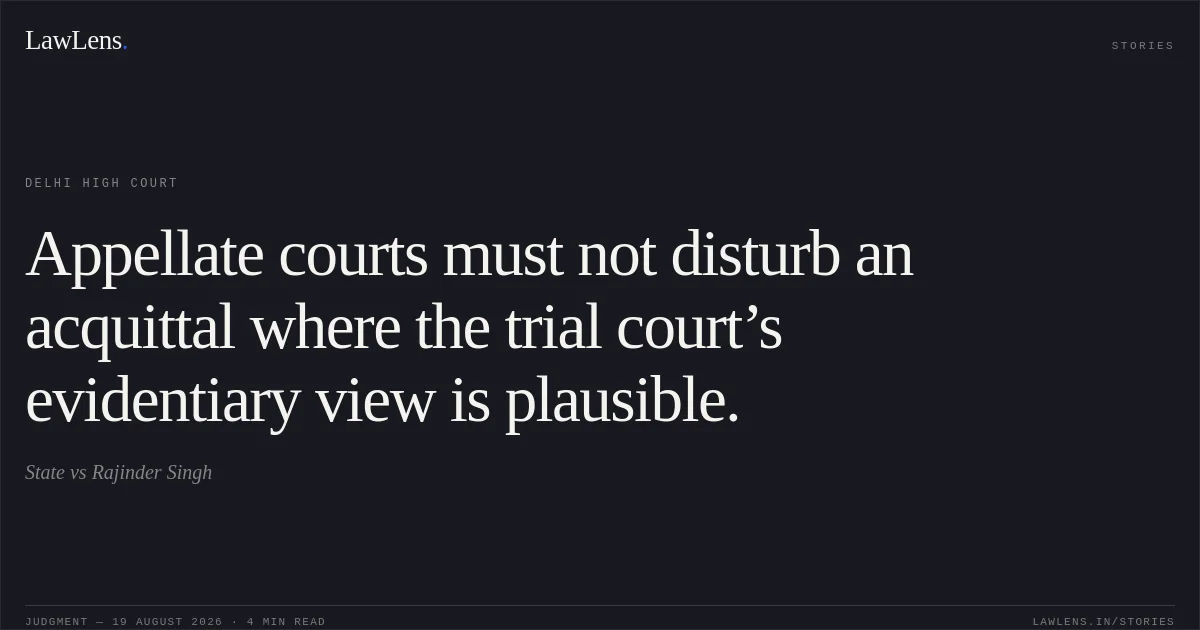
Source reference: paras. 47–48In these circumstances, the Trial Court’s view that the prosecution had not proved the case beyond reasonable doubt was found to be plausible and reasonable, and therefore did not meet the stringent standard for appellate interference with an acquittal.
Source reference: paras. 60–64Holding
The Court answered the issues against the State and held that the prosecution failed to prove beyond reasonable doubt that the respondent committed the offences under Sections 302 and 307 IPC.
The Trial Court’s acquittal was held to be a plausible and reasonable view supported by the evidence and was therefore not perverse or manifestly illegal.
Source reference: paras. 64–65The appeal was dismissed, and the respondent’s bail bonds and surety bonds were discharged.
Source reference: paras. 65–66A copy of the judgment was directed to be communicated to the Trial Court and the concerned Jail Superintendent for information and compliance.
Source reference: para. 67Acts & Sections Cited
5 provisions across 2 statutes referred to in this judgment. Each provision opens on LawLens.
Indian Penal Code, 18602
Code of Criminal Procedure, 19733
Original Court PDF
StatevsRajinder Singh
Click to open original judgment
Original judgment, available to read, download and summarize on LawLens.in