Facts
The victim, aged approximately 16 years and 11 months, was allegedly kidnapped from Sojitra on 22 December 2022.
Source reference: no citationHer father lodged an FIR under Section 363 of the IPC on 26 December 2022.
Source reference: no citationThe victim was subsequently found with the accused on 8 October 2025, when it was alleged that the accused had repeatedly committed penetrative sexual assault upon her, resulting in pregnancy.
Source reference: para. 4, p. 2Additional charges were therefore brought under Sections 366, 376(2)(n) and 376(3) of the IPC and Sections 4, 6 and 8 of the POCSO Act.
Source reference: para. 4, p. 2After trial, the Additional Sessions Judge, Petlad, acquitted the accused in Special POCSO Case No. 14 of 2025 by judgment dated 20 March 2026.
Source reference: para. 2, p. 1The original complainant challenged the acquittal under Section 413 of the Bharatiya Nagarik Suraksha Sanhita, 2023, corresponding to Section 372 of the CrPC.
Source reference: para. 1, p. 1The Trial Court relied principally on the victim’s failure to support the prosecution, her refusal to give a statement under Section 164 CrPC, her non-cooperation with medical examination, and the absence of DNA evidence linking the accused to the pregnancy.
Source reference: para. 8, p. 3Issues
Whether the Trial Court was justified in acquitting the accused where the victim did not support the prosecution and the prosecution lacked DNA or other forensic evidence connecting the accused with the alleged sexual assault and pregnancy?
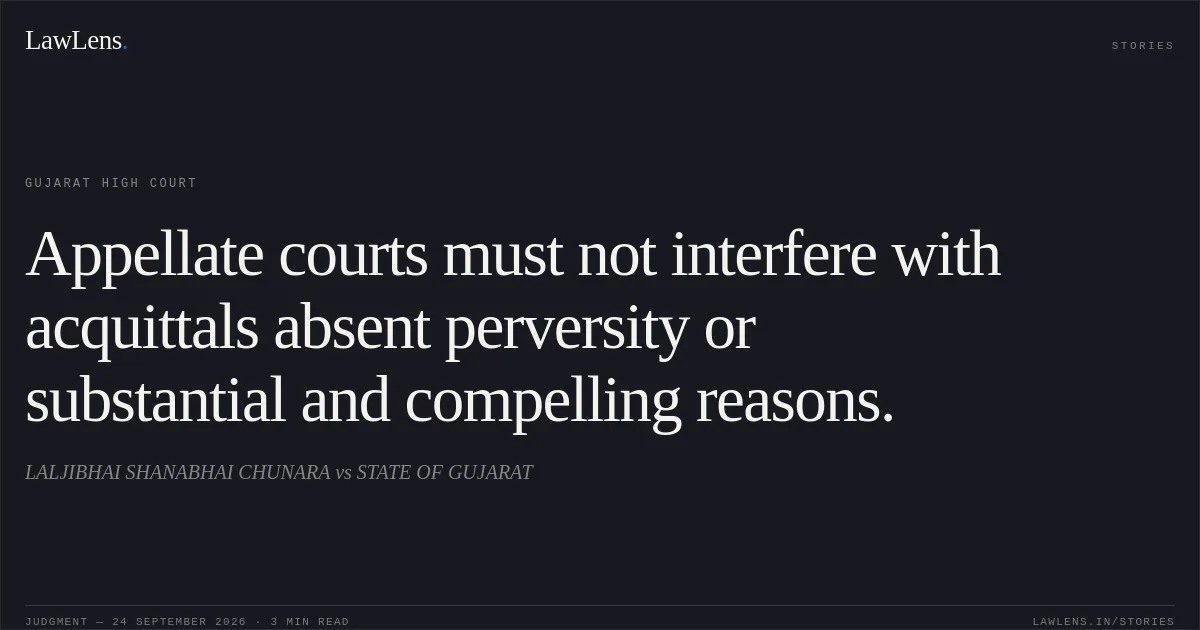
Source reference: para. 12, p. 4; para. 15, p. 5Whether the High Court, in an appeal against acquittal, should interfere with the Trial Court’s findings in the absence of perversity, substantial grounds, or compelling circumstances?
Source reference: para. 14, p. 5Law Applied
The Court applied Section 413 of the Bharatiya Nagarik Suraksha Sanhita, 2023, corresponding to Section 372 of the CrPC, governing an appeal by the victim or complainant against acquittal.
Source reference: para. 1, p. 1The prosecution was required to establish the charged offences under Sections 363, 366, 376(2)(n) and 376(3) of the IPC and Sections 4, 6 and 8 of the POCSO Act beyond reasonable doubt.
Source reference: para. 2, p. 1In an appeal against acquittal, the appellate court must respect the presumption of innocence strengthened by the acquittal and should interfere only in exceptional cases involving compelling circumstances, perversity, or an unreasonable view; where another view is reasonably possible, routine interference is impermissible.
Source reference: para. 14, p. 5The Court further applied the principle that circumstantial evidence must form a complete and reliable chain sufficient to establish guilt, particularly where the principal witness does not support the prosecution and the available forensic evidence does not connect the accused to the alleged offence.
Source reference: para. 15, p. 5Reasoning
The High Court found that the victim did not depose against the accused, refused to give a statement under Section 164 CrPC, and did not cooperate with the medical examination.
Source reference: para. 15, p. 5Consequently, the prosecution case substantially depended upon circumstantial and forensic evidence.
Source reference: no citationHowever, although the victim was allegedly pregnant when recovered, the Investigating Officer failed to obtain a DNA profiling report capable of establishing the accused’s paternity of the foetus.
Source reference: para. 15, p. 5The Court held that the existing forensic material did not show that the accused was responsible for the pregnancy, and the proved circumstances did not form a sufficient basis for inferring his guilt.
Source reference: para. 15, p. 5Since the Trial Court’s appreciation of the evidence was not perverse or unreasonable, and no substantial or compelling reason for appellate interference was demonstrated, the presumption of innocence arising from the acquittal remained undisturbed.
Source reference: paras. 14–16, pp. 5–6Holding
The High Court answered the issues against the appellant and held that the Trial Court was justified in acquitting the accused.
It found no perversity in the impugned judgment and no substantial or compelling ground warranting interference in the appeal against acquittal.
Source reference: para. 16, p. 6The criminal appeal was therefore dismissed at the admission stage.
Source reference: para. 17, p. 6Acts & Sections Cited
11 provisions across 4 statutes referred to in this judgment. Each provision opens on LawLens.
Bharatiya Nagarik Suraksha Sanhita, 20231
Code of Criminal Procedure, 19733
Indian Penal Code, 18604
Original Court PDF
LALJIBHAI SHANABHAI CHUNARAvsSTATE OF GUJARAT
Click to open original judgment
Original judgment, available to read, download and summarize on LawLens.in