Facts
The appellant-plaintiff instituted a suit seeking declaration, cancellation of a Release Deed (Haqtyagnama) dated 22.11.2021, and permanent injunction concerning land bearing Khasra Nos. 118/326, 261/327 and 636/122 at Mouza Gudla, Nagaur.
Source reference: p.2, para. 2He alleged that Respondent No. 1, along with late Hayat Ali, had fraudulently executed the Release Deed in favour of Respondents Nos. 2 and 3, prejudicing his rights.
Source reference: p.2, para. 2The appellant further claimed settled possession and cultivation and alleged that the respondents were attempting to alienate the property, create third-party interests, and alter its nature.
Source reference: p.2, para. 2Along with the suit, he sought temporary injunction under Order XXXIX Rules 1 and 2 read with Section 151 CPC.
Source reference: p.2, para. 2The trial court dismissed the application, principally relying on the admitted fact that Smt. Razia Sultana had predeceased Abdul Rehman and concluding that the appellant had not established a prima facie case.
Source reference: p.2–3, paras. 2.1The appellant challenged that order in the present appeal.
Source reference: p.2–3, paras. 2.1Issues
1. Whether the trial court’s refusal to grant temporary injunction under Order XXXIX Rules 1 and 2 read with Section 151 CPC warranted appellate interference.
Source reference: p.3, para. 4; p.5–6, paras. 6–72. Whether the appellant had demonstrated that the trial court’s exercise of discretion was arbitrary, capricious, perverse, legally untenable, or contrary to the settled principles governing interlocutory injunctions.
Source reference: p.3–5, paras. 4–5; p.6, paras. 6–6.3Law Applied
The court applied Order XXXIX Rules 1 and 2 read with Section 151 CPC, which govern the grant of temporary injunctions to preserve rights and property during the pendency of a suit.
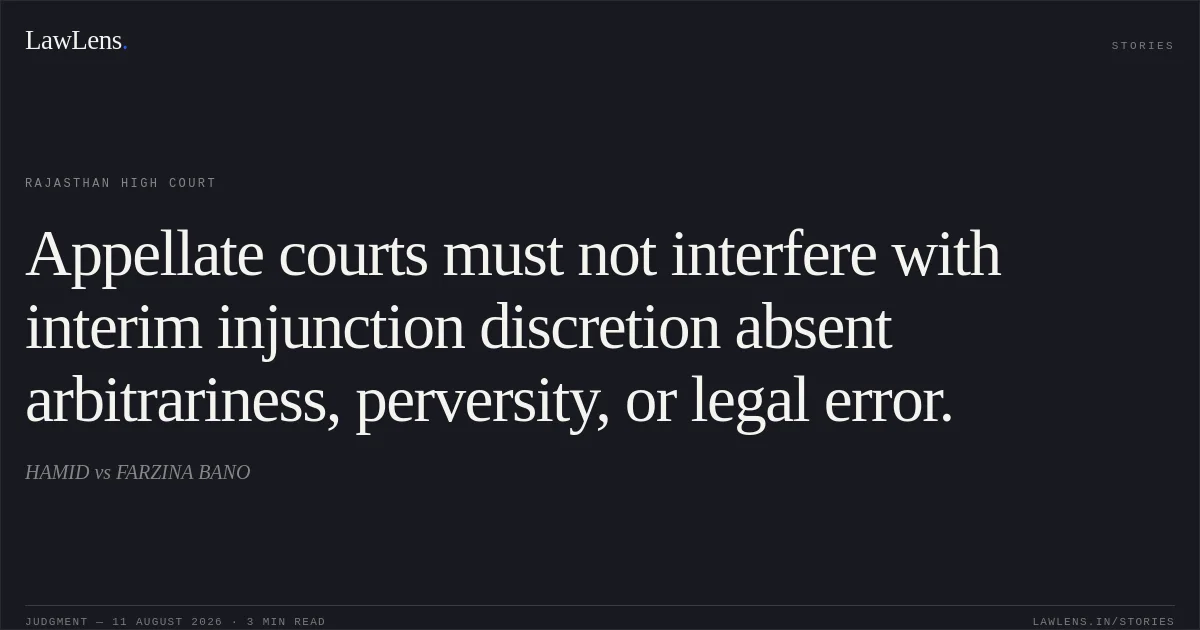
Source reference: p.3–5, para. 5It held that an appellate court exercising jurisdiction over an order granting or refusing interlocutory injunction must ordinarily defer to the trial court’s discretion and cannot substitute its own view merely because another conclusion is possible.
Source reference: p.3–5, para. 5Relying on Wander Ltd. v. Antox India (P) Ltd., 1990 Supp SCC 727, the court reiterated that appellate interference is justified only where the discretion has been exercised arbitrarily, capriciously, perversely, or by ignoring settled legal principles; the appellate court must determine whether the view taken was reasonably possible on the material before the trial court.
Source reference: p.3–5, para. 5Reasoning
The High Court found that the trial court had considered the pleadings and available material and had recorded reasons for refusing interim relief.
Source reference: p.5–6, paras. 6–6.2The appellant’s submissions essentially required a fresh examination of disputed questions concerning succession, inheritance, possession, and the validity of the Release Deed.
Source reference: p.5–6, para. 6.1Those matters formed the substance of the pending civil suit and required examination of oral and documentary evidence at trial; deciding them conclusively at the interlocutory stage would risk prejudging the suit.
Source reference: p.5–6, para. 6.1The High Court found no indication that the trial court had ignored relevant material, relied on extraneous considerations, or failed to apply the governing principles.
Source reference: p.6, paras. 6.2–6.3Even if a different view could reasonably have been taken, that circumstance did not justify appellate substitution of discretion under the restrictive standard in Wander Ltd.
Source reference: p.6, paras. 6.2–6.3Holding
The court held that the appellant failed to establish that the trial court’s refusal of temporary injunction was arbitrary, perverse, capricious, or contrary to law.
The Civil Miscellaneous Appeal was dismissed, and the order dated 04.05.2026 passed by the Additional District Judge No. 2, Nagaur in Civil Misc. Case No. 73/2024 was affirmed.
Source reference: p.7, para. 8The stay petition and all pending applications were also disposed of.
Source reference: p.7, para. 8Acts & Sections Cited
1 provisions across 1 statute referred to in this judgment. Each provision opens on LawLens.
Code of Civil Procedure, 19081
Original Court PDF
HAMIDvsFARZINA BANO
Click to open original judgment
Original judgment, available to read, download and summarize on LawLens.in