Facts
The appellant filed a complaint under Section 138 of the Negotiable Instruments Act, alleging that the respondent borrowed ₹5,00,000 in cash on 19 November 2018 and issued a cheque for that amount, which was dishonoured for insufficient funds. The respondent denied the loan, asserting that the appellant had misused a signed blank cheque given in connection with earlier, smaller transactions.
Source reference: p.2–3The trial court acquitted the respondent on 27 April 2023, finding the alleged loan doubtful; the complainant appealed under Section 378 CrPC. In appeal, the appellant relied on the cheque and the statutory presumptions, while the respondent pointed to the parties’ earlier transactions, the appellant’s financial capacity, and bank records showing that the ₹19,00,000 said to fund the loan belonged to a third party, Darani.
Source reference: p.2–6Issues
1. Whether the trial court’s acquittal in the Section 138 complaint was perverse or otherwise warranted interference in appeal
Source reference: p.3–72. Whether the evidence—including the respondent’s denial, the parties’ prior transactions, and the evidence concerning the appellant’s financial capacity—left the alleged ₹5,00,000 loan and cheque liability doubtful
Source reference: p.5–6Law Applied
Section 138 of the Negotiable Instruments Act criminalises the dishonour of a cheque issued in discharge of a legally enforceable debt or liability; Sections 118 and 139 provide statutory presumptions concerning consideration and the holder’s receipt of the cheque in discharge of a debt, which the appellant invoked because the respondent did not deny the cheque or signature.
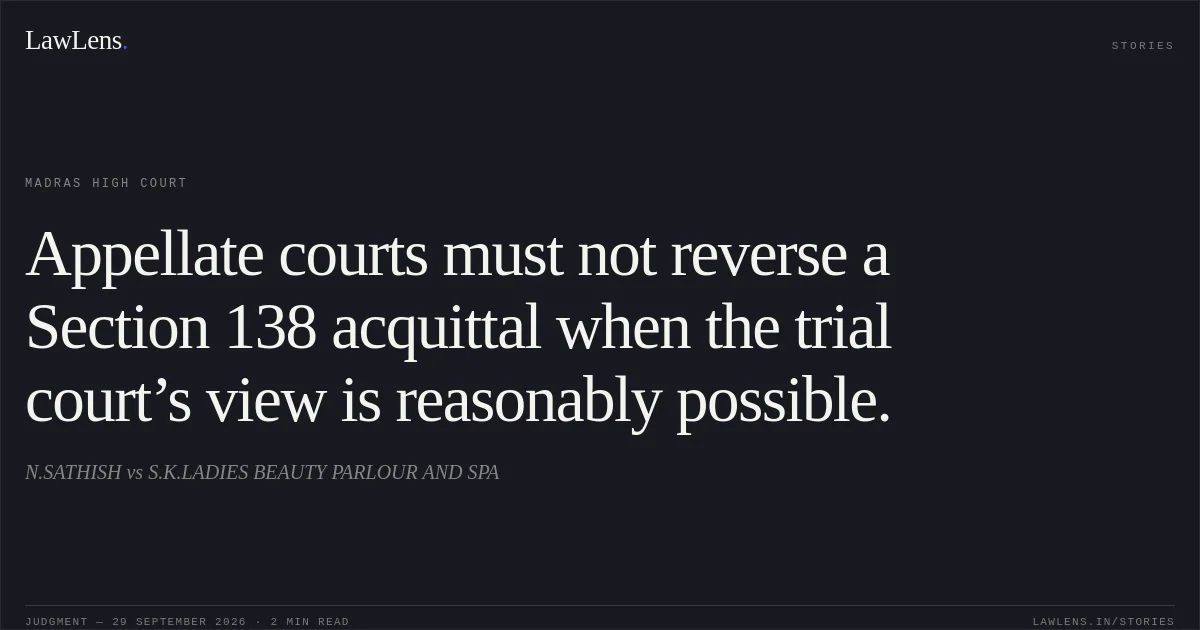
Source reference: p.2–3The appeal was brought under Section 378 CrPC against an acquittal. Relying on K. Prakashan v. P.K. Surenderan, (2008) 1 SCC 258, the Court applied the principle that an appellate court should not reverse an acquittal merely because another view is possible where the trial court’s view is reasonably available.
Source reference: p.7Reasoning
The parties’ earlier loans were comparatively small and, according to the respondent, had been transacted through banks; the respondent had also raised the cheque-misuse defence in her reply notice.
Source reference: p.5–6Although the appellant relied on bank entries showing receipts totalling ₹19,00,000 around the alleged loan date, he acknowledged that the money belonged to Darani and was intended for an agricultural land purchase. Darani was not examined, and the appellant’s income-tax return did not record the alleged loan and had been filed after the statutory notice and reply. On this record, the Court found the trial court’s conclusion that the loan and the appellant’s means to advance it were doubtful to be a reasonable view, not a perverse one.
Source reference: p.5–7Holding
The Court held that the trial court’s acquittal was supported by a detailed and reasoned assessment of the evidence and found no basis to interfere under the principles governing appeals against acquittal.
The criminal appeal was dismissed, leaving the acquittal undisturbed.
Source reference: p.7Acts & Sections Cited
4 provisions across 2 statutes referred to in this judgment. Each provision opens on LawLens.
Code of Criminal Procedure, 19731
Negotiable Instruments Act, 18813
Original Court PDF
N.SATHISHvsS.K.LADIES BEAUTY PARLOUR AND SPA
Click to open original judgment
Original judgment, available to read, download and summarize on LawLens.in