Facts
The petitioner was convicted by the Judicial Magistrate First Class, Bilaspur, under Section 138 of the Negotiable Instruments Act ("N.I. Act") on January 31, 2024.
Source reference: para. 2He was sentenced to one year of rigorous imprisonment and directed to pay compensation of Rs. 50,00,000/-.
Source reference: para. 2The petitioner challenged this judgment before the 8th Additional Sessions Judge, Bilaspur, via a criminal appeal under Section 415 of the Bharatiya Nagarik Suraksha Sanhita, 2023 ("BNSS").
Source reference: para. 3Along with the appeal, the petitioner filed an application for suspension of execution of the judgment under Section 430 of the BNSS.
Source reference: para. 3On February 20, 2024, the Appellate Court allowed the suspension but imposed a condition that the petitioner deposit 20% of the compensation amount (Rs. 10,00,000/-).
Source reference: para. 1, 3The petitioner moved the High Court under Section 528 of the BNSS, contending the condition was imposed without assigning reasons or considering the discretionary nature of the word "may" in Section 148 of the N.I. Act.
Source reference: para. 4Issues
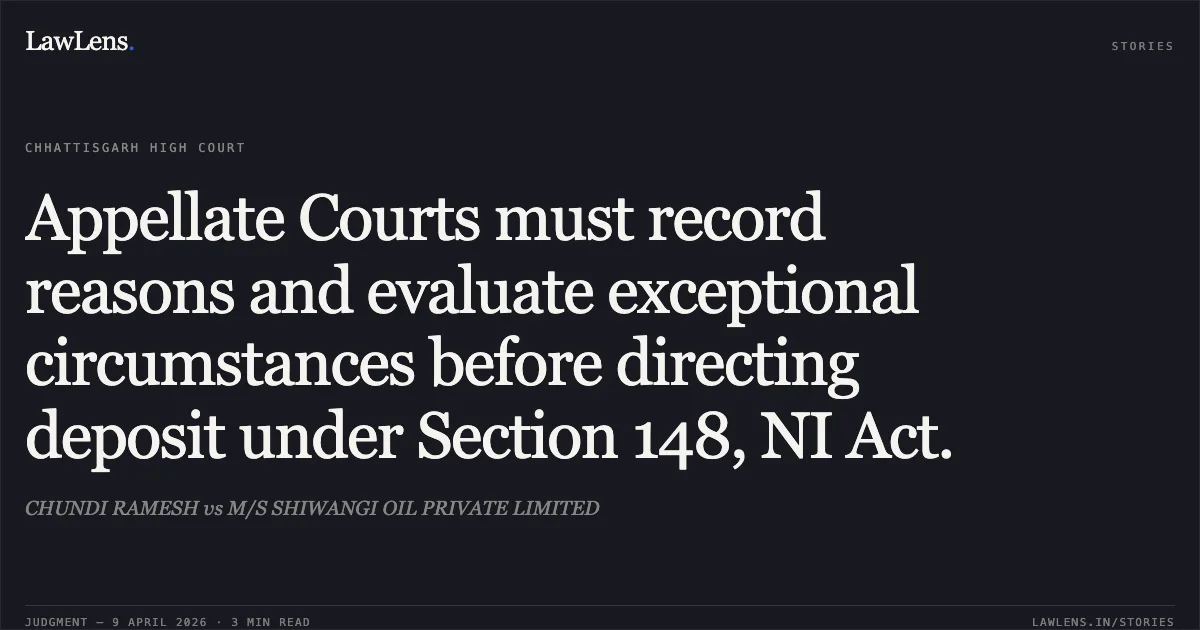
1. Whether the Appellate Court is mandatorily required to impose a 20% deposit condition under Section 148 of the N.I. Act while suspending a sentence, or if it must record reasons for such an imposition.
Source reference: para. 5, 82. Whether the impugned order dated February 20, 2024, was passed in accordance with the legal principles governing "exceptional cases" as established by the Supreme Court.
Source reference: para. 6, 8Law Applied
Section 148 of the N.I. Act (as amended in 2018), which stipulates that the Appellate Court "may" order the appellant to deposit a minimum of 20% of the fine or compensation.
Source reference: para. 5The precedent set by the Hon’ble Supreme Court in Jumboo Bhandari v. M.P. State Industrial Development Corporation Ltd. & Ors. (2023), which established that the Appellate Court must consider whether a case is "exceptional" to warrant a suspension of sentence without the 20% deposit, and such conclusions must be supported by recorded reasons.
Source reference: para. 6This principle was further reinforced by Muskan Enterprises & Anr. v. State of Punjab & Anr. (2024).
Source reference: para. 7Reasoning
The High Court examined whether the Appellate Court had exercised its discretion judiciously under Section 148 of the N.I. Act.
Source reference: para. 8It observed that while the law provides the power to impose a deposit condition, the Supreme Court's mandate in Jumboo Bhandari requires a qualitative assessment of the case.
Source reference: para. 6, 8The High Court noted that the impugned order of the 8th Additional Sessions Judge did not disclose any reasoning as to whether the petitioner’s case fell within an "exceptional" category or why the 20% deposit was necessary in this specific instance.
Source reference: para. 8The Court found that the Appellate Court had failed to follow the procedural requirement of passing a "reasoned order" when applying the BNSS (corresponding to the Cr.P.C.) alongside the N.I. Act.
Source reference: para. 9Holding
The High Court set aside the impugned order dated February 20, 2024.
It restored the petitioner’s application for suspension of sentence (originally filed under Section 430 BNSS/389 Cr.P.C.) to the Appellate Court for fresh consideration.
Source reference: para. 9The Appellate Court was directed to dispose of the application with a fresh, reasoned order as soon as possible.
Source reference: para. 9In the interim, the execution of the trial court's judgment dated January 31, 2024, was ordered to remain suspended. The CRMP was disposed of accordingly.
Source reference: para. 9, 10Acts & Sections Cited
7 provisions across 3 statutes referred to in this judgment. Each provision opens on LawLens.
Bharatiya Nagarik Suraksha Sanhita, 20233
Negotiable Instruments Act, 18812
Code of Criminal Procedure, 19732
Original Court PDF
CHUNDI RAMESHvsM/S SHIWANGI OIL PRIVATE LIMITED
Click to open original judgment
Original judgment, available to read, download and summarize on LawLens.in