Facts
The Petitioners (Mayank) and Respondent No. 1 (Raju) are partners in Vidhi Research and Development LLP, governed by an LLP Agreement dated August 14, 2014.
Source reference: para. 2The parties are embroiled in arbitration regarding governance rights and control of the LLP’s primary asset—land admeasuring ~2,18,122 sq. meters (“Subject Land”).
Source reference: para. 3In July 2022, a consent order established an interim arrangement requiring Mayank to give Raju notice of any proposal to deal with the Subject Land, allowing Raju six weeks to object and an additional two weeks to move the Tribunal before implementation.
Source reference: para. 15In July 2025, Mayank issued a notice to sell ~100,000 sq. meters of the land for ₹1,250 crores based on an alleged third-party offer.
Source reference: para. 5Raju filed an application (IA 14) under Section 17 of the Arbitration and Conciliation Act, seeking a restraint on the sale.
Source reference: no citationThe Arbitral Tribunal, after finding Mayank’s disclosures regarding the transaction to be redacted and "cloaked in mystery," passed the Impugned Order restraining Mayank from dealing with the land.
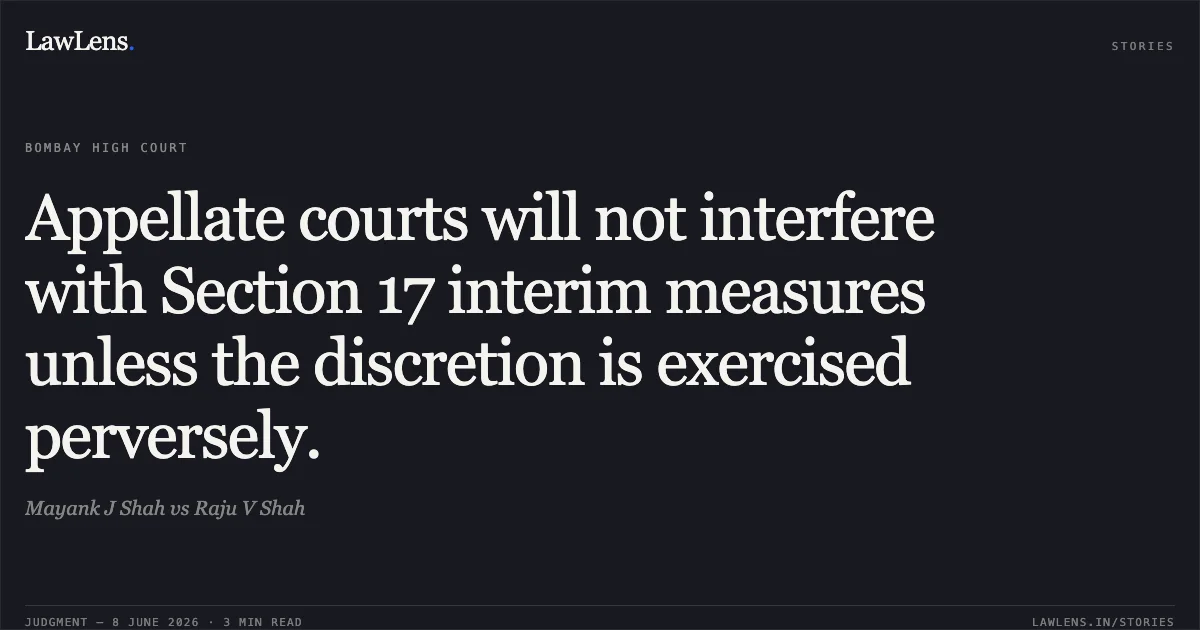
Source reference: paras. 20-25Mayank challenged this under Section 37.
Source reference: para. 1Issues
1. Whether the Arbitral Tribunal misinterpreted the consent order dated July 20, 2022, thereby making the Impugned Order perverse.
Source reference: para. 132. Whether the restraint on the sale of the Subject Land was a justified interim measure under Section 17 to protect the subject matter of arbitration.
Source reference: para. 25-263. Whether an appellate court under Section 37 should interfere with the discretionary interlocutory order of an Arbitral Tribunal.
Source reference: para. 36Law Applied
Section 17 of the Arbitration and Conciliation Act, 1996, regarding the Tribunal's power to order interim measures to preserve the subject matter of the dispute.
Source reference: para. 25The court applied the restrictive scope of judicial interference under Section 37, equating it with the standards of Section 34.
Source reference: para. 36The principle from Wander Ltd. v. Antox India (P) Ltd. (1990), which mandates that an appellate court shall not substitute its own discretion for that of the lower forum unless the exercise of discretion is shown to be arbitrary, capricious, or perverse.
Source reference: para. 36"working partner" protections and majority principles under the Limited Liability Partnership Act, 2008.
Source reference: paras. 6, 18Reasoning
The Court rejected Mayank’s argument that his 80% majority interest granted him absolute commercial wisdom to sell assets without full disclosure to the minority partner.
Source reference: para. 11The Court found that even if the July 2022 order was interpreted narrowly as Mayank suggested, the Tribunal had independent authority under Section 17 to protect the Subject Land, which constitutes substantially all of the LLP’s assets.
Source reference: paras. 15, 25Upon reviewing the documents shared by Mayank—which were heavily redacted and involved a 18% fee to a "group company" (Ulltra)—the Court agreed with the Tribunal that the transaction lacked transparency and "did not inspire confidence".
Source reference: paras. 21-24, 27The Court reasoned that allowing the sale of half the Subject Land in a "cloak-and-dagger manner" would render the final arbitral award a mockery by destroying the substratum of the partnership.
Source reference: paras. 31, 33Consequently, the Tribunal’s decision was found to be a "sensible and reasonable" exercise of discretion to maintain the status quo.
Source reference: para. 18Holding
The Court answered the issues in the negative, holding that the Arbitral Tribunal did not err in its interpretation and that the protective measures were necessary.
The Court held that the Subject Land must be preserved as the subject matter of the arbitration.
Source reference: para. 33The Petition was dismissed with costs to be assessed and factored in by the Arbitral Tribunal at the conclusion of the arbitration proceedings.
Source reference: paras. 38-40Acts & Sections Cited
3 provisions across 1 statute referred to in this judgment. Each provision opens on LawLens.
Arbitration and Conciliation Act, 19963
Original Court PDF
Mayank J ShahvsRaju V Shah
Click to open original judgment
Original judgment, available to read, download and summarize on LawLens.in