Facts
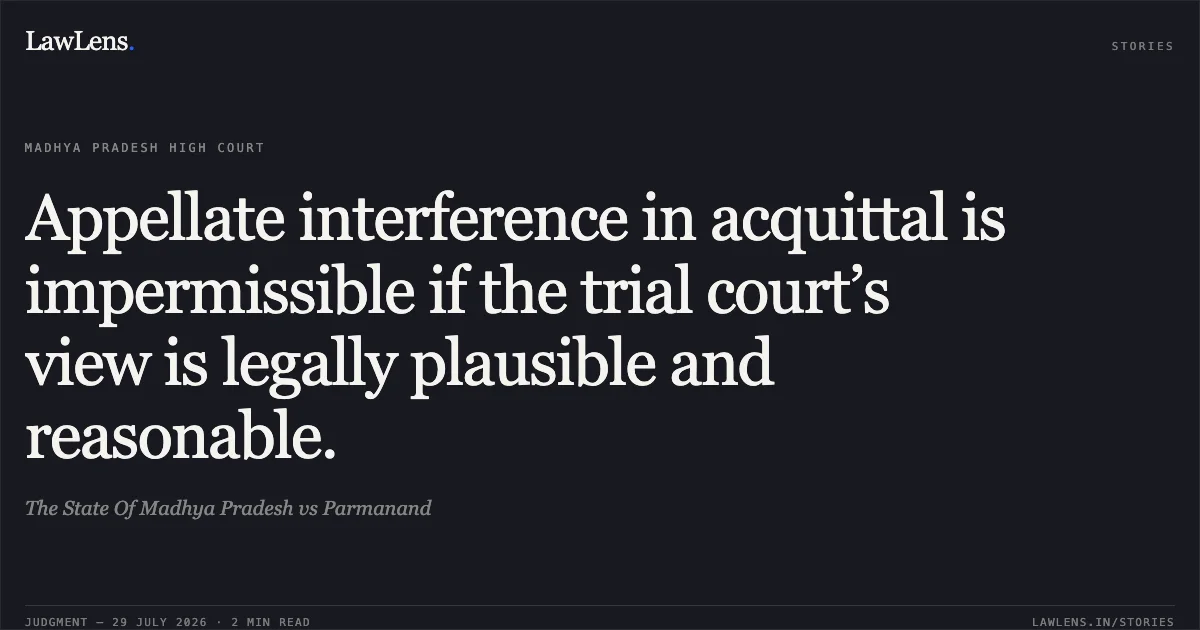
The State appealed against the judgment dated 19.10.2022 by the Special Judge, POCSO Act, Betul, which acquitted the respondent (a School Headmaster) of charges under Sections 354 and 506 Part-II of the IPC, Sections 9/10 of the POCSO Act, and various sections of the SC/ST (Prevention of Atrocities) Act.
Source reference: para 1The prosecution alleged that the accused engaged in indecent behavior and inappropriate physical contact with several girl students residing in a school hostel.
Source reference: para 2An inquiry committee report (Ex.P/53) led to the FIR, although no victim or parent lodged a direct complaint despite the police station being adjacent to the hostel.
Source reference: paras 2, 8During the trial, 15 out of 17 victim witnesses turned hostile, alleging their prior statements were coached by others.
Source reference: para 9Issues
1. Whether the trial court erred in granting the benefit of doubt to the accused despite the incriminating testimony of two victims (PW-1 and PW-2).
Source reference: para 62. Whether the findings of the trial court were perverse or legally implausible, necessitating interference by the appellate court under Section 378 of the CrPC.
Source reference: paras 13-16Law Applied
The court applied the standards for appellate review of acquittals under Section 378 of the CrPC, emphasizing that an order of acquittal should not be disturbed unless "perverse" or "wholly unreasonable".
Source reference: para 13It relied on H.D. Sundara v. State of Karnataka (2023), which dictates that if two views are possible, the one favoring the accused must be followed.
Source reference: para 13It further cited Babu Sahebagouda Rudragoudar v. State of Karnataka (2024) and Mallappa v. State of Karnataka (2024), affirming that acquittal strengthens the presumption of innocence and requires the appellate court to demonstrate patent perversity or error of law to reverse the trial court's decision.
Source reference: paras 14, 15Reasoning
The High Court found the trial court's appreciation of evidence comprehensive and rational. It noted that the prosecution failed to explain why no FIR was lodged by victims or parents immediately, despite the proximity of the police station.
Source reference: para 8The Court observed that the inquiry committee (Ex.P/53) did not provide the accused an opportunity for defense and that committee members admitted no teachers had complained about the accused's behavior.
Source reference: para 8Critically, 15 victims (PW-3 to PW-21) turned hostile, claiming their Section 164 CrPC statements were made under duress from hostel staff.
Source reference: para 9While PW-1 and PW-2 initially supported the prosecution, PW-2 recanted her testimony during cross-examination, and PW-1’s statements were riddled with omissions and contradictions.
Source reference: paras 9, 11Because the testimony lacked specific details regarding the date, time, and place of the incidents, the High Court held that the trial court's doubt was a "legally plausible view".
Source reference: paras 11, 12, 16Holding
The High Court held that the trial court’s judgment did not suffer from perversity or misreading of evidence.
The High Court dismissed the application for leave to appeal and the criminal appeal itself, affirming the acquittal of the respondent/accused and granting him the benefit of doubt.
Source reference: paras 16, 17Acts & Sections Cited
11 provisions across 4 statutes referred to in this judgment. Each provision opens on LawLens.
Code of Criminal Procedure, 19733
Indian Penal Code, 18603
Protection of Children from Sexual Offences Act, 20124
Scheduled Castes and the Scheduled Tribes (Prevention of Atrocities) Act, 19891
Original Court PDF
The State Of Madhya PradeshvsParmanand
Click to open original judgment
Original judgment, available to read, download and summarize on LawLens.in