Facts
On December 15, 2024, a decomposed body tied with stones was discovered in Jisfari Dam
Source reference: para. 4The deceased was later identified as Chudru Ram, who had been missing for approximately 15 days
Source reference: para. 5The prosecution alleged that the respondents murdered the deceased with a wooden stick (sarei danda) and disposed of the body to conceal the crime
Source reference: para. 5Following an investigation, the respondents were charged under the Bharatiya Nyaya Sanhita (BNS).
Source reference: para. 3The Trial Court, in its judgment dated December 9, 2025, acquitted the respondents, holding that the prosecution failed to prove the charges beyond reasonable doubt
Source reference: para. 3The State subsequently filed the present petition seeking leave to appeal the acquittal, along with an application to condone an eight-day delay in filing
Source reference: para. 1, 3Issues
Whether the eight-day delay in filing the petition for leave to appeal should be condoned.
Source reference: para. 1Whether the State provided sufficient grounds to grant leave to appeal against the judgment of acquittal, specifically regarding the sufficiency of circumstantial evidence.
Source reference: para. 9-11Law Applied
The court examined charges under Sections 103(1) (murder), 238 (causing disappearance of evidence), and 3(5) (joint liability) of the Bharatiya Nyaya Sanhita, 2023
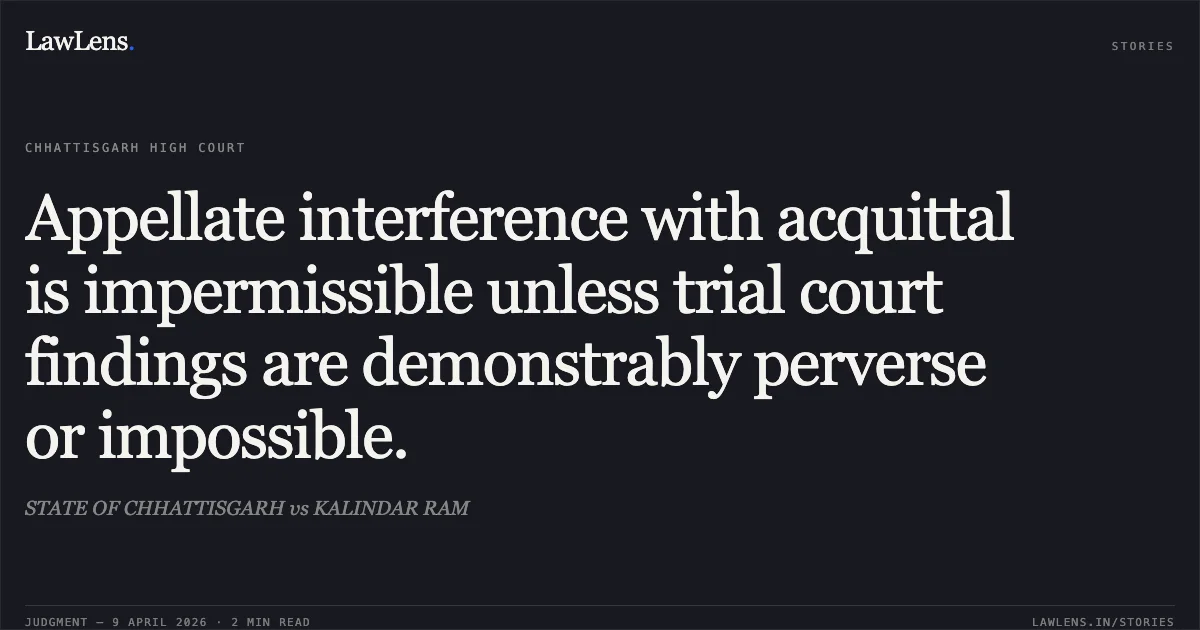
Source reference: para. 3Regarding the scope of appellate interference in acquittals, the court relied on the precedent set in State of Rajasthan v. Kistoora Ram (2022 SCC OnLine SC 984), which mandates that an acquittal cannot be disturbed unless the trial court's view is "impossible or perverse"
Source reference: para. 19The court also applied the established principles of circumstantial evidence, which require a "complete chain" of events pointing unerringly to the guilt of the accused and excluding every other hypothesis
Source reference: para. 14, 16Reasoning
The High Court first condoned the eight-day delay, finding sufficient cause
Source reference: para. 2On the merits of the leave to appeal, the Court observed that although the medical evidence by PW-09 confirmed the death was homicidal due to strangulation, the prosecution failed to establish a nexus between the accused and the crime
Source reference: para. 13The Court noted that the case relied entirely on circumstantial evidence; however, key prosecution witnesses (PW-02, PW-03, and PW-04) turned hostile, particularly regarding the identification of the gamcha used to tie the stones
Source reference: para. 14Furthermore, the forensic examination of the seized wooden stick failed to detect human blood, significantly weakening the recovery evidence
Source reference: para. 15The Court reasoned that the Trial Court’s findings were plausible because the memorandum statements and seizures lacked independent corroboration and the chain of circumstances remained broken
Source reference: para. 15-17Holding
The High Court denied the State's petition for leave to appeal.
It held that the Trial Court’s view was a reasonable and plausible interpretation of the evidence on record
Source reference: para. 21The Court concluded that there was no perversity, illegality, or material irregularity in the impugned judgment that would warrant appellate interference
Source reference: para. 20The application for leave to appeal was rejected as devoid of merit
Source reference: para. 22Acts & Sections Cited
3 provisions across 1 statute referred to in this judgment. Each provision opens on LawLens.
Bharatiya Nyaya Sanhita, 20233
Original Court PDF
STATE OF CHHATTISGARHvsKALINDAR RAM
Click to open original judgment
Original judgment, available to read, download and summarize on LawLens.in