Facts
The 1st Respondent, an employee of the appellant Cooperative Society, was placed under suspension following allegations of misappropriation exceeding Rs. 1 Crore
Source reference: p. 6He approached the Joint Commissioner of Labour under the Tamil Nadu Payment of Subsistence Allowances Act, 1981, seeking a direction for the disbursement of subsistence allowance totaling Rs. 17,51,266/-.
Source reference: p. 2The competent authority under the General Act passed an order in his favor on 14.12.2021
Source reference: p. 2The 1st Respondent then filed a Writ of Mandamus (W.P. No. 6284 of 2022) to implement this order, which was allowed on 08.12.2025
Source reference: p. 2The appellant Society filed this intra-court appeal challenging the maintainability of the original application before the Labour Commissioner, arguing that the Cooperative Societies Act provides an exclusive remedy
Source reference: p. 2-3Issues
1. Whether an application for subsistence allowance under the Tamil Nadu Payment of Subsistence Allowances Act, 1981 is maintainable against a Cooperative Society governed by special bye-laws and the Tamil Nadu Co-operative Societies Act, 1983?
Source reference: p. 3-42. Whether the 1st Respondent was required to exhaust the alternative remedies available under the Tamil Nadu Co-operative Societies Act, 1983 before seeking writ jurisdiction?
Source reference: p. 3Law Applied
The Court applied the principle that a Special Act prevails over General Law, identifying the Tamil Nadu Co-operative Societies Act, 1983 and its Rules (specifically Rule 149) as special legislation that overrides the Tamil Nadu Payment of Subsistence Allowances Act, 1981
Source reference: p. 4Rule 149(1) of the Tamil Nadu Co-operative Societies Rules, 1988, which mandates that Societies adopt special bye-laws governing service conditions
Source reference: p. 3-4Section 153 (Revision) and Section 154 (Review) of the Tamil Nadu Co-operative Societies Act as the prescribed statutory remedies
Source reference: p. 5Division Bench precedent in Registrar of Co-operative Societies v. V.M. Elango (2021), which affirms the right to subsistence allowance under Article 21 but subjects its administration to the Society's bye-laws and the employer's discretion
Source reference: p. 7-8Reasoning
The Court reasoned that since the appellant Society is registered under the Tamil Nadu Co-operative Societies Act, its service conditions are strictly governed by special bye-laws approved by the Registrar under Rule 149
Source reference: p. 4Although Clause 31(2) of the Society’s bye-laws adopts the quantum of allowance prescribed by the General Subsistence Act, the power to grant it remains vested in the Society's management
Source reference: p. 4Consequently, the Joint Commissioner of Labour lacks jurisdiction because the special law provides a complete machinery for redressal
Source reference: p. 5The Court observed that the 1st Respondent bypassed the mandatory revisional procedure under Section 153 of the Act
Source reference: p. 5The Court further noted that the Society is empowered to initiate simultaneous criminal, disciplinary, and surcharge proceedings (under Section 87) for financial loss, and that any claim for allowance must comply with the procedural requirements (e.g., non-employment certificates) stipulated by the employer
Source reference: p. 6-7Holding
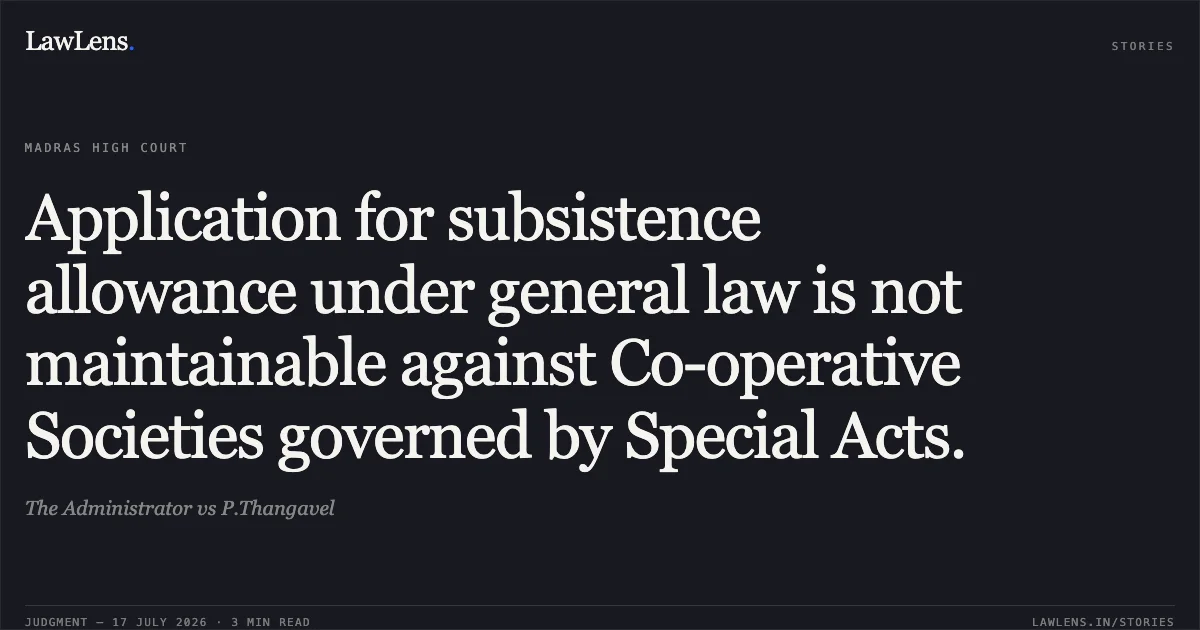
The High Court held that the application filed before the Joint Commissioner of Labour was not maintainable due to a lack of jurisdiction under the special statutory framework governing Cooperative Societies
The Court set aside the writ order dated 08.12.2025 and allowed the Writ Appeal. The 1st Respondent was granted liberty to submit a fresh application for subsistence allowance to the Society's Management and, if aggrieved by their decision, to seek redressal through the revisional authority under Section 153 of the Tamil Nadu Co-operative Societies Act
Source reference: p. 9Acts & Sections Cited
8 provisions across 3 statutes referred to in this judgment. Linked provisions open on LawLens.
Tamil Nadu Payment of Subsistence Allowance Act, 19816
Tamil Nadu Co-operative Societies (Third Permanent) Act, 20081
National Dope Testing Laboratory (Service, Administrative & Financial) Bye-Laws, 20091
Original Court PDF
The AdministratorvsP.Thangavel
Click to open original judgment
Original judgment, available to read, download and summarize on LawLens.in