01Facts
The respondent, a Lower Grade Clerk (LGC), was dismissed from service on May 16, 2018, following a departmental inquiry.
¶ 1, 72The inquiry found him guilty of three charges: failing to report to his new posting at Van Sadan, proceeding to the mainland without approved leave, and refusing to accept official memos.
¶ 59-62The respondent challenged the dismissal before the Central Administrative Tribunal (CAT).
¶ 2, 20The CAT quashed the dismissal order solely on the ground that the Chief Secretary, who acted as the Disciplinary Authority, was also the designated Appellate Authority under a 2009 Gazette Notification, thereby depriving the respondent of a legitimate forum for appeal.
¶ 2, 20The Administration filed this writ petition challenging the CAT’s order of reinstatement.
¶ 102Issues
i.1. Whether the Chief Secretary was the competent "Appointing Authority" under Rule 2(a) of the CCS-CCA Rules to impose the penalty of dismissal.
¶ 23ii.2. Whether the initiation of the inquiry by the Secretary (Personnel) and the subsequent imposition of penalty by the Chief Secretary was legally valid under Article 311(1) of the Constitution.
¶ 9, 30iii.3. Whether the respondent was deprived of an appellate forum, rendering the punishment order void.
¶ 13, 20iv.4. Whether the subsequent disciplinary action was barred by the principle of res judicata.
¶ 1703Law Applied
The court primarily applied Article 311(1) of the Constitution of India, which prohibits dismissal by an authority subordinate to the Appointing Authority.
¶ 30It relied on Rule 2(a) of the CCS-CCA Rules, 1965, which defines "Appointing Authority" as the highest among the authority empowered to appoint or the authority that actually appointed the servant.
¶ 24, 29The court further cited The State of Jharkhand v. Rukma Kesh Mishra (2025) to establish that a subordinate may initiate proceedings, while only the final penalty must be by the Appointing Authority.
¶ 10, 35Precedents from Monmatha Nath Ghosh v. DPI and Iuwangjao Kabul v. Union of India were used to rule that if the Appellate Authority passes the initial order, an appeal lies to the next higher administrative officer.
¶ 11, 40-41Provisions in the judgment · 1
Central Civil Services (Classification, Control & Appeal) Rules, 1965 Section 2
04Reasoning
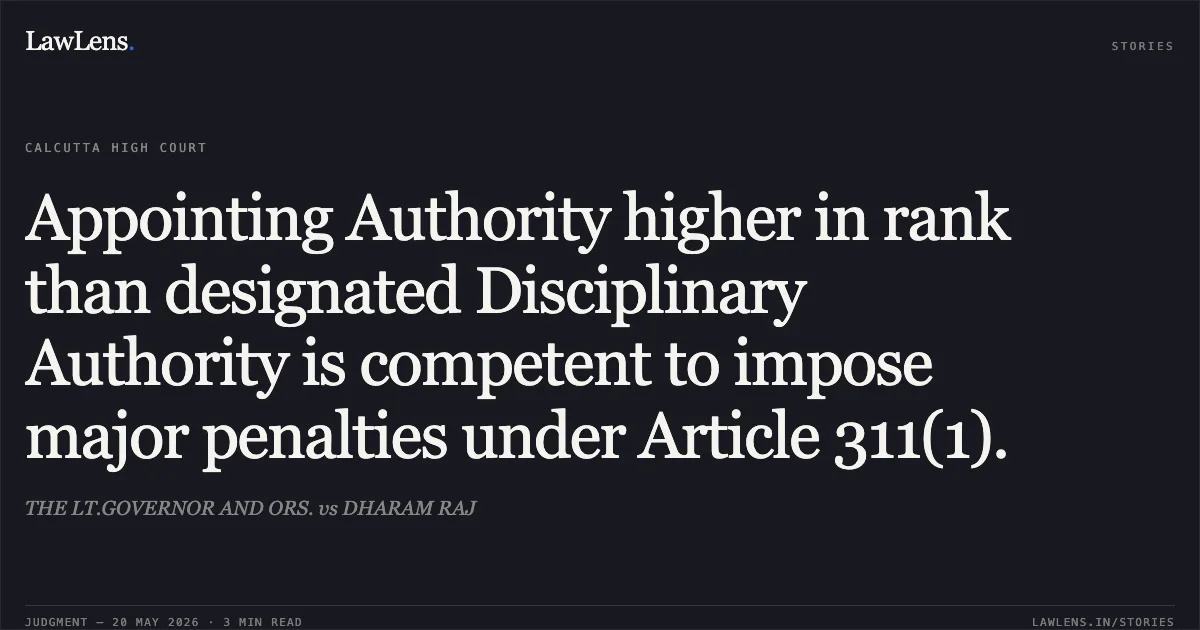
The court found that although a 2009 notification designated the Secretary (Personnel) as the Appointing Authority, Rule 2(a)(iii) and (iv) of the CCS-CCA Rules mandate that the "highest" authority among the options (actual vs. designated) is the Appointing Authority; since the Chief Secretary actually appointed the respondent in 1990, he remained the Appointing Authority.
¶ 26-29Per Article 311(1), while a subordinate cannot dismiss, a superior (the Chief Secretary) is fully empowered to do so.
¶ 31The court rejected the "loss of appeal" argument, noting that in the A&N Islands hierarchy, an appeal against the Chief Secretary’s order lies to the Lieutenant Governor—a forum the respondent had actually utilized.
¶ 49-50Regarding res judicata, the court clarified that a previous remand by a coordinate bench implicitly set aside the earlier CAT order, allowing for fresh deliberation.
¶ 67-69Finally, the court held that judicial review cannot re-appreciate evidence where the CAT had already found no procedural lapses or vagueness in charges.
¶ 54-56, 6405Holding
The Court allowed the petition in part, setting aside the CAT's judgment and affirming the respondent’s dismissal.
¶ 72It held that the Chief Secretary was the competent Disciplinary Authority and his order did not violate Article 311 or the CCS-CCA Rules.
¶ 29, 47The Principle of res judicata did not apply as the matter was previously remanded for re-evaluation.
¶ 69The appellate order dated August 07, 2018, was upheld.
¶ 72Original Court PDF
THE LT.GOVERNOR AND ORS.vsDHARAM RAJ
Click to open original judgment
Original judgment, available to read, download and summarize on LawLens.in