Facts
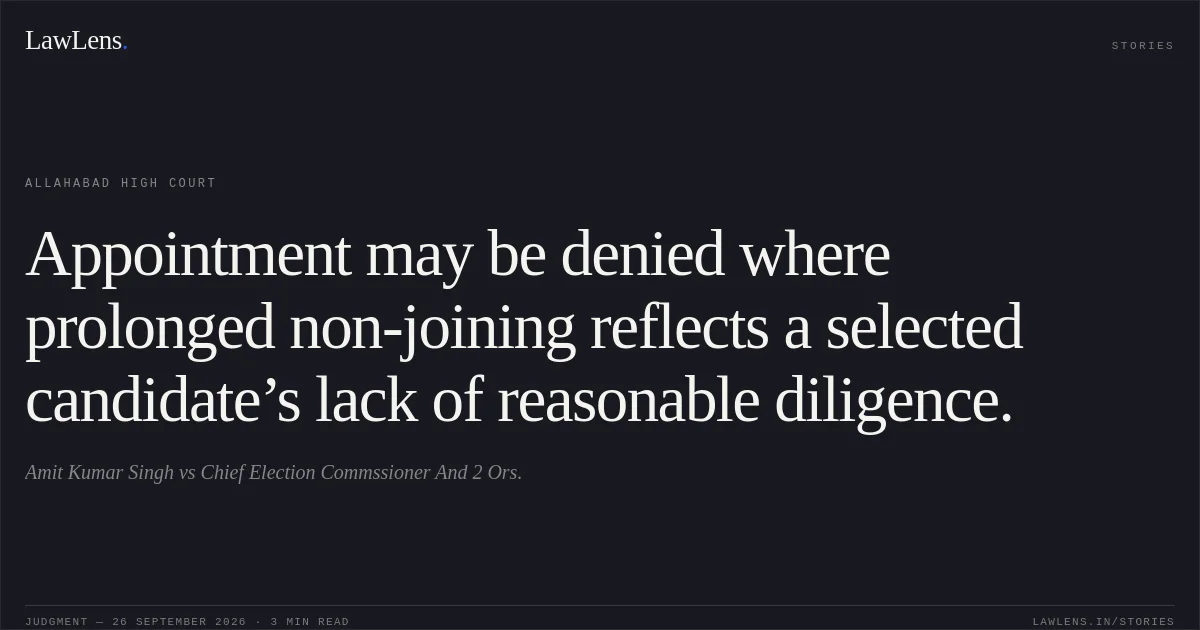
The petitioner applied for appointment to the post of Upper Division Assistant and furnished a permanent address in Jaunpur and a correspondence address in Lucknow.
Source reference: paras. 4–5The respondents sent the admit card, a document-verification communication, and the final-examination result to the Lucknow address.
Source reference: paras. 4–5The petitioner admittedly received the communication dated 8 June 2004 informing him that he had been successful in the final examination.
Source reference: para. 6However, the appointment letter dated 24 November 2004 was initially sent to his permanent address in Jaunpur.
Source reference: para. 7It was allegedly redirected after postal endorsements and ultimately received by a neighbour in Lucknow, who, according to the petitioner, handed it over to him only on 14 April 2006.
Source reference: paras. 7–9The petitioner applied for permission to join on 17 April 2006 and submitted explanations regarding the delay.
Source reference: para. 10After seeking further clarification, the competent authority cancelled his appointment on 19 October 2006 for failure to join within the stipulated period.
Source reference: paras. 10–11The petitioner challenged the cancellation and sought appointment, seniority, and consequential service benefits.
Source reference: para. 2Issues
Whether the cancellation of the petitioner’s appointment for failure to join within the prescribed time was arbitrary, procedurally unfair, or otherwise legally infirm under Article 226 of the Constitution.
Source reference: para. 14Whether the petitioner’s delayed receipt of the appointment letter, allegedly caused by its dispatch to the permanent address and subsequent postal irregularities, entitled him to appointment and consequential service benefits.
Source reference: paras. 12, 16–21Whether the principle laid down in Purushottam v. Chairman, M.S.E.B. , (1999) 6 SCC 49, required restoration of the petitioner’s appointment.
Source reference: paras. 13, 20–21Law Applied
The Court applied the principles governing judicial review under Article 226 of the Constitution, under which interference with an administrative decision is warranted where the decision is arbitrary, perverse, procedurally unfair, or otherwise legally unsustainable.
Source reference: no citationIt further applied the principle that a selected candidate should not lose appointment because of an illegality attributable entirely to the employer, as recognised in Purushottam v. Chairman, M.S.E.B. , (1999) 6 SCC 49.
Source reference: paras. 20–22However, that protection does not relieve a candidate of the obligation to act with reasonable diligence, particularly where the candidate knows of his selection and fails to maintain contact with the appointing authority.
Source reference: paras. 20–22Reasoning
The Court found that the petitioner had been given an adequate opportunity to explain the delay: he submitted an application and affidavit, responded to specific queries raised by the authority, and his explanation was considered before the cancellation order was passed.
Source reference: para. 15Although the appointment letter was not initially sent to the Lucknow correspondence address, it was sent to the permanent address furnished by the petitioner himself.
Source reference: paras. 16, 18More importantly, the petitioner admittedly knew by 8 June 2004 that he had passed the final examination, yet remained silent until 17 April 2006 and produced no evidence of making any inquiry regarding his appointment.
Source reference: paras. 16–17He was residing and working in Hardoi but did not communicate that address to the respondents.
Source reference: para. 18Consequently, the delay could not be attributed solely to the respondents.
Source reference: no citationThe Court distinguished Purushottam , where the candidate’s exclusion resulted entirely from the employer’s erroneous decision and no lapse was attributable to him.
Source reference: paras. 20–21The authority’s conclusion that the petitioner’s explanation was insufficient was therefore neither arbitrary nor perverse.
Source reference: para. 22Holding
The Court held that the cancellation of the petitioner’s appointment dated 19 October 2006 disclosed no arbitrariness, perversity, procedural unfairness, or other legal infirmity.
The petitioner’s failure to inquire about his appointment for nearly two years, despite knowledge of his successful selection, disentitled him from relying solely on the alleged postal irregularities.
Source reference: paras. 22–23The principle in Purushottam was held inapplicable.
Source reference: paras. 22–23The writ petition was accordingly dismissed, with no order as to costs; the claims for appointment, seniority, and consequential service benefits were also rejected.
Source reference: paras. 22–23Original Court PDF
Amit Kumar SinghvsChief Election Commssioner And 2 Ors.
Click to open original judgment
Original judgment, available to read, download and summarize on LawLens.in